TL;DR
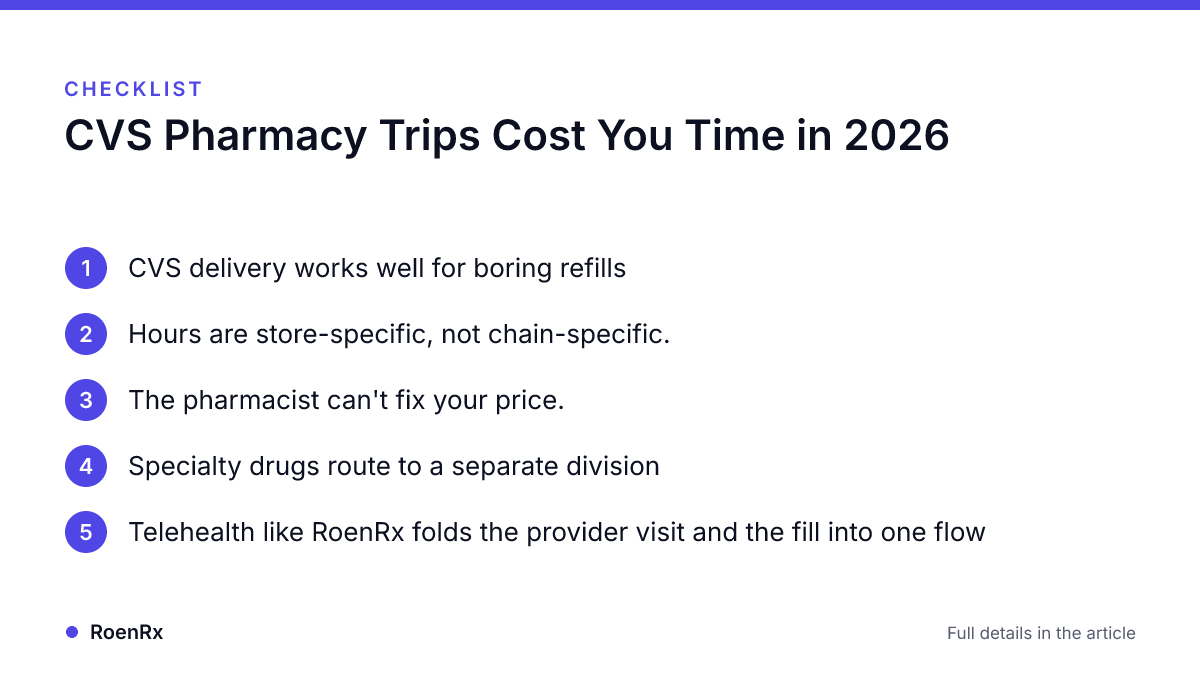
- CVS delivery works well for boring refills and poorly for anything new, controlled, or waiting on prior authorization, because those orders sit in a verification queue no matter which fulfillment option you picked.
- Hours are store-specific, not chain-specific. The pharmacy counter routinely closes hours before the front of the store, including at some 24-hour locations and inside Target.
- The pharmacist can't fix your price. Formulary tier, prior authorization rules, and appeals all live with your insurer, and that paperwork is where days disappear.
- Specialty drugs route to a separate division with its own enrollment, benefits investigation, and shipment scheduling. It's a different animal from the counter you're standing at.
- Telehealth like RoenRx folds the provider visit and the fill into one flow for prescriptions such as GLP-1 weight loss medication and ED treatment, which removes the drive, the hold music, and most of the follow-up calls.
A CVS Pharmacy trip in 2026 costs you more than gas money. It costs the drive, the wait behind six people, the phone tag with your insurer over a rejected claim, and sometimes a second trip because the store didn't have your dose. None of that prints on the receipt. It still gets paid.

Table of Contents
- How does CVS Pharmacy delivery and mail-order work if you can't get to a store?
- What should you check before driving to a CVS Pharmacy?
- How do CVS prices and insurance compare to a telehealth membership?
- What does CVS specialty pharmacy handle that a retail counter can't?
- When does telehealth beat a "CVS Pharmacy near me" search?
- Frequently asked questions
How does CVS Pharmacy delivery and mail-order work if you can't get to a store?
For a refill you've had for years, it's genuinely easy. Link the prescription to your CVS account, pick delivery instead of pickup, pay whatever your plan leaves you, and it shows up in a few days. Blood pressure pills, statins, thyroid meds: that path works.
Anything else is where the model breaks down.
New prescriptions, controlled substances, and drugs needing prior authorization can't ship until a pharmacist verifies details with your prescriber. That verification usually goes out as an electronic request or, still, a fax. Yes, fax. Then it sits in a stack at your doctor's office next to twenty others, and nobody at CVS is calling to hurry it along. Your "delivery" order just quietly stalls with no status update beyond "in process."
I've watched patients wait eleven days on a request that took the prescriber's office four minutes to sign once someone actually asked.
Pro tip: the day you drop off a new script, call the prescriber's office and ask one specific question: "Did you receive the prior authorization request from CVS, and who's working it?" Get a name. Call that person back in 48 hours. Chasing your own paperwork is the single highest-return thing you can do, and nobody in the chain will do it for you.
What should you check before driving to a CVS Pharmacy?
Run this list before you leave the house. Skipping any one of these is how a 15-minute errand eats an afternoon.
- Look up your specific store's pharmacy hours, not the chain's. A standalone 24-hour location, a neighborhood store, and a counter inside Target all keep different schedules. The pharmacy window frequently closes at 6 or 7 p.m. even when the doors stay open late.
- Call and confirm the exact dose is on the shelf. Not the drug. The dose. Pharmacies stock what their patient panel uses, and GLP-1s in particular have been hit-or-miss by strength for a while now. Five minutes on the phone beats a round trip.
- Check that your insurance card matches what's on file. New plan year, new group number, new BIN. Old data on file is the most common reason a claim rejects at the register while six people wait behind you.
- Ask outright whether the drug needs prior authorization. If it does, get the pharmacist's expected timeline and your prescriber's direct line, not the main switchboard.
- Bring photo ID for anything controlled. Certain anxiety medications, some sleep aids, and testosterone products require verification every single fill, regardless of how well the staff knows you.
- Ask whether a 90-day fill costs the same as a 30-day. On many plans it does for maintenance drugs, and that turns twelve pickups a year into four. Worth one question.
- Confirm the drive-thru takes what you're picking up. Plenty of locations restrict it to established refills and send new prescriptions inside. Good to know before you idle in a line of eight cars.
- Turn on auto-refill for the boring stuff. It won't fix anything else on this list, but it removes the "did I already refill this?" loop.
- Ask whether it's a specialty drug in disguise. Biologics, injectables, and several high-cost categories get pulled out of retail and into a separate division with its own paperwork, and you'd rather learn that on the phone than at the counter.
The two things that trip people up most
Formulary math you can't argue with. Your plan might cover one GLP-1 brand and not the other, or one testosterone-support product and not its near-twin. The pharmacist has zero override authority here. None. What looks like a pharmacy problem is an insurance decision, and the only real levers are a formulary alternative or a formal appeal your prescriber files.
Assuming "online" means "shipped." Choosing delivery in the app doesn't change what has to happen first. Many controlled substances can't go out by mail on a first fill depending on where you live, specialty drugs route through an entirely different intake system, and a pending prior authorization freezes the order whether you selected pickup or delivery. The app just changes the last mile.
How do CVS prices and insurance compare to a telehealth membership?
CVS pricing comes from two places: your plan's formulary tier if you're covered, and store-level cash pricing if you're not. Cash prices aren't uniform across locations and they move. A telehealth membership like RoenRx bundles the provider consult, ongoing follow-up, and the medication into one number you know before you start.
Here's the honest side-by-side for someone starting something new:
| Factor | CVS Pharmacy (retail) | RoenRx telehealth |
|---|---|---|
| Provider visit | Separate appointment, booked and paid for on its own | Included in the membership, done in-app |
| Prior authorization | Days to weeks, and you'll be the one following up | Handled inside the provider workflow |
| Cash pricing | Varies by store and by month, steep for GLP-1s | Flat program price stated upfront |
| Refills | Manual or auto-refill, still needs a pickup or delivery order | Automatic, built into the membership |
| Your time | Driving, counter lines, hold music, callbacks | Intake and messaging on your phone |
| Discretion | Named out loud at a public counter | Plain packaging to your door |
Run the math on your own time. Say a new prescription takes three trips: drop off the script, come back because the prior authorization hadn't cleared, come back again to actually get it. Call each one 45 minutes round-trip with parking and the line. That's 135 minutes, or 2.25 hours. Value your time at $25 an hour, a conservative stand-in for lost work, a missed errand run, or the sitter you paid, and you get 2.25 × $25 = $56.25 before gas.
Re-run it with your real numbers. If your hourly rate is $60 and you're a 20-minute drive from the store, the same three trips cost you $135. Here's the threshold I'd use: when your time cost for a prescription clears roughly $50 a month, the delivery-and-telehealth path is already winning on economics alone, never mind the aggravation.
What does CVS specialty pharmacy handle that a retail counter can't?
Specialty pharmacy exists for drugs that need cold-chain shipping, hands-on insurance case management, or both. Biologics for autoimmune conditions, certain fertility protocols, some injectable weight-loss medications. Your neighborhood counter, CVS or Walgreens alike, isn't set up to hold that inventory or to run a benefits investigation and appeal on your behalf, so those prescriptions get pulled out of retail automatically.
What that actually looks like on your end: a welcome call from a case manager, an insurance benefits investigation that can run a couple of weeks, a copay assistance application if the manufacturer offers one, then a scheduled shipment in an insulated box with gel packs that you need to be home to receive and refrigerate within a few hours. Miss the delivery window on a heat-sensitive drug in July and you're rescheduling, not re-dosing.
That system is well built for a $6,000-a-month biologic. It's overkill for someone who wants to start enclomiphene for low testosterone or begin a straightforward GLP-1 program and would rather not spend three weeks onboarding to find out what it costs. That mismatch is the gap telehealth was built into: a licensed provider reviews your intake, sets a plan, and a U.S.-based pharmacy fills it, without you learning which division of which chain owns which drug class.
When does telehealth beat a "CVS Pharmacy near me" search?
Telehealth wins whenever the condition can be evaluated through a detailed intake and monitored through follow-up messaging, which covers far more than most people expect. Weight management, birth control, ED, hair loss, low testosterone support, acne and rosacea, mild-to-moderate anxiety and depression, sleep, and perimenopause symptoms all fit that description.
CVS still wins for acute problems. The antibiotic your kid needs tonight. A flu shot you want in an arm today. A medication your own physician wants filled and watched locally. Retail pharmacy was designed for drop-in convenience on a prescription you already hold, not for the visit and the plan-building that has to happen before the prescription exists, which is also why it's worth comparing Walgreens pharmacy costs against mail-order before assuming the counter is cheaper. RoenRx's FAQ page and reviews spell out what the intake and follow-up look like if you want the specifics first.
Pro tip: if you're paying cash at a counter for something like ED medication or a weight-loss GLP-1, don't compare the sticker prices alone. Add the office visit you'd pay for separately, plus the follow-up visit for a dose adjustment. That's usually where the bundled program pulls ahead.
Frequently asked questions
Can CVS transfer a prescription from another pharmacy?
Most retail prescriptions transfer fine from Walgreens or an independent, either by calling the store or requesting it in the app. Controlled substances carry tighter rules and often can't be transferred more than once. Specialty medications typically need the insurance re-verified after a transfer, which adds days you weren't planning for.
Can I get my medication from CVS without going into a store?
For a standard refill, yes. Delivery and mail-order handle it. New prescriptions, anything requiring prior authorization, and specialty drugs still need coordination between the pharmacy, your insurer, and your prescriber before that first box ships. No store visit doesn't automatically mean no friction.
Is a telehealth prescription the same medication I'd get at the counter?
Same FDA-regulated medications, filled by licensed U.S.-based pharmacies at reputable platforms like RoenRx. What changes is the route to the prescription, not what's in the bottle.
If your last CVS trip cost you an afternoon and a surprise at the register, pull up your prescription list and mark which ones are ongoing rather than acute. Those are the candidates. Start with RoenRx's weight-loss FAQ or the about page and sort it out before your next refill comes due, not the day you run out.