Buy an automatic, validated upper-arm cuff monitor, not a wrist or finger device. The American Heart Association recommends this cuff style specifically because it consistently produces more reliable readings than devices strapped to your wrist or finger, which shift too easily out of position at heart level.
Before you buy anything, wrap a soft measuring tape around your bare upper arm, midway between your shoulder and elbow. That number determines which cuff size actually fits you, and cuff fit is one of the two biggest reasons home readings go wrong. The other is buying a monitor that was never independently validated for accuracy in the first place.
Pro Tip: Take the tape measure with you when you shop, or measure your arm first and write the number on your phone. Cuffs sold as “one size fits most” often fit fewer people than the label suggests.
Accurate home blood pressure monitoring depends on three things working together: a validated upper-arm monitor, correct measurement technique, and consistent sharing of results with a clinician.
| Point | Details |
|---|---|
| Buy validated, upper-arm only | Skip wrist and finger devices; confirm the model appears on a recognized validated device list. |
| Measure your arm first | Cuff mismatch can skew systolic readings by about 19.5 mm Hg, more than most medication effects. |
| Follow the same protocol every time | Rest five minutes, bare skin, arm at heart level, two readings one minute apart. |
| Trends beat single readings | One high number means little; a repeated pattern across days is what should prompt action. |
| Share data, don’t just collect it | Bring logs, exports, or the device itself to appointments, or use RoenRx virtual care to review trends and adjust treatment. |
Self-measured blood pressure, often shortened to SMBP, catches things a single office visit misses. Some people spike in a doctor’s office and look normal at home, a pattern called white-coat hypertension. Others do the opposite: normal at the clinic, elevated everywhere else. That second pattern, masked hypertension, is arguably more dangerous because it hides in plain sight.
Monitoring blood pressure outside the clinic gives a more authentic picture of cardiovascular status than sporadic office visits, according to Harvard Health.
The CDC frames SMBP as most effective when it’s paired with support from your health care team, not done in isolation. Readings that just sit in a monitor’s memory, unseen by anyone with the authority to act on them, don’t move the needle much. Both the CDC and the American Heart Association point to home monitoring as a standard recommendation once you’ve been diagnosed with hypertension or your clinician suspects you might have it.
Home monitoring isn’t just for people already on medication. Several groups benefit clearly, and if you fall into one of these, it’s worth raising the topic at your next appointment rather than waiting to be asked.
Home readings can get unreliable if you have an irregular heart rhythm like atrial fibrillation, since most automatic cuffs assume a steady pulse to calculate the numbers. If that’s you, ask your clinician which device models handle irregular rhythms better before you buy.
Pro Tip: Don’t just start monitoring and hope it helps. Ask your clinician up front what numbers should trigger a call, so you’re not guessing later.
Home monitoring isn’t a wellness trend clinicians tolerate. It’s built into hypertension guidelines. A peer-reviewed review in PMC concludes that home blood pressure monitoring is a legitimate self-monitoring tool that multiple professional groups recommend incorporating into ongoing hypertension care, not just an optional add-on.
The strongest evidence points to a specific combination: SMBP works best paired with clinician support, not as a standalone habit. The CDC notes that people who self-measure and stay connected to a care team are more likely to actually lower their blood pressure than people measuring alone with no follow-up loop. That distinction shapes almost everything else in this guide, including why we keep circling back to sharing your numbers rather than just recording them.
Cuff sizing turns out to carry more weight in the evidence than most people expect. A Harvard-cited analysis found that using a regular cuff on someone who needed an extra-large cuff inflated systolic readings by roughly 19.5 mm Hg. That’s not a rounding error. That’s the difference between “normal” and “call your doctor.”
Home blood pressure monitoring, done correctly, is now considered part of standard hypertension care by multiple professional medical groups, not an alternative to it.
Pro Tip: If you’re between cuff sizes on the packaging chart, size up. An oversized cuff introduces a smaller error than an undersized one.
Shopping for a monitor comes down to a short list of things that matter and a longer list of things that don’t. Validation status and cuff fit matter enormously. Bluetooth syncing and app dashboards are nice, but they’re not going to save you from a bad reading.
Start by confirming the device appears on a recognized validated device list, such as the one maintained through validatebp.org. Independent testing groups like Consumer Reports have also found that not every monitor on store shelves passes accuracy testing, and established, validated manufacturers such as Omron tend to outperform cheaper store-brand alternatives that skip independent validation entirely.
Reliable upper-arm monitors typically run in a moderate price range, with the higher end buying you app connectivity, multiple user profiles, or irregular heartbeat detection rather than better core accuracy. A validated $45 monitor with a properly fitted cuff will outperform an unvalidated $90 monitor every time.
| What to Check | Why It Matters |
|---|---|
| Validation listing | Confirms independent testing verified accuracy against clinical standards |
| Cuff size range | Wrong size can skew systolic readings by about 19.5 mm Hg |
| Device type | Upper-arm recommended by AHA; wrist and finger are not |
| Display and controls | Fewer buttons and larger numbers reduce user error |
| Price band | $40 to $100 covers most validated, reliable options |
Pro Tip: Bring your new monitor to your next pharmacy or clinic visit and take a reading side by side with their equipment. If the numbers are more than a few points apart, something is off with fit or technique, not necessarily the device.
Not every validated monitor needs to do everything. A retired grandparent tracking stable blood pressure has different needs than someone whose clinician is actively titrating three medications at once.
Broadly, validated upper-arm monitors fall into a few functional categories. Validated clinical models focus purely on accuracy and simplicity, often with minimal extra features, and suit anyone whose clinician needs raw, trustworthy numbers for diagnosis or dosing decisions. Consumer value models add memory storage and multi-user profiles at a modest price bump, which works well for households tracking more than one person’s readings. Tech-forward models add Bluetooth syncing and app dashboards, useful if you or your clinician want to review trends remotely between visits.
| Feature Category | Best Suited For |
|---|---|
| Validated clinical models | New diagnosis, medication titration, situations needing maximum trust in each number |
| Consumer value models | Households with more than one person tracking BP, basic daily habit tracking |
| Tech-forward models | Remote care relationships, sharing trend data digitally with a care team |
Technique errors are shockingly common, and they don’t announce themselves. A number that looks fine might just be fine because you happened to measure it wrong in a forgiving direction. Follow this sequence every time.
These steps come directly from Harvard Health’s measurement protocol, and skipping any one of them can shift your numbers enough to change a clinical decision.
| Monitoring Phase | Frequency |
|---|---|
| Initial baseline (first week) | Twice daily, morning and evening, two readings each time |
| Ongoing tracking (stable BP) | A few times per week, or per clinician instructions |
| After medication change | Daily for one to two weeks, then reassess with your clinician |
Common errors that quietly wreck accuracy: crossed legs, an unsupported back, a cuff over clothing, and talking mid-reading. Any one of these can add several points to your systolic number without you noticing.

Pro Tip: If you have a larger arm, don’t assume a standard cuff is “close enough.” An undersized cuff inflated systolic readings by about 19.5 mm Hg in one analysis. Get the correctly sized cuff before you trust a single number from it.
One high reading doesn’t mean much on its own. A pattern of high readings means quite a lot. Here’s how the standard categories break down.
Trends matter more than any single number. A reading of 145/92 after a stressful phone call isn’t the same signal as 145/92 showing up consistently across a week of morning checks. If one reading looks unusually high, sit quietly for a few minutes and take it again before assuming anything is wrong.
A reading above 180/120, especially paired with chest pain, shortness of breath, vision changes, or difficulty speaking, is a hypertensive emergency. Call 911. Don’t wait to see if it comes down on its own.
If your readings are consistently elevated but you have no symptoms, that’s a call-your-clinician situation, not a call-911 situation. Save the emergency line for symptoms plus dangerously high numbers together.
A monitor’s memory is only useful if someone with medical training eventually sees the data. Whatever format you use, capture the same core fields every time: date, time, which arm you used, both numbers, heart rate, and any relevant context like stress or poor sleep.
Clinicians commonly prefer averaged data over single readings when making decisions, often looking at something like 12 readings over three days or 28 readings over seven days to smooth out day-to-day noise. A structured approach to tracking progress toward any health goal tends to outperform sporadic, unstructured check-ins, and blood pressure is no exception.
| Sharing Method | Best For |
|---|---|
| Bring device to appointment | Simple monitors with no app or export feature |
| App CSV export | Tech-forward monitors, remote care relationships |
| Patient portal message | Quick updates between scheduled visits |
| Printed or handwritten log | People who prefer paper tracking or have basic monitors |
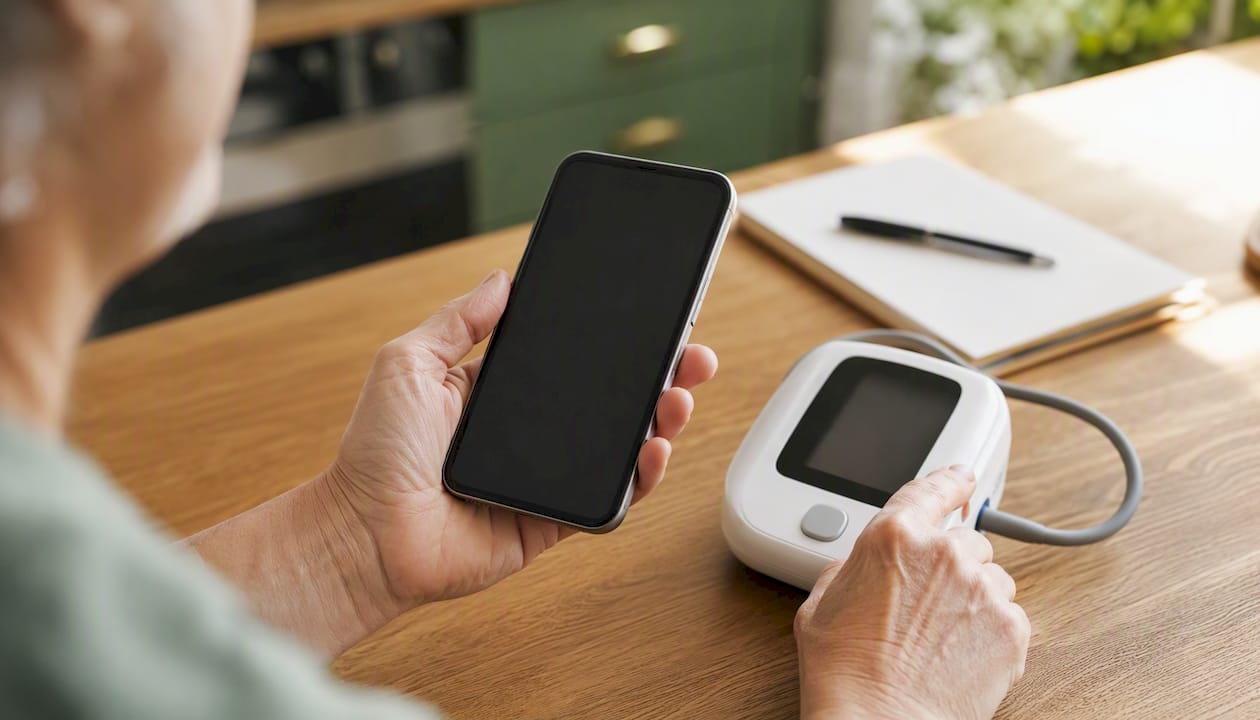
Pro Tip: Average your readings yourself before your appointment. A quick mental average of the week gives your clinician more useful context than 14 individual numbers read aloud.
A monitor that was accurate on day one won’t necessarily stay that way. Batteries weaken, cuffs wear, and internal sensors drift. Treat your monitor like any other piece of medical equipment that needs occasional upkeep.
According to Mayo Clinic, you should bring your monitor to a clinic or pharmacy roughly once a year to compare its reading against professional equipment.
“Validated” isn’t a marketing word here. It means a monitor’s readings were tested against a trained observer using a reference method and found to be accurate within an established standard. A device without that testing is essentially a guess wearing a display screen.
Checking a listing takes two minutes and tells you something no product description ever will: whether the numbers this device produces have actually been checked against a clinical gold standard.
Cuff fit and averaging get overlooked more than any other part of self-monitoring, and both are silent problems. A cuff that’s slightly wrong doesn’t beep an error. It just quietly gives you a wrong number that looks plausible enough to trust. The same goes for reacting to one bad reading instead of waiting for a pattern to form.
The behavioral side matters just as much as the technical side. People who fold monitoring into an existing routine, like right after brushing their teeth in the morning, stick with it far longer than people who treat it as a separate task requiring willpower. A phone reminder at a consistent time works better than good intentions.
Use your readings as a conversation starter, not a diagnosis you deliver to yourself. Bring the trend, not just the worst number, to your next visit. If your care includes ongoing medication management, a virtual primary care follow-up can turn a week of home readings into an actual medication adjustment without waiting weeks for the next in-person slot.
A monitor tells you a number. It takes a clinician to tell you what to do about it, and that’s where most home monitoring routines quietly stall out. People buy a good device, measure diligently for a few weeks, then let the data pile up in an app with nobody reviewing it.
RoenRx closes that gap with virtual primary care that reviews your home readings and adjusts your treatment plan without you needing to book a weeks-out in-person appointment. You message your care team, share your logged trend, and get feedback on whether your current medication is working or needs a change, all from your phone. If a dose adjustment or new prescription makes sense based on your numbers, RoenRx handles that through online prescription management with delivery built into the process.
This doesn’t replace emergency care. If you experience a hypertensive crisis with symptoms, call 911 first. For the ongoing week-to-week management of a chronic condition like hypertension, start a virtual primary care visit and bring your logged readings to the conversation.
This article is general information, not a substitute for advice from a qualified doctor. Consult a qualified healthcare professional about your own circumstances before acting on anything here.
There’s no single “most accurate” model; accuracy depends on whether the specific device is independently validated and whether the cuff fits your arm. Check the model against the Validated Device Listing before buying rather than chasing a brand name alone.
An automatic upper-arm cuff monitor that appears on a validated device list, sized correctly to your arm circumference, is the AHA-recommended choice over wrist or finger devices.
Look for a validated upper-arm monitor priced roughly between $40 and $100, with a cuff that matches your measured arm size; extras like Bluetooth syncing are optional, not essential.
Staying hydrated supports normal circulation, but drinking extra water is not a validated treatment for hypertension. Talk to your clinician about proven treatment options rather than relying on hydration alone.
Most people start with twice-daily checks for the first week to establish a baseline, then shift to a few times weekly, adjusting frequency based on their clinician’s guidance, especially after any medication change.