Starting mental health treatment at home means initiating care in a safe, familiar environment that supports your nervous system and lets you set the pace. This approach covers a wide spectrum, from telehealth therapy sessions and tele-psychiatry to psychiatric home nursing and daily stabilization support. Trauma-informed care delivered at home is often more effective than clinic-based care because the familiar setting lowers anticipatory anxiety and helps regulate emotional responses. Research also shows that integrated home mental health care reduces hospitalizations when treatment begins early rather than waiting for a crisis. The clinical term for this model is “behavioral health home care,” and understanding that term helps you ask the right questions when searching for providers and coverage.
Home mental health care begins with identifying which type of service fits your current level of need. The options range from self-directed digital tools to fully supervised psychiatric nursing, and choosing the wrong level is one of the most common early mistakes.

Tele-psychiatry connects you with a licensed psychiatrist or therapist through a secure video platform. No physician certification is required, and Medicare and most Medicaid programs cover telehealth mental health visits in the home without geographic restrictions as of 2026. That coverage removes one of the biggest financial barriers for people who previously avoided care.
In-home psychiatric nursing is a different service entirely. It involves a licensed psychiatric nurse visiting your home to manage medication, conduct risk assessments, and evaluate daily functioning. Physician certification of homebound status is required for these visits, which distinguishes them from telehealth. Many people do not realize this distinction until they try to schedule a visit and hit an administrative wall.
Therapy modalities available at home include:
Mental health companions provide a fourth layer of support. These are clinically informed aides who help stabilize daily routines such as sleep schedules, hygiene, and meal consistency. Companions bridge the gap between therapy sessions and real life, addressing what a 50-minute session cannot.
Pro Tip: If you are unsure which level of care you need, start with a tele-psychiatry intake appointment. A licensed clinician can assess your needs and refer you to the right service tier within the same visit.
Preparation determines whether home mental health care succeeds or stalls. A poorly set-up environment undermines even the best clinical care.
The physical setup matters more than most people expect. You need a private, quiet space where you will not be interrupted during sessions. A locked door, headphones, and a reliable internet connection are the minimum requirements for telehealth. Poor audio or video quality disrupts the therapeutic relationship and can make trauma-focused work feel unsafe.
Emotional preparation is equally important. Many people attempt therapy before stabilizing their basic daily routines, and this is a leading reason early treatment fails. Patients who lack stable sleep, nutrition, and hygiene routines often cannot engage productively with therapy. If your daily functioning is significantly disrupted, address stabilization first, whether through a mental health companion, a caregiver, or structured self-help tools.
The table below outlines the core tools and their roles in a home mental health setup:
| Tool or resource | Primary role | Who needs it most |
|---|---|---|
| Telehealth platform (video) | Therapy and psychiatric consultations | Anyone starting tele-psychiatry or CBT |
| Mental health companion | Daily routine stabilization | People with significant functional impairment |
| Caregiver or support person | Safety monitoring and logistics | Those with moderate to severe symptoms |
| Safety plan document | Crisis response guidance | Everyone starting home treatment |
| Emergency contacts list | Rapid access to 988 Lifeline or local ER | Everyone starting home treatment |
Safety planning is non-negotiable. Before your first session, write down the 988 Suicide and Crisis Lifeline number, your nearest emergency room address, and two trusted contacts. Share this plan with your provider during the intake appointment.
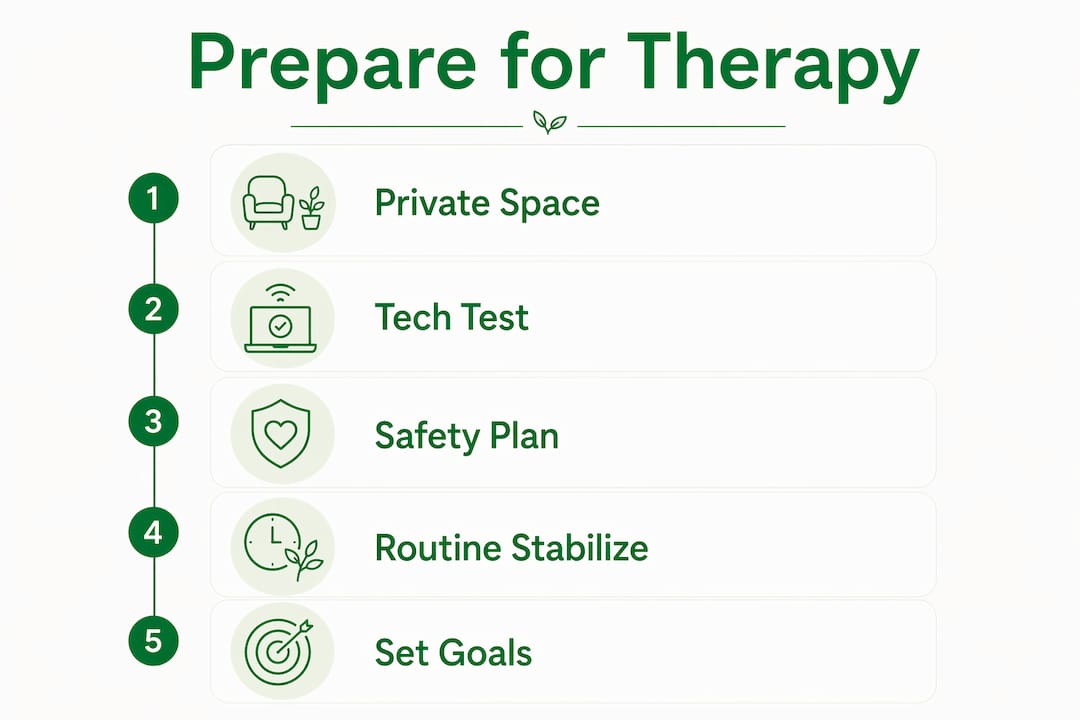
Pro Tip: Test your telehealth technology 24 hours before your first appointment. A failed connection at the start of a first session creates unnecessary stress and can delay your care by days.
Finding a qualified provider is the step where most people lose momentum. The search feels abstract until you know exactly what credentials and questions to look for.
For tele-psychiatry and online therapy, look for providers licensed in your state who hold credentials such as MD, DO, LCSW, or LPC. Licensing boards in each state maintain public directories. When you contact a provider, ask directly whether they offer telehealth consent documentation and whether they coordinate with your primary care physician. Integrated care, where your mental health provider communicates with your physical health team, produces measurably better outcomes.
Key questions to ask any prospective home mental health provider:
Setting measurable goals from the start keeps treatment on track. Work with your provider to define specific, observable targets such as sleeping at least six hours per night, completing three CBT worksheets per week, or reducing panic episodes from daily to twice weekly. Vague goals like “feeling better” make it impossible to evaluate whether treatment is working.
Depression goes undiagnosed in 30–50% of patients receiving physical home care. If you are already receiving home health services for a physical condition, you can request a behavioral health screening as part of your existing care plan. This is an underused right that many patients do not know they have.
Regarding insurance, online primary care services increasingly bundle mental and physical health coverage, which simplifies billing. Confirm your benefits before your first appointment to avoid unexpected costs.
The most common barrier is internal, not logistical. Stigma and self-doubt cause many people to delay starting care until symptoms become severe. Waiting for a mental health crisis to initiate treatment is a documented clinical mistake. Early treatment produces better outcomes and fewer hospital admissions, full stop.
Other common challenges include:
Knowing when home care is not enough is just as important as knowing how to start it. Psychiatric home care complements but does not replace inpatient care or intensive outpatient programs. If you experience active suicidal ideation, psychosis, or inability to care for yourself, escalate to a higher level of care immediately.
“The goal of home-based mental health treatment is not to avoid the healthcare system. It is to meet you where you are, stabilize your foundation, and build toward recovery at a pace that does not overwhelm your nervous system. Small, consistent steps outperform dramatic interventions every time.”
Integrating home wellness practices alongside clinical treatment, such as structured relaxation, light movement, and sensory comfort routines, can reinforce the stability your therapy work builds.
Starting mental health treatment at home works best when you match the right service level to your current needs, stabilize daily routines before beginning formal therapy, and build a coordinated care team from the start.
| Point | Details |
|---|---|
| Match care to your needs | Choose tele-psychiatry, in-home nursing, or companion support based on your current symptom severity. |
| Stabilize before therapy | Address sleep, nutrition, and hygiene routines before starting structured therapy sessions. |
| Prepare your environment | Secure a private space, reliable internet, and a written safety plan before your first appointment. |
| Coordinate your care team | Connect your mental health provider with your primary care physician for integrated, better outcomes. |
| Start early, not at crisis | Early treatment reduces hospitalizations and produces stronger long-term recovery results. |
The conventional model assumes that effective mental health care requires a clinical setting. I no longer believe that is true for most people. What I have seen, again and again, is that the clinical setting itself creates a barrier. The commute, the waiting room, the fluorescent lights, the sense of being observed in a foreign space. These are not trivial inconveniences. For someone managing anxiety or trauma, they are genuine obstacles that reduce the quality of care before the session even begins.
Home-based care removes those obstacles. The patient is already regulated. The environment is already familiar. That head start matters clinically, not just emotionally. The evidence on trauma-informed home treatment confirms what practitioners have observed for years: familiar surroundings lower the activation threshold and make therapeutic work more accessible.
What I would tell anyone starting this process is to resist the urge to do everything at once. Pick one service, set it up properly, and give it four to six weeks before evaluating. Mental health treatment is not a sprint. The people who see lasting results are the ones who build slowly and consistently, not the ones who overhaul everything in week one.
Self-compassion is not a soft concept here. It is a clinical variable. Treating yourself with patience during the early, unstable phase of home treatment is what keeps you in the process long enough for it to work.
— Bryan
Getting started with at-home mental health care should not require navigating a maze of referrals and wait times. Roenrx offers virtual mental health services, including anxiety prescription support and clinician-led consultations, all accessible from your home with same-day appointments available.

Roenrx connects you directly with experienced medical professionals who can assess your needs, prescribe when appropriate, and coordinate ongoing care through secure messaging. The platform is built for people who need real clinical support without the delays of traditional healthcare. If you are ready to take a concrete first step, explore Roenrx’s home-based care options and find out what treatment is available for you today.
Behavioral health home care is the clinical term for mental health treatment delivered in a patient’s home, including tele-psychiatry, psychiatric nursing visits, and daily stabilization support. It differs from standard outpatient therapy in that care is brought to the patient rather than the patient traveling to a clinic.
Medicare and most Medicaid programs cover telehealth mental health visits in the home without geographic restrictions as of 2026. Private insurance coverage varies, so confirm your benefits before scheduling your first appointment.
Tele-psychiatry and online therapy do not require physician certification or a formal referral in most states. In-home psychiatric nursing visits, however, require physician certification of homebound status before services can begin.
Contact the 988 Suicide and Crisis Lifeline immediately by calling or texting 988. If you are in immediate danger, call 911 or go to your nearest emergency room. Every home treatment plan should include these contacts in writing before care begins.
A mental health companion provides clinically informed daily support to stabilize routines such as sleep, hygiene, and nutrition. A therapist delivers structured, evidence-based treatment such as CBT or EMDR. Companions support the conditions that make therapy effective; they do not replace licensed clinical care.