Semaglutide is covered by insurance for many patients, but coverage is conditional. Whether your plan pays depends on three things: the FDA-approved indication on the prescription, your plan type, and whether you clear prior authorization. Wegovy (semaglutide for chronic weight management) is covered by many large employer commercial plans, while small employer plans cover it at about 30% as of 2026. Medicare Part D now has a dedicated bridge program launching July 1, 2026. Medicaid is a patchwork.
Your first move: pull out your insurance card, find the pharmacy benefit number (usually on the back), and call to ask whether Wegovy is on your formulary and whether prior authorization is required. Alternatively, use the NovoCare coverage lookup tool to get a fast answer online.
Pro Tip: The single document that most reduces denials is a dated, clinician-signed log of supervised lifestyle interventions covering 3–6 months, paired with a current BMI measurement and at least one documented weight-related comorbidity. Gather this before your provider submits anything.
The core logic is straightforward: insurers pay for the drug when the prescription matches an FDA-approved indication they’ve chosen to cover. That distinction trips up a lot of patients.

Ozempic is FDA-approved for type 2 diabetes management and cardiovascular risk reduction in adults with established heart disease. Wegovy is FDA-approved for chronic weight management in adults with a BMI of 30 or higher, or 27 or higher with at least one weight-related condition. A plan that covers Ozempic for diabetes may flatly deny the same molecule when it’s prescribed off-label for weight loss. Ozempic is widely covered for type 2 diabetes but typically not for weight loss unless the plan explicitly includes obesity medications.
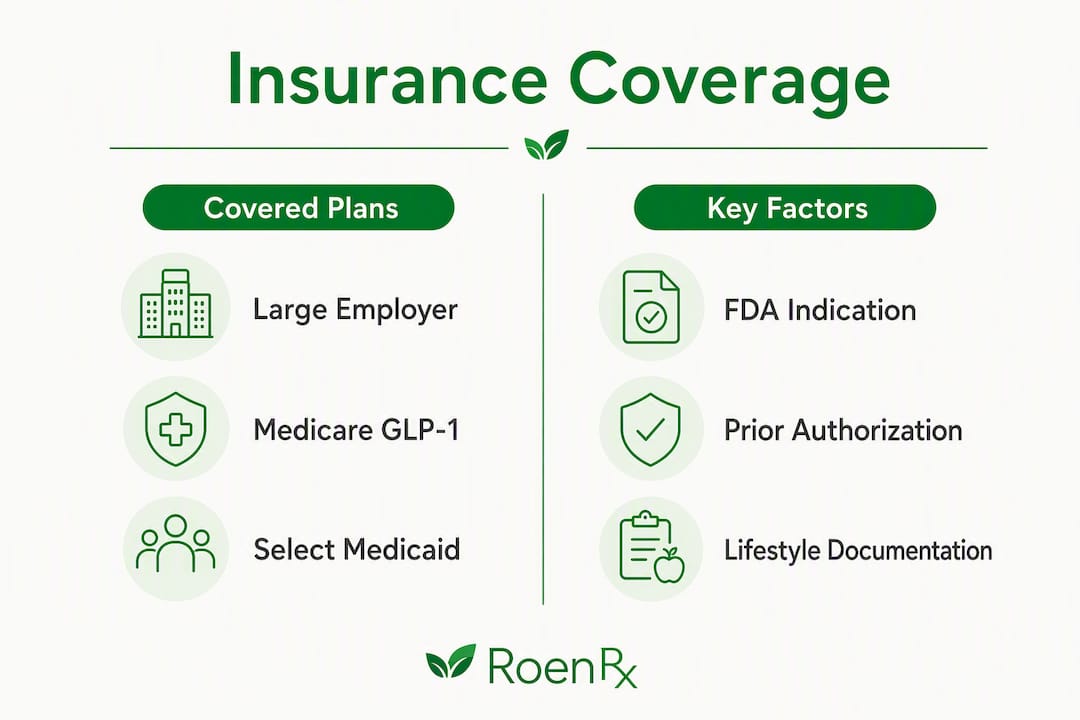
There’s a third pathway worth knowing: plans may cover semaglutide for cardiovascular risk reduction even when they exclude weight-loss-only coverage. If a patient has established cardiovascular disease plus obesity, accurate problem-list documentation and ICD-10 coding can open a door that a weight-management-only claim would not.
Most plans require more than a BMI number. Typical requirements include:
Prior authorization (PA) for Wegovy is near-universal. The PA form typically asks for the diagnosis code, BMI, documented comorbidities, and evidence of prior conservative therapy. Clinicians should use E66.01 (morbid obesity due to excess calories) or E66.09 (other obesity) for weight management cases, paired with any relevant comorbidity codes. For cardiovascular risk reduction, I25.x or I10 codes alongside Z68.x BMI codes strengthen the case.
Documentation gaps that cause the most denials:
Pro Tip: Ask your insurer for their written PA criteria before your clinician submits anything. Manufacturer guidance recommends this step specifically — it lets your provider tailor the submission to match exactly what the reviewer will check.
Coverage varies significantly by plan type. Here’s a realistic picture.

Large employers have the most flexibility to add obesity drug coverage, and many have. About 60% of large employer plans cover Wegovy for weight loss as of 2026, compared with roughly 30% of small employer plans. If you work for a company with hundreds of employees, your odds are better than even. If you’re on a small-group or individual market plan, expect a harder road.
Traditional Medicare Part D has historically excluded weight-loss drugs. That changed with the Medicare GLP-1 Bridge program. Eligible Part D beneficiaries can access Wegovy at a flat $50/month copay from July 1, 2026 through December 31, 2027. Eligibility criteria and plan participation details are available at Medicare.gov. This is a time-limited program, so beneficiaries should confirm their plan’s participation before assuming they qualify.
$50/month — the flat copay for eligible Medicare Part D beneficiaries under the GLP-1 Bridge program, active July 1, 2026 through December 31, 2027.
Medicaid coverage is optional at the state level and varies widely. Approximately 15–18 states had added Wegovy to their Medicaid formularies as of early 2026. If you’re on Medicaid, check your state’s preferred drug list directly, because a state that covered Wegovy last year may have changed its formulary, and a state that didn’t may have added it.
| Plan type | FDA indication covered | Prior auth required | Estimated coverage likelihood |
|---|---|---|---|
| Large employer commercial | Weight management (Wegovy) | Yes, nearly always | ~60% |
| Small employer commercial | Weight management (Wegovy) | Yes | ~30% |
| Medicare Part D (GLP-1 Bridge) | Weight management (Wegovy) | Varies by plan | Eligible beneficiaries: $50/mo copay July 2026–Dec 2027 |
| Medicaid | Weight management (Wegovy) | Yes, where covered | ~15–18 states |
| Any commercial plan | Type 2 diabetes (Ozempic) | Often yes | High, when T2D is documented |
Wegovy’s list price runs over $1,300/month without insurance. With commercial insurance coverage and a manufacturer savings offer, many patients pay significantly less, though actual copays vary by plan design. Ozempic carries a similar list price.
NovoCare and the Wegovy savings offer can lower costs for commercially insured patients. These programs are not available to patients on Medicare, Medicaid, or other government-funded plans. If you have commercial insurance and meet eligibility requirements, the savings offer can reduce your monthly out-of-pocket cost substantially.
Key eligibility points:
For eligible Medicare Part D beneficiaries, the $50/month copay under the GLP-1 Bridge program is a meaningful shift from the prior status quo of no coverage. That figure applies from July 1, 2026 through December 31, 2027.
If your plan doesn’t cover Wegovy and you don’t qualify for manufacturer savings, a few options exist:
Pro Tip: If your plan covers Wegovy but your copay is still high, use the manufacturer savings offer first. If you’re on Medicare or Medicaid and the savings offer doesn’t apply, ask your clinician about the GLP-1 Bridge program eligibility or a GLP-1 without insurance self-pay pathway before paying full list price.
You can get a definitive answer in one call or one online lookup. Here’s the exact process.
What to have ready before you call:
Step-by-step coverage check:
Using the NovoCare coverage lookup tool:
The NovoCare coverage check lets you enter your insurance information online and get a preliminary coverage result. Print or screenshot the result and bring it to your clinician’s office. It won’t replace a direct call to your PBM, but it’s a fast first filter.
After you have the PA criteria:
Expected response times: formulary lookups are instant by phone or online. PA decisions typically take 3–10 business days after submission. Urgent PA requests (when clinically appropriate) can be resolved in 24–72 hours.
Getting approved on the first submission is mostly a documentation problem. Here’s what clinicians need to submit and what patients can do to help.
Prior authorization checklist for clinicians:
Sample justification language clinicians can adapt:
The prescription and PA form must use the same diagnosis codes. A mismatch between what the prescriber writes and what the PA form states is a common, easily avoided denial trigger. Knowing the plan’s PA criteria before submission reduces delays significantly.
Standard PA decisions arrive within 3–10 business days. If the plan requests a peer-to-peer review, that typically adds 3–5 business days. Urgent requests, when clinical urgency is documented, can be decided in 24–72 hours.
Pro Tip: The single most effective submission move is pairing complete, dated lifestyle documentation with a precise ICD-10 code that matches the plan’s written criteria. A GLP-1 insurance coverage guide can help you and your clinician align on what each payer expects.
Denials are common, but they’re not final. The remedy depends on the denial type.
A coverage exclusion denial means your plan simply doesn’t cover obesity medications. The appeals process for this is harder, but not impossible. Your best lever is your employer’s HR or benefits team, who can request that coverage be added at the next plan renewal.
A medical-necessity denial means the plan covers the drug but decided your documentation didn’t meet criteria. This is the more winnable appeal.
Step-by-step appeals process:
Involving HR for coverage exclusions:
If the denial is a blanket exclusion, a one-sentence email to HR can plant the seed for next year’s benefits negotiation: “I was denied coverage for an FDA-approved obesity medication. I’d like to understand whether the plan can add obesity drug coverage at renewal.” Many large employers have added Wegovy coverage in response to employee requests.
While you wait:
Documents to gather before starting an appeal:
Coverage decisions and patient suitability overlap more than most patients realize.
FDA-approved indications relevant to coverage:
Insurers check the indication on the prescription against their formulary. A prescription written for the wrong indication, or one that doesn’t match the PA, will be denied regardless of clinical appropriateness.
Key safety and monitoring points insurers look for:
Off-label prescribing: Insurers almost universally deny off-label weight-loss prescriptions. If a clinician writes Ozempic for weight loss rather than Wegovy, the claim will likely be denied unless the plan specifically covers Ozempic for obesity. The difference between Wegovy and Ozempic matters for coverage, not just dosing.
Consult your clinician for a full medical evaluation before starting semaglutide. Keep records of all monitoring visits, because insurers may request them at renewal or during a PA extension review.
This article is general information, not medical or insurance advice. Verify your plan’s current formulary and PA criteria with your insurer or a qualified benefits professional.
Most patients need prior authorization for semaglutide, and coverage depends on plan type, FDA indication, and documented clinical necessity, with the Medicare GLP-1 Bridge program offering eligible Part D beneficiaries a $50/month copay from July 1, 2026 through December 31, 2027.
| Point | Details |
|---|---|
| Check your plan type first | Large employer plans cover Wegovy at ~60%; small employer plans at ~30%; Medicaid in ~15–18 states. |
| Indication determines coverage | Wegovy (weight management) and Ozempic (type 2 diabetes) are covered differently; the prescription must match the PA. |
| PA documentation is the key variable | Dated, clinician-supervised lifestyle records covering 3–6 months reduce denials more than any other single factor. |
| Medicare GLP-1 Bridge starts July 1, 2026 | Eligible Part D beneficiaries pay a flat $50/month copay through December 31, 2027. |
| RoenRx can help with the process | RoenRx provides telehealth evaluations, PA documentation support, and prescription fulfillment for patients navigating coverage. |
The conventional framing is that insurance coverage for semaglutide is a binary: either your plan covers it or it doesn’t. That framing leads patients to give up too early.
What actually determines the outcome, in most cases, is documentation quality and coding precision, not plan generosity. A plan that technically covers Wegovy will still deny a PA submission that’s missing a dated lifestyle log or uses the wrong ICD-10 code. Conversely, a plan that excludes weight-loss drugs may still cover semaglutide when the indication is cardiovascular risk reduction in a patient with established heart disease, because that’s a different clinical category entirely.
The other thing patients consistently underestimate is the peer-to-peer review. Most people accept the first denial and move to cost-reduction workarounds. But when a treating clinician gets on the phone with an insurer’s medical director and walks through the clinical picture, denials reverse at a rate that should make every patient push for that call before accepting a no.
The Medicare GLP-1 Bridge program is genuinely new territory. A $50/month copay for a drug that previously lacked Part D coverage is a meaningful shift, and many Medicare beneficiaries don’t yet know it exists. If you or someone you know is on Medicare Part D and has been told semaglutide isn’t covered, that answer may have changed as of July 1, 2026.
Navigating prior authorization while also managing a health condition is a lot to ask of anyone. RoenRx handles the clinical and administrative side of that process so you don’t have to figure it out alone.
With RoenRx, you get a same-day telehealth evaluation with a licensed clinician who understands what insurers actually require for semaglutide approval. The care team helps gather the documentation that reduces denials: current BMI, comorbidity coding, and a dated record of supervised lifestyle efforts. For patients whose plans don’t cover Wegovy, RoenRx also offers self-pay options with prescription fulfillment and home delivery, including access to GLP-1 medications at transparent pricing.
RoenRx works with both insured and self-pay patients across the United States. If you’re ready to find out whether you qualify and what your real cost will be, start your evaluation at RoenRx today. A clinician reviews your intake the same day, and the care team can submit PA paperwork directly to your PBM.
Formulary rules and program eligibility change frequently. Use these sources to confirm current requirements before submitting a PA or enrolling in a savings program.
Reminder: Plan-specific formulary and PA criteria change regularly. Always confirm current requirements with your insurer or PBM before submitting a PA request or assuming a savings program applies to your situation.