No, compounded semaglutide is not considered as safe as FDA-approved semaglutide, and the gap isn’t just paperwork. It comes down to four documented problems: no premarket FDA review, widespread dosing and administration errors, confirmed cases of contamination or incorrect ingredients, and active regulatory action to shut down the legal pathways that allowed these products to spread in the first place.
Here’s what’s driving that verdict:
Pro Tip: Before you use any compounded semaglutide product, ask the pharmacy directly whether it’s a 503B-registered outsourcing facility and request a certificate of analysis for that specific batch. If they can’t produce one, walk away.
Compounded semaglutide safety depends less on the drug’s chemistry and more on dosing accuracy, pharmacy verification, and clinical oversight throughout the process.
| Point | Details |
|---|---|
| Not FDA-approved | Compounded semaglutide skips the premarket review that Ozempic, Wegovy, and Rybelsus underwent. |
| Dosing errors dominate | 95% of GLP-1 adverse events in 2024 traced back to dosing or administration mistakes, not the drug itself. |
| Overdoses are severe when they happen | Reported accidental overdoses ranged from 5 to 20 times the intended dose due to unit confusion. |
| Verify before you inject | Confirm 503B registration, request a certificate of analysis, and get dosing in mg/mL, never units. |
| Supervised access reduces risk | RoenRx pairs prescriptions with licensed clinician oversight and verified pharmacy fulfillment to remove the guesswork. |
Compounding is the practice of a pharmacy creating a customized medication rather than dispensing a factory-made, FDA-approved drug. It exists for legitimate reasons: a patient allergic to a filler ingredient, a child who needs a liquid version of a pill, or, in recent years, a nationwide shortage of brand-name GLP-1 drugs that pushed pharmacies to fill the gap.
Two regulatory categories matter here. A 503A pharmacy compounds for an individual patient with a specific prescription, typically on a smaller scale. A 503B outsourcing facility compounds in bulk under stricter oversight, closer to (but still short of) standard drug manufacturing rules.
A compounded semaglutide product can look nothing like the injector pen you’d get from a pharmacy filling a Wegovy prescription. It might arrive as a multidose vial requiring manual measurement, an oral tablet, or even a sublingual drop, sometimes blended with additives never studied alongside semaglutide.
The core issue: none of these formulations went through FDA premarket review. That means no verified proof of safety, efficacy, or consistent quality control before it reaches you.
Demand outpaced supply for years. When Ozempic and Wegovy shortages hit their peak, compounding pharmacies stepped in to fill prescriptions the manufacturers couldn’t. Cost is another driver. Brand-name GLP-1 drugs run expensive even with insurance, and compounded versions often undercut that price significantly. Some patients also seek alternative delivery forms, like oral drops, that don’t officially exist in FDA-approved semaglutide.
You’ll find these products through a few main channels:
Watch for red flags: no prescription requirement, shipping from overseas addresses, vague or foreign-language labeling, and packaging that arrives damaged or unsealed. Any one of these should stop you from using the product.
The differences aren’t cosmetic. They touch every stage from manufacturing to the needle in your hand.
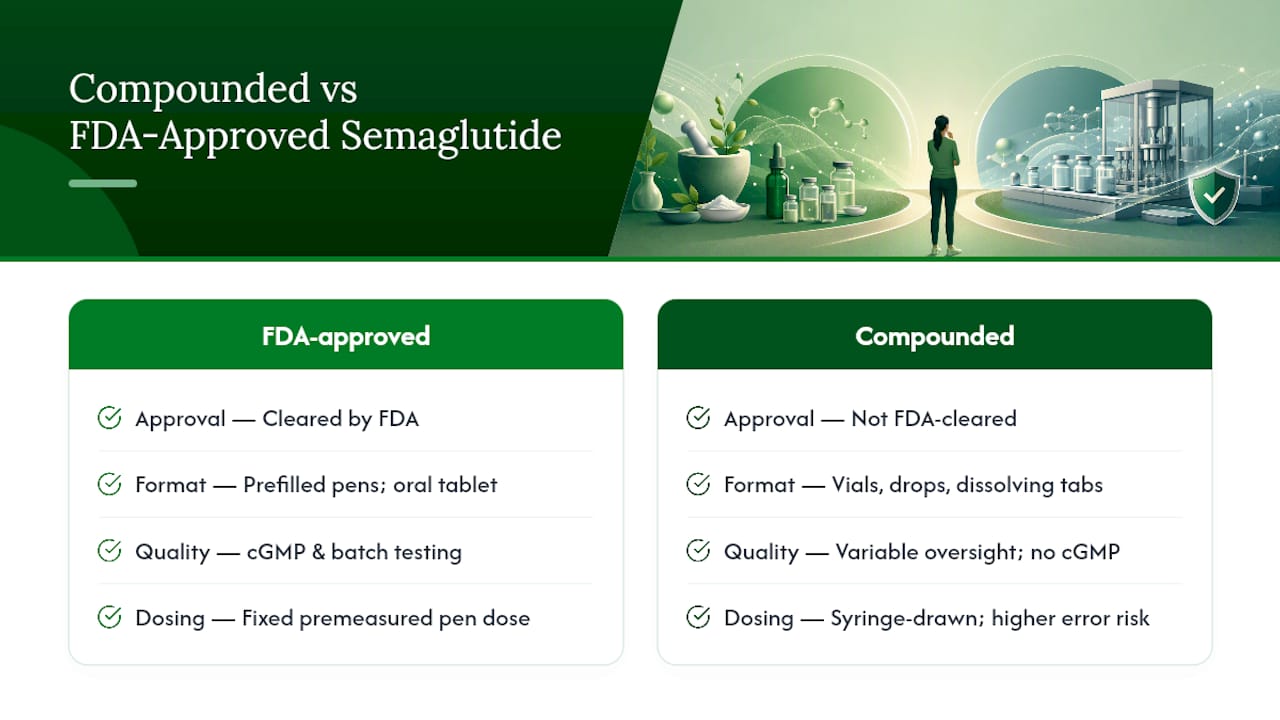
Approval status is the starting point. Ozempic, Wegovy, and Rybelsus all cleared FDA review for safety, efficacy, and manufacturing quality. Compounded semaglutide has not, regardless of how professional the packaging looks.
Formulation and route diverge sharply. Approved products come as prefilled injector pens (Ozempic, Wegovy) or an approved oral tablet (Rybelsus). Compounded versions often show up as multidose vials, sublingual drops, or dissolving tablets, formats that have never been tested in clinical trials for this drug.
Quality control separates the two categories further. FDA-approved manufacturing follows current good manufacturing practice (cGMP) standards with mandated batch testing. Compounding facilities operate under lighter, more variable oversight, and testing consistency differs from one pharmacy to the next.
Dosing accuracy may be the most dangerous gap. An approved pen delivers a fixed, pre-measured dose. A compounded vial requires someone, sometimes the patient, to draw an exact volume with a syringe, a step that introduces real room for error.
As of April 30, 2025, the FDA had logged 520 adverse event reports tied to compounded semaglutide and another 480 for compounded tirzepatide. Those numbers almost certainly understate the real total, since adverse event reporting is voluntary and many incidents never get logged with the FDA at all.
The pattern in these reports is fairly consistent. Common complaints include:
What’s notable is where the blame actually lies. It’s tempting to assume these reactions trace back to something inherently dangerous in the drug itself. That’s not quite right. Data from 2024 found that the vast majority of adverse events associated with GLP-1 medications were linked to dosing or administration errors, not the underlying pharmacology of semaglutide. In other words, the drug class itself has a reasonably well-understood side effect profile from years of clinical use in Ozempic and Wegovy. What’s breaking down is the delivery: unclear labeling, manual measurement, and inconsistent instructions on vials that were never designed with a general consumer in mind.
Most reported reactions fall into the gastrointestinal category and resolve with supportive care. A smaller but real subset required emergency treatment or hospital admission, usually tied to a dosing mistake severe enough to cause dangerous blood sugar drops, extreme GI distress, or dehydration requiring IV fluids.
Dosing mistakes with compounded semaglutide aren’t occasional slip-ups. They follow a specific, well-documented mechanism. Multidose vials require patients or clinicians to draw an exact volume, and the instructions accompanying these vials have often used “units” instead of standard milligrams or milliliters, a labeling choice that has directly caused massive overdoses.
The FDA’s own safety communication confirms that patients have inadvertently administered doses 5 to 20 times higher than intended because of confusing volume-to-dose conversions.
Clinicians who manage patients switching between compounded and approved GLP-1 products consistently flag the same issue: vial-based dosing removes the built-in safety margin that a prefilled pen provides, and patients rarely get clear guidance on converting “units” into an actual milligram dose before they self-inject.
The evidence gap that remains is real. There’s no comprehensive registry tracking every compounded product formulation, so it’s hard to say precisely how many distinct products are circulating or which specific compounders account for the worst outcomes. What is clear is the direction of the data: this is overwhelmingly a measurement and labeling problem layered on top of a drug with a known safety profile.
Beyond dosing errors, compounded semaglutide carries hazards tied directly to how it’s made, not just how it’s measured.
Contamination and sterility are genuine concerns. Compounding facilities, particularly smaller 503A pharmacies or unverified overseas suppliers, don’t always match the sterility controls of licensed drug manufacturing, raising the risk of bacterial contamination or impurities in injectable products.

Added ingredients show up more often than most patients expect. Some compounded formulations mix in vitamin B12, glycine, or ondansetron alongside semaglutide. Combining these substances can create entirely new chemical entities whose safety and interaction profile has never been studied, with no demonstrated clinical benefit to justify the risk.
Alternative salt forms present a subtler problem. The FDA has noted that some compounders use semaglutide sodium or semaglutide acetate instead of the base compound used in approved drugs. These salts haven’t been shown to behave the same way in the body, which means the drug’s absorption, potency, or side effect profile could shift in ways nobody has measured.
Storage and shipping vulnerabilities round out the list. Semaglutide is a peptide, and peptides are sensitive to temperature. Shipped without validated cold-chain handling, a compounded vial can degrade quietly, losing potency without any visible change in color or clarity. You’d have no way to know just by looking at it.
Pro Tip: If a compounded product arrives warm to the touch, without an ice pack, or with a shipping delay longer than promised, don’t use it. Contact the pharmacy and ask whether the product’s stability was validated for that transit time and temperature.
The regulatory ground has shifted meaningfully in the past two years. During the height of the Ozempic and Wegovy shortages, the FDA allowed compounding under temporary enforcement discretion. That discretion ended once semaglutide’s shortage resolved in February 2025 and tirzepatide’s resolved in December 2024, closing the main legal justification for mass compounding of these drugs.
The FDA has since moved further, proposing to remove semaglutide and tirzepatide from the 503B bulk drug substances list entirely, a step that would eliminate one of the last remaining legal pathways for large-scale compounding of these medications. That process is ongoing, and timelines for federal rulemaking can stretch out, so the legal landscape here is still in motion rather than fully settled.
In the meantime, the agency’s practical recommendations are consistent:
Separately, the University of Illinois Chicago’s Drug Information Group has flagged counterfeit and fraudulently labeled GLP-1 products circulating in the U.S. supply chain, some marketed as “for research use” while actually being sold for human injection with none of the quality assurances that phrase implies.
If you’re already using, or seriously considering, a compounded semaglutide product, a few concrete steps cut your risk substantially.
Pro Tip: If you’ve been using a multidose vial, bring the actual syringe you use, along with any written instructions, to your next clinician visit. Having them physically verify your draw volume catches errors that a phone conversation never will.
Certain symptoms cross the line from “call your doctor” to “go to the ER now”:
If gastrointestinal symptoms keep worsening despite rest and fluids, don’t wait it out. Get evaluated urgently. And never stop a prescribed diabetes medication abruptly without talking to your clinician first, even if you suspect the compounded product is the problem.
You have several reporting paths: FDA MedWatch online or by phone, your state board of pharmacy, your local poison control center, and your prescribing clinician directly.
When you report, include:
Reporting isn’t just paperwork. It’s the mechanism that feeds enforcement decisions and public safety alerts.
The conventional warning about compounded semaglutide tends to focus on the drug itself, as if the molecule is the danger. The data tells a more specific story: the overwhelming majority of harm traces back to how these products are labeled, measured, and shipped, not to semaglutide’s underlying pharmacology. That distinction matters for how you protect yourself. It’s not enough to just avoid “sketchy” sellers; you need clarity on dosing units, storage conditions, and pharmacy credentials every single time. Licensed, supervised access to GLP-1 medications removes nearly all of the variables driving these adverse event reports. That’s the piece worth acting on.
Everything above points to one practical conclusion: the risk in compounded semaglutide isn’t really about the drug, it’s about the gaps around it, unclear dosing, unverified pharmacies, and no clinician checking your numbers along the way. RoenRx closes those gaps by pairing you with a licensed clinician who manages your prescription, dosing, and follow-up through one continuous telehealth relationship instead of leaving you to interpret vial instructions on your own.

Through RoenRx, you get a same-day medical review, prescriptions sent to a verified pharmacy, and a care team you can message directly if a side effect shows up or your dose needs adjusting. Every part of that process, from your intake to your refill schedule, stays under clinical supervision rather than guesswork with a syringe.
This is general health information, not a substitute for individualized medical advice. Talk to your clinician before starting, stopping, or switching any weight-loss medication, and report any adverse reaction to your care team right away.
If you want to see whether supervised semaglutide treatment fits your situation, you can check your eligibility for weight-loss injections and get a same-day medical review to start.
For deeper detail beyond this article, these sources are worth bookmarking:
If you ever experience a reaction, report it through MedWatch and loop in your clinician immediately.
No. Ozempic went through FDA premarket review for safety, efficacy, and manufacturing quality; compounded semaglutide has not, and it carries documented risks including dosing errors and formulation inconsistencies.
Not banned outright, but the legal pathway is narrowing. The FDA ended temporary enforcement discretion after shortages resolved and has proposed removing semaglutide and tirzepatide from the 503B bulk drug substances list, which would close much of the remaining legal compounding route.
Reported harms include severe gastrointestinal symptoms, dehydration, fainting, and in serious cases pancreatitis or hospitalization, though most of these adverse events with compounded products trace back to dosing and administration errors rather than the drug’s core pharmacology.
FDA-approved semaglutide (Ozempic, Wegovy, Rybelsus) has a well-studied side effect profile primarily involving GI symptoms. Compounded versions carry additional, avoidable risks tied to inconsistent quality control, unclear dosing instructions, and unapproved formulations.
RoenRx connects you with licensed clinicians for same-day review, prescription management through verified pharmacies, and ongoing follow-up, removing the manual dosing and sourcing risks tied to unsupervised compounded products.