Messaging in mental health care is defined as the use of digital communication tools, including text messaging and app-based platforms, to support therapeutic interaction, symptom monitoring, and patient engagement between clinical sessions. The role of messaging in mental health care has grown from a convenience feature into a clinically recognized modality, particularly for anxiety and depression management. Research from 2026 shows that self-focused message framing increases patient engagement by up to 4.6%, with stronger effects among minoritized groups. That finding alone signals that how a message is written matters as much as what it says. For mental health professionals and patients alike, understanding digital communication in therapy is no longer optional. It is a core competency.
Messaging in mental health care serves three primary functions: extending therapeutic contact between sessions, monitoring symptoms in real time, and reducing the stigma that prevents many patients from seeking help. These are not minor benefits. They address the three biggest structural failures in traditional outpatient mental health care, which are access gaps, symptom blind spots between appointments, and the shame that keeps people silent.
Text messaging in therapy works partly because it creates a private, low-pressure channel. Research confirms that messaging reduces stigma by providing a richer, more private communication medium, and that a patient’s willingness to disclose sensitive information depends directly on trust in the digital platform. This means the platform itself is a clinical variable, not just a delivery mechanism.
For mild to moderate conditions such as generalized anxiety disorder and major depressive disorder, messaging-based care produces symptom reduction outcomes comparable to traditional therapy. That is a significant finding. It means a well-structured messaging program is not a lesser substitute. It is a legitimate treatment pathway for a large portion of the patient population.
The benefits of messaging therapy extend beyond symptom reduction. Patients report feeling more supported between sessions, more likely to complete homework assignments, and more willing to flag early warning signs before they escalate. Clinicians gain a richer data stream, and access to messaging data leads to more frequent treatment plan adjustments, even when outcome improvements remain nuanced.
Key benefits of messaging for patients:
Pro Tip: Frame messages around the patient’s own goals and language. Self-focused framing, where the message centers on what the patient wants rather than what the clinician recommends, consistently outperforms generic psychoeducational content.

Messaging is not a universal solution. Severe psychiatric conditions, active suicidality, psychosis, and complex trauma require in-person care where nonverbal cues, physical presence, and immediate crisis response are available. Treating messaging as a replacement for face-to-face therapy in these cases is a clinical error.
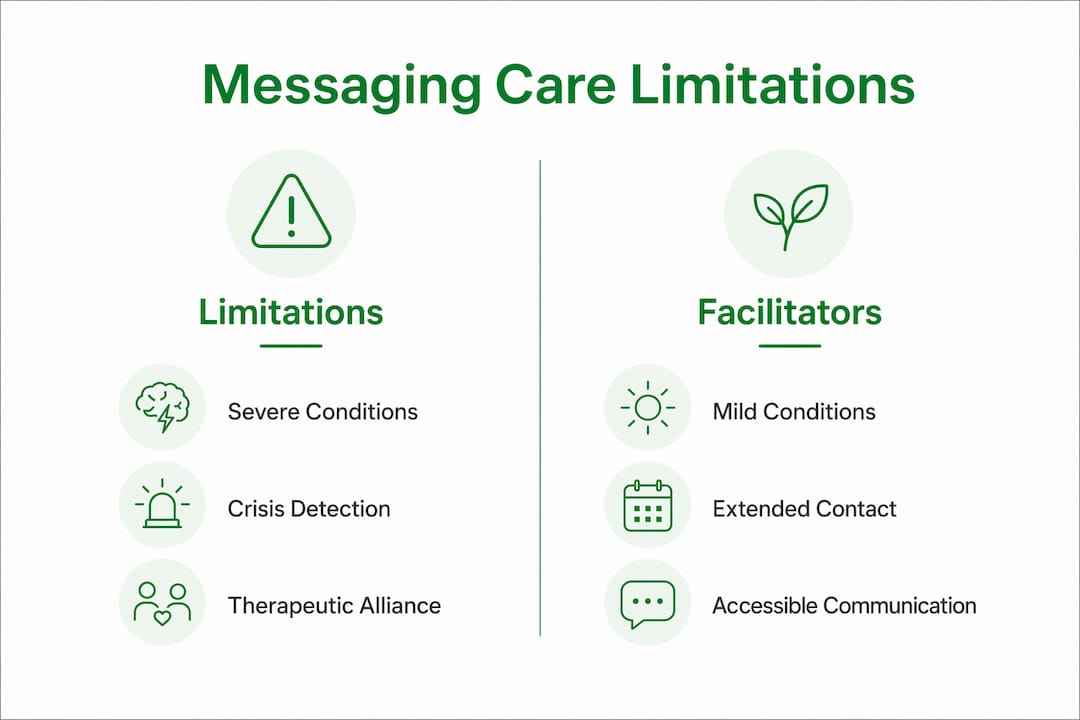
Even for appropriate cases, clinicians face real challenges adapting their skills to a text-only format. Qualitative interviews with community mental health clinicians reveal consistent difficulty interpreting tone, managing crisis signals in text, and maintaining a therapeutic alliance without vocal or visual cues. A clinician who is skilled in Cognitive Behavioral Therapy or Motivational Interviewing must relearn how to deliver those techniques through written language.
The relational dimension of therapy is also at risk. Research on messaging’s impact on therapeutic alliance confirms that messaging offers transactional convenience but alters relational dynamics. Patients may feel heard in the moment but miss the deeper connection that drives long-term therapeutic change. This is not a technology problem. It is a structural feature of text-based communication.
| Dimension | Messaging-based care | Face-to-face therapy |
|---|---|---|
| Access and convenience | High, available anytime | Limited by scheduling |
| Emotional nuance | Low, tone is easily misread | High, nonverbal cues present |
| Crisis management | Risky without clear protocols | Direct and immediate |
| Stigma reduction | Strong | Moderate |
| Therapeutic alliance depth | Moderate | High |
| Suitable severity range | Mild to moderate | Mild to severe |
Pro Tip: Never use messaging as the sole channel for a patient who has expressed passive suicidal ideation. Establish a clear escalation protocol before the first message is sent, and document it in the patient’s care plan.
Effective messaging-based care requires clinicians to develop a distinct skill set, one that does not transfer automatically from in-person practice. Clinicians must learn new therapeutic strategies specifically suited to messaging to build effective therapeutic alliances. The term “mobile interventionist” has emerged in the literature to describe this specialized role, and it is a useful frame. A mobile interventionist does not simply type what they would say in a session. They write with precision, brevity, and emotional awareness.
Workflow integration is the second major challenge. Messaging does not fit neatly into a 50-minute session model. Clinicians need defined response windows, clear role boundaries, and platform tools that flag urgent messages. Clinician recommendations consistently point to clearer role definitions, platform improvements, targeted training, and simplified clinical goals as the four pillars of successful implementation.
Hybrid models produce the best outcomes. Messaging works best as a supplement to scheduled sessions, not as a standalone service. A patient receiving weekly video therapy who also has access to between-session check-in messages shows better engagement and symptom tracking than one receiving either modality alone.
Best practices for clinicians using messaging in mental health care:
Pro Tip: Build a library of pre-written, clinically reviewed message templates for common scenarios, such as post-session summaries, coping skill reminders, and appointment confirmations. Templates save time and maintain consistency without sacrificing personalization.
Messaging is a tool within a system, not a system by itself. Translation and messaging tools must be embedded in system-level approaches that prioritize the emotional and relational dimensions of care for best effect. This matters especially for multilingual populations, where translation technology can support communication but cannot replace human interpreters when emotional nuance is at stake.
At the infrastructure level, health systems investing in messaging must address data security, HIPAA compliance, and platform reliability. Patients who experience technical failures or privacy concerns disengage quickly. Trust in the platform is a prerequisite for clinical effectiveness, and that trust is built through consistent, secure, and responsive technology.
Equitable implementation requires attention to digital access. Patients without reliable smartphones or data plans cannot benefit from messaging programs. Health systems that deploy messaging without addressing this gap will widen existing disparities rather than close them. The most effective programs pair digital tools with community outreach to reach patients who would otherwise be excluded.
The table below compares technology-only and hybrid care approaches across key dimensions.
| Dimension | Technology-only messaging | Hybrid messaging plus human care |
|---|---|---|
| Therapeutic alliance | Weak | Strong |
| Crisis response capability | Limited | Reliable |
| Patient satisfaction | Variable | Consistently higher |
| Scalability | High | Moderate |
| Equity of access | Dependent on digital access | Improved with outreach support |
Messaging in mental health care improves patient engagement and symptom monitoring when clinicians apply self-focused framing, clear protocols, and hybrid delivery models.
| Point | Details |
|---|---|
| Messaging framing matters | Self-focused message framing increases engagement by up to 4.6%, especially among minoritized groups. |
| Mild to moderate conditions benefit most | Messaging-based care produces outcomes comparable to traditional therapy for anxiety and depression. |
| Clinicians need specialized training | Text-based care requires new skills in tone interpretation, crisis management, and structured communication. |
| Hybrid models outperform solo messaging | Messaging works best as a supplement to scheduled sessions, not as a standalone treatment. |
| Platform trust is a clinical variable | Patients disclose more when they trust the digital platform, making security and reliability non-negotiable. |
The most common mistake I see clinicians make with messaging is treating it like a shorter version of a therapy session. They write long, nuanced messages that would work beautifully in a 50-minute room but land as overwhelming walls of text on a phone screen. The medium changes the message in ways that are easy to underestimate.
What actually works is restraint. A single, well-framed question sent at the right moment, such as “How did the breathing exercise go this week?”, does more clinical work than a paragraph of psychoeducation. Patients respond to brevity. They engage with messages that feel personal and low-stakes. The moment a message feels like homework, engagement drops.
The other thing I would tell any clinician starting out with messaging is to take the telehealth consent process seriously. Patients who understand what messaging is for, what it is not for, and how quickly they can expect a response are far more likely to use it appropriately. Ambiguity about the channel creates anxiety, which is the last thing you want to add to a mental health patient’s experience.
Messaging will not replace the therapy room. But for the right patient, at the right moment, a well-timed text can do something a weekly session cannot. It can reach someone in the middle of a hard Tuesday afternoon, before the crisis, before the spiral. That is not a small thing.
— Bryan
Mental health professionals and patients looking for a platform that integrates messaging with real clinical care have a clear option in RoenRx.
RoenRx combines on-demand telehealth access with direct messaging to care teams, same-day appointments, and prescription delivery for conditions including anxiety and primary care needs. The platform is built around the principle that timely communication between patients and providers changes outcomes. Clinicians on the RoenRx network follow structured messaging protocols, and patients can reach their care team without waiting weeks for a follow-up slot. For anyone ready to experience mental health support that fits real life, RoenRx is worth a closer look.
Messaging in mental health care refers to the use of text-based digital tools to support therapeutic communication, symptom monitoring, and patient engagement between clinical sessions. It is recognized as a legitimate care modality for mild to moderate conditions such as anxiety and depression.
Research shows that messaging-based care produces symptom reduction outcomes comparable to traditional therapy for mild to moderate mental health conditions. Effectiveness depends on message framing, clinician training, and clear protocols.
Clinicians report difficulty interpreting tone, managing crisis signals in text, and maintaining therapeutic alliance without nonverbal cues. Workflow integration and clear role definitions are the most commonly cited implementation barriers.
Messaging provides a private, low-pressure channel that lowers the barrier to disclosure. Patients are more willing to share sensitive information through text than in face-to-face settings, particularly when they trust the platform.
Messaging is not appropriate as the primary modality for severe psychiatric conditions, active suicidality, psychosis, or complex trauma. These cases require in-person care where immediate crisis response and nonverbal communication are available.