Insurance often cuts your monthly semaglutide bill significantly, but the range is wide. A commercially insured patient using a Novo Nordisk savings card might pay as little as $25/month. A Medicare enrollee without a demonstration program could pay several hundred dollars. Someone paying cash faces a list price around $1,349/month for Wegovy in 2026. The gap between those numbers comes down to three things: which indication is on your prescription, which formulary tier your plan assigns the drug to, and which payer type you have.
Two things to do right now:
Semaglutide cost with insurance depends most on formulary tier, indication, and payer type — and commercially insured patients who use manufacturer savings programs often pay far less than the $1,349/month list price.
| Point | Details |
|---|---|
| Indication drives coverage | Ozempic (diabetes) is covered more often than Wegovy (weight management) across most payer types. |
| Specialty tier means coinsurance | “Covered” on a specialty tier can still mean $200–$350/month until your out-of-pocket max is met. |
| Savings cards change the math | Commercially insured patients may pay as little as $25/month with a Novo Nordisk savings card; Medicare/Medicaid enrollees cannot use them. |
| Medicare rules are shifting | 2026 CMS negotiations and the $2,000 annual Part D cap affect what Medicare beneficiaries pay, but manufacturer cards remain off-limits. |
| RoenRx handles the process | RoenRx clinicians verify coverage, prepare PA documentation, and coordinate prescriptions through a single telehealth visit. |
The same molecule, semaglutide, is sold under two brand names with different FDA-approved indications. Ozempic is approved for type 2 diabetes and cardiovascular risk reduction. Wegovy is approved for chronic weight management. FDA label differences between these formulations give insurers a clear basis to cover one and exclude the other, even for the same patient.
Formulary tiers are the mechanism that translates “covered” into an actual dollar amount. Most plans run four to six tiers, from generic (cheapest) to specialty (most expensive). GLP-1 drugs almost always land on specialty tiers, where the patient pays coinsurance — a percentage of the drug’s cost — rather than a flat copay. Plans that place GLP-1 drugs on specialty tiers can expose patients to large annual out-of-pocket costs when coinsurance applies to a $1,300+ list price.
Prior authorization (PA) is nearly universal for semaglutide. Insurers require it before they will pay, and they typically want documentation of a qualifying diagnosis, a BMI threshold, prior treatment attempts, and relevant lab results. Step therapy adds another layer: some plans require you to try and fail a cheaper medication first. The prescribing clinician carries most of this documentation burden, which is why having a provider who knows the PA process matters.
Indication drives coverage more than anything else. A patient with type 2 diabetes prescribed Ozempic has a much higher chance of coverage than a patient prescribed Wegovy for weight loss alone, because many commercial plans and nearly all government payers have historically excluded obesity-only indications. The FDA’s 2024 approval of Wegovy for cardiovascular risk reduction created a third coverage pathway that some plans now recognize separately.
Pro Tip: Open your plan’s formulary PDF (usually downloadable from the insurer’s website) and search for “semaglutide” rather than the brand name. The tier number listed there tells you whether you’ll pay a flat copay or a coinsurance percentage — and coinsurance on a specialty drug is almost always the more expensive outcome.
The numbers below reflect 2026 pricing and program structures. Your exact cost depends on your deductible status, coinsurance rate, and whether you qualify for a savings program.
| Scenario | Monthly estimate | Annual estimate |
|---|---|---|
| Cash pay, Wegovy list price | ~$1,349 | ~$16,188 |
| Commercial insurance, specialty tier (20% coinsurance, deductible met) | moderate to high monthly cost | corresponding annual cost |
| Commercial insurance + Novo Nordisk savings card | significantly reduced monthly cost | substantially lower annual cost |
| Medicare Part D (standard, no demo program) | variable monthly cost depending on plan | variable annual cost depending on plan |
| Medicaid (state with coverage) | low monthly cost in covered states | low annual cost in covered states |
| Cash-pay compounded semaglutide (telehealth) | lower monthly cost but with regulatory risk | lower annual cost but with regulatory risk |
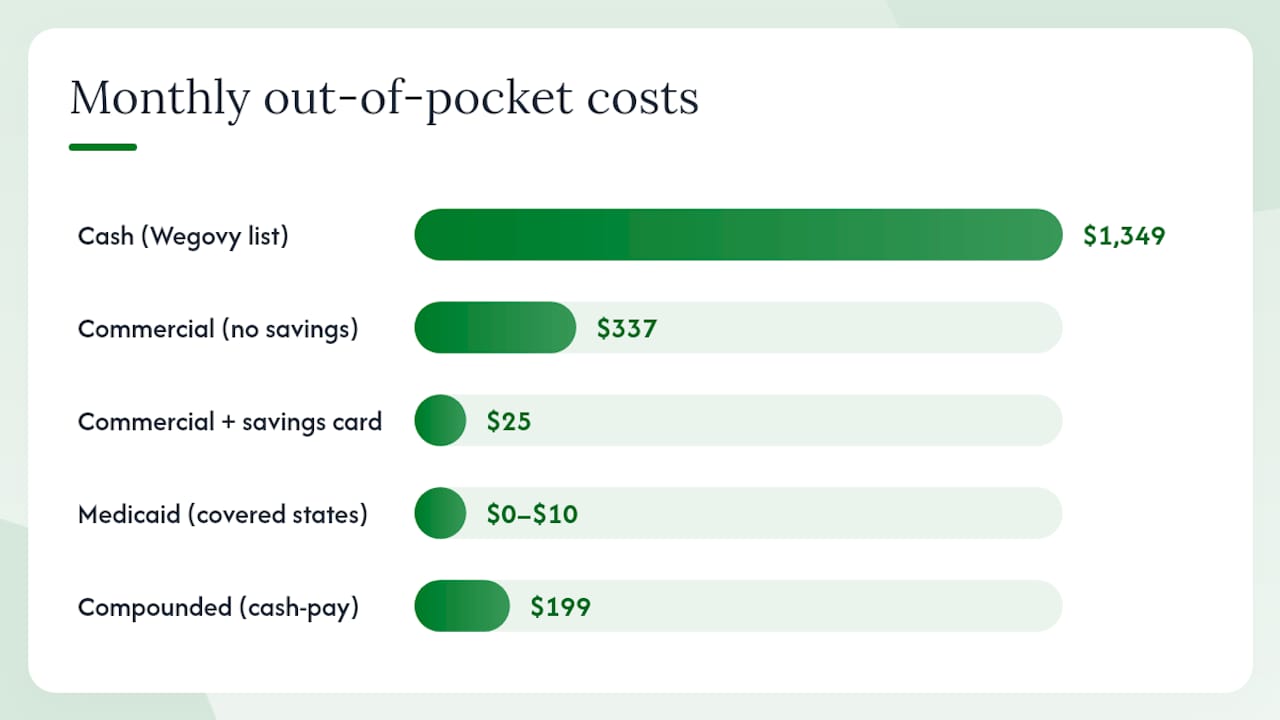
Patient scenario A — Commercial insurance with savings card. A 38-year-old with employer-sponsored insurance and a Wegovy prescription for weight management. Her plan covers it on tier 5 with 25% coinsurance. Without a savings card, her monthly cost after meeting her deductible would be roughly $337. With the NovoCare savings offer, her copay drops to as low as $25/month. She is not on Medicare or Medicaid, so she qualifies.
Patient scenario B — Medicare Part D enrollee. A 67-year-old with type 2 diabetes prescribed Ozempic. Medicare Part D covers Ozempic for diabetes on most plans. CMS drug pricing negotiations and Medicare demonstration programs are actively reshaping what Medicare beneficiaries pay in 2026, but costs still vary by plan. He cannot use manufacturer copay cards. His monthly cost depends on his specific Part D plan’s formulary and whether he has reached his out-of-pocket cap.
Patient scenario C — Medicaid enrollee. A 44-year-old in a state that covers GLP-1s for obesity. Her cost-sharing is minimal, often $0–$10/month. But if she lived in a neighboring state without that coverage, she would pay full list price or seek alternatives.
Patient scenario D — Cash-pay compounded option. A 31-year-old without insurance who finds a telehealth provider offering compounded semaglutide at $199/month. The price is lower, but compounded products carry regulatory risk (more on that in Section 6).
Regional variation is real. State Medicaid formularies, local pharmacy pricing, and employer plan designs all shift these numbers. Treat the ranges above as starting estimates, not guarantees.
Most large employer plans cover Ozempic for type 2 diabetes. Coverage for Wegovy for weight management is less consistent — coverage for obesity treatment is rapidly changing, and patients should re-check formularies annually because what was covered last year may not be this year. Prior authorization is almost always required. Manufacturer savings cards from Novo Nordisk are available to commercially insured patients who meet eligibility criteria, and they can reduce monthly costs substantially.
Medicare Part D covers Ozempic for type 2 diabetes on most plans. Coverage for Wegovy for weight management has historically been excluded under Medicare, though the cardiovascular indication approved in 2024 has opened some pathways. The 2026 Medicare drug pricing negotiations are affecting access and cost for beneficiaries. Critically, Medicare beneficiaries cannot use manufacturer copay cards — federal anti-kickback rules prohibit it. The $2,000 annual out-of-pocket cap introduced under the Inflation Reduction Act applies to Part D in 2025 and beyond, which helps high-cost drug users.
Medicaid coverage is highly fragmented. As of early 2026, only a minority of states include GLP-1s for weight management on their formularies. Diabetes indications fare better but still vary. Residency is a major determinant of access. If you are on Medicaid, the only reliable answer is to check your state’s Medicaid drug formulary directly.
The VA addresses semaglutide (Wegovy) within its treatment pathways, with specific clinical-use guidance in its formulary documents. Enrolled veterans should contact their VA primary care provider and check the VA formulary advisor for current access criteria. VA coverage follows its own clinical criteria and is not subject to the same commercial PA rules.
This process takes about 30 minutes and gives you a reliable answer before you fill a prescription.
What to capture and save:
Pro Tip: Ask your insurer’s pharmacy line for the specific ICD-10 codes that trigger coverage for semaglutide under your plan. Share those codes with your prescriber before the PA is submitted — it eliminates one of the most common reasons for denial.
For a deeper walkthrough of navigating GLP-1 insurance coverage, RoenRx has a practical guide that covers prior authorization and appeals step by step.
Novo Nordisk runs savings programs for both Ozempic and Wegovy through NovoCare. Commercially insured patients who meet eligibility criteria can reduce their monthly cost significantly. The NovoCare coverage-check tool lets you enter your insurance information to see what programs you qualify for. These programs are not available to Medicare or Medicaid beneficiaries due to federal regulations.
For uninsured or low-income patients who do not qualify for government coverage, Novo Nordisk’s PAP may provide medication at no cost or reduced cost. Eligibility is income-based. Your prescribing clinician or a patient advocate can help with the application.
GoodRx and similar discount services can reduce the cash price at participating pharmacies. They work best for patients without insurance or when the cash price beats the insured price. GoodRx cannot be used simultaneously with insurance — you choose one or the other at the pharmacy counter. Medicare beneficiaries can use GoodRx, but using it means the purchase does not count toward their Part D deductible or out-of-pocket cap.
Telehealth and compounding pharmacy programs have offered compounded semaglutide at $149–$299/month, well below the brand-name list price. The tradeoff is regulatory risk. Peer-reviewed literature and FDA safety communications highlight concerns about unapproved compounded products, including quality and dosing consistency. The FDA has issued guidance on compounded GLP-1 products as national supply stabilizes, and enforcement priorities are shifting. If you are considering this route, use only a licensed compounding pharmacy with a valid prescription from a licensed clinician. For guidance on accessing semaglutide safely, RoenRx outlines what to look for in a legitimate provider.

Medicare beneficiaries cannot use manufacturer copay cards. Medicaid beneficiaries are generally covered at low or no cost in states with formulary coverage, but cannot stack additional savings programs. If you are on a government plan, your savings options are limited to the plan’s own cost-sharing structure and, for Medicare, the annual out-of-pocket cap.
Insurance denials for semaglutide are often not about the drug itself — they are about incomplete documentation. These are the items that most commonly make or break a prior authorization.
Clinical documentation checklist:
ICD-10 codes commonly used to support semaglutide coverage:
The cardiovascular indication is worth noting separately. The FDA’s approval of Wegovy for cardiovascular risk reduction means that patients with established cardiovascular disease and obesity now have a stronger coverage argument than weight management alone provides.
How to package a prior authorization:
For a detailed look at weight loss medication insurance coverage, including what documentation works best for GLP-1 approvals, the RoenRx guide covers the full process.
Getting semaglutide covered involves more steps than most patients expect: formulary checks, PA paperwork, clinical documentation, and pharmacy coordination. RoenRx handles all of it through a single telehealth platform.
What RoenRx offers:
How RoenRx reduces friction at each step:
RoenRx is a telehealth provider. All clinical decisions follow a medical evaluation, and prescriptions require an appropriate clinical encounter. Coverage outcomes depend on your individual plan and clinical eligibility — RoenRx cannot guarantee insurance approval, but the team works to give your PA the strongest possible documentation.
Most people searching for semaglutide cost with insurance are asking the wrong question. “Does my plan cover it?” is less useful than “What tier is it on, and what will I actually pay after my deductible?” A drug on a specialty tier with 25% coinsurance is technically covered — and it can still cost you $300+ a month until your out-of-pocket maximum kicks in.
The manufacturer savings card changes that math dramatically for commercially insured patients. A $25/month copay versus $300/month is not a small difference over a year of treatment. But that card disappears the moment you turn 65 and go on Medicare. That transition catches people off guard, and it is worth planning for if you are approaching Medicare eligibility while on a GLP-1.
The other thing most articles understate: the cardiovascular indication approved in 2024 is genuinely useful for coverage appeals. If a patient has obesity plus documented cardiovascular disease, the clinical argument for Wegovy is now stronger than it was under the weight-management-only framing. Prescribers who know to cite that indication in the PA cover letter are getting better results than those who default to the obesity codes alone.
One more timing note: open enrollment is the single best moment to switch to a plan with better GLP-1 coverage. Most people pick their plan based on premium, not formulary. Spending 20 minutes comparing formulary tiers during open enrollment can save thousands of dollars over the following year.
Figuring out what you’ll pay for semaglutide with insurance takes time most people do not have. RoenRx cuts through it: a clinician reviews your situation, checks your coverage, prepares your prior authorization with complete documentation, and coordinates your prescription — all through a telehealth visit you can do from home.
Patients who come to RoenRx for semaglutide weight loss support get a care team that handles the insurance paperwork alongside the clinical care. No separate calls to your insurer, no guessing about which ICD-10 codes to use, no waiting to find out if your PA was submitted correctly.
To get started:
RoenRx is a telehealth service. Clinical eligibility and coverage outcomes vary by individual. This is not a guarantee of insurance approval or specific pricing.
These are the primary sources worth bookmarking for policy updates, pricing, and program enrollment.
This article is general information, not a substitute for advice from a qualified doctor. Consult a qualified healthcare professional about your own circumstances before acting on anything here.
Yes. Ozempic is covered by most commercial plans and Medicare Part D for type 2 diabetes. Wegovy coverage for weight management is less consistent but is expanding as more plans recognize the cardiovascular indication approved by the FDA in 2024.
Commercially insured patients can apply for the Novo Nordisk savings card through NovoCare, which can reduce monthly costs to as low as $25. Uninsured patients may qualify for Novo Nordisk’s patient assistance program. GoodRx can lower the cash price at participating pharmacies, though it cannot be combined with insurance at the same transaction.
Oral semaglutide (Rybelsus) is approved for type 2 diabetes and carries a similar list price to Ozempic. Whether it costs less depends on your plan’s formulary tier for that specific formulation. Some plans tier the injectable and oral versions differently, so it is worth checking both when comparing your options.
Ozempic pens come in multiple dose configurations. Each pen contains four doses, and your prescriber selects the pen based on your current dose in the titration schedule.