Yes, most people regain some weight after stopping semaglutide. Clinical trial data shows participants regaining roughly two-thirds of their prior loss within a year of discontinuation, and a 2026 systematic review pegs typical regain at 0.4 to 0.8 kilograms per month depending on the drug. The rest of this guide breaks down the timeline, the biology behind it, and the clinical strategies that actually blunt the rebound.
TL;DR:
- Most people regain about two-thirds of their weight within a year after stopping semaglutide, with newer agents like semaglutide causing about 0.8 kg of regain per month.
- Discontinuation often leads to a rapid return of appetite signals and hunger hormones, contributing to faster weight regain than behavioral changes alone.
- Gradual tapering with clinician support and building maintenance habits beforehand can significantly reduce the speed and amount of weight regained.
- Around 1.5 to 2 years after stopping, many individuals are likely to return to their starting weight if no ongoing support strategies are in place.
- Monitoring blood pressure, blood sugar, and hunger cues early post-discontinuation allows for timely adjustments to prevent excessive regain.
The clearest evidence comes from the STEP 1 trial extension, which followed people who had lost weight on semaglutide 2.4 mg and then stopped taking it. One year off the drug, participants had regained about 66% of the weight they’d originally lost. That’s not a full bounce back to baseline.
A larger, more recent analysis backs this up with more precision. The 2026 systematic review and meta-analysis published in BMJ pooled data across multiple weight-management drug trials and found an average regain rate of about 0.4 kg per month overall. For newer GLP-1 agents specifically, including semaglutide, that rate nearly doubled to approximately 0.8 kg per month. Extrapolated forward, the review projected that many people on these newer drugs would return to their starting weight within about 1.5 to 2 years of stopping.
Here’s what stands out about that comparison: people who stopped diet-and-exercise programs regained weight more slowly than people who stopped medication. Oxford University’s summary of the review noted that drug discontinuation created a faster rebound than ending a behavioral program, even though people still kept off roughly a quarter of what they’d lost. That gap suggests something specific to stopping a GLP-1 drug, not just “people go back to old habits.”
Key figures from the current evidence base:
The numbers in context: A person who lost 20 kilograms on semaglutide and then stopped could, based on the pooled 0.8 kg/month rate, regain close to 10 kilograms within a year if no maintenance strategy is in place. That’s a projection based on group averages, not a guarantee for any one person.
It’s worth being honest about the limits of this evidence. Trial populations in studies like STEP 1 don’t perfectly mirror every real-world patient, and follow-up windows in most studies max out around one to two years, so long-term data beyond that point is thinner than anyone would like. Still, the consistency between the trial extension data and the independent meta-analysis gives this pattern real weight.
Cardiometabolic markers tend to move the same direction as body weight. In the STEP 1 extension, blood pressure and blood sugar improvements that patients gained while on semaglutide moved back toward their pre-treatment baseline as weight returned. This isn’t universal or automatic. Some people retain partial improvements even with significant regain, but the general direction of travel tracks with the number on the scale.
Turning these study-level averages into something usable means picturing a timeline instead of a single statistic. Using the pooled rate of roughly 0.4 kg/month and the newer-agent rate of roughly 0.8 kg/month, three scenarios illustrate the range of what someone might expect.
These are projections built from group-level averages, not individual predictions. Someone’s actual trajectory depends on how much muscle mass they retained, whether they kept up resistance training, how quickly their appetite rebounded, and whether they had a structured plan in place before stopping the medication.
Why the 12-month mark is a soft boundary, not a hard wall: Most of the trial data extrapolating regain out to 1.5 or 2 years relies on modeling rather than direct long-term observation. Regain doesn’t necessarily continue in a straight line forever. Some trial data suggests a plateau effect, where weight loss and regain settle into a new, higher equilibrium once appetite and metabolic adaptations stabilize, though this hasn’t been tracked consistently across large populations for many years.
Statistic to remember: if you’re trying to gauge personal risk, the single most load-bearing number from the evidence is that ≈0.8 kg/month regain rate for newer GLP-1 agents. It’s the figure that turns “weight might come back” into something you can actually plan around, whether that means scheduling a follow-up visit at the 3-month mark or deciding in advance what a maintenance dose might look like.
Individual variability matters more here than in almost any other part of this discussion. Someone who built strong resistance-training habits and high-protein eating patterns while on semaglutide tends to land closer to the optimistic end. Someone who relied heavily on appetite suppression without addressing underlying eating patterns tends to land closer to the faster end. For a sense of what the loss side of the curve looked like on the way up, the month-by-month weight loss benchmarks on semaglutide offer a useful comparison point.
Semaglutide works by mimicking a gut hormone called GLP-1, which signals fullness to the brain and slows how fast food leaves the stomach. Once the drug clears your system, both of those effects fade, and they don’t fade gradually into some new normal. Appetite signaling tends to snap back toward where it was before treatment, sometimes within weeks.
This isn’t just about willpower cracking under pressure. Adaptive physiology plays a direct role. Hormones involved in hunger and satiety, including ghrelin and leptin, shift during weight loss in ways that push the body to defend its prior, heavier weight. That’s a documented feature of weight loss generally, not something unique to drug-assisted loss, but it becomes especially noticeable once the appetite-suppressing effect of semaglutide is gone, and the body’s hunger drive is unmasked all at once.
Behavioral factors compound the physiological ones. People describe a return of “food noise,” the persistent mental chatter about food that many say disappears almost entirely on semaglutide. When that noise comes back, old cues, like walking past a bakery or feeling stressed after work, start triggering the same responses they used to.
Pro Tip: If you noticed your hunger cues change dramatically on semagludite, treat that as diagnostic information. It tells you how much of your prior eating pattern was driven by biology versus habit, and that distinction should shape your maintenance plan before you ever stop the drug.
Stopping semaglutide cold, without any plan, is the single easiest way to see rapid regain. Harvard Health’s guidance on transitioning off GLP-1 medications recommends working with a clinician on a gradual approach rather than abrupt discontinuation, since rebound hunger and faster gastric emptying tend to hit hardest right after the drug clears.
Specific supports worth building into your routine:
Healthline’s overview of semaglutide withdrawal lists increased appetite, decreased satiety, and shifting blood sugar as common effects of stopping, and echoes the same core advice: plan the transition with a clinician rather than navigating it alone.
Pro Tip: Ask your care team to schedule your first follow-up appointment for 4 to 6 weeks after any dose reduction, not 3 months out. Rapid regain and appetite rebound tend to show up early, and catching the trend at week 4 gives you far more room to adjust than catching it at week 12.
Red flags that should prompt a re-evaluation include regain that outpaces the general 0.8 kg/month benchmark for newer agents, a return of elevated blood pressure or blood sugar, or a sense that hunger has become genuinely difficult to manage despite lifestyle efforts. None of those are signs of failure. They’re signals that your plan needs adjusting, ideally with your clinician rather than on your own.
Not everyone who regains weight after stopping semaglutide needs to go back on it, but plenty of people do, and the decision usually comes down to a few concrete factors rather than a gut feeling.
Clinicians typically weigh the speed and magnitude of regain first. Someone who regains 2 to 3 kilograms slowly over six months looks different from someone who regains 8 kilograms in the same window. The second scenario usually pushes toward re-evaluation sooner. Cardiometabolic markers matter just as much. If blood pressure or blood sugar readings drift back toward pre-treatment levels, that’s often a stronger signal than the scale alone.
Side effects during the original course of treatment factor into the decision too. Someone who tolerated semaglutide well and simply stopped for a non-medical reason, like cost or a supply gap, faces a different conversation than someone who stopped because of persistent nausea or other tolerability issues.
Alternatives exist beyond simply restarting the same medication at the same dose. Options include intensifying behavioral and lifestyle support, referral to an obesity medicine specialist for a more structured long-term plan, or, in some cases, considering a different GLP-1 agent such as liraglutide, which carries its own dosing schedule and considerations.
Before any appointment about restarting therapy, it helps to bring:
The physical side of regain gets most of the attention, but the psychological side often determines how someone responds to it. Many people describe a sense of loss or failure when weight starts coming back, even when the regain is a documented, expected physiological response rather than a personal shortcoming. That emotional reaction can create a cycle of its own. Feeling like the medication “didn’t work” or that regain reflects poor discipline sometimes leads people to disengage from follow-up care entirely, which removes the exact support most likely to slow the rebound. The framing matters here: obesity is recognized by the World Health Organization as a chronic, relapsing condition, not a one-time problem solved by a single course of treatment. Regain after stopping a medication fits that pattern rather than contradicting it.
There’s also a subtler psychological shift tied to the return of “food noise.” People who experienced near silence around food thoughts on semaglutide sometimes interpret the return of normal hunger signals as something having gone wrong, when it’s often just the drug’s effect wearing off. Recognizing that distinction ahead of time, before stopping, tends to reduce panic-driven eating responses when hunger returns. Clinicians and coaches who address this directly, rather than focusing purely on the physical plan, tend to see patients navigate the transition with less distress and fewer abrupt derailments.
Regain patterns aren’t identical across every weight-management drug, and that difference is part of why the 2026 systematic review broke results out by drug class rather than lumping everything together. Newer GLP-1 agents, including semaglutide, showed a pooled regain rate of about 0.8 kg per month after discontinuation, roughly double the 0.4 kg/month average across all weight-management medications in the review.
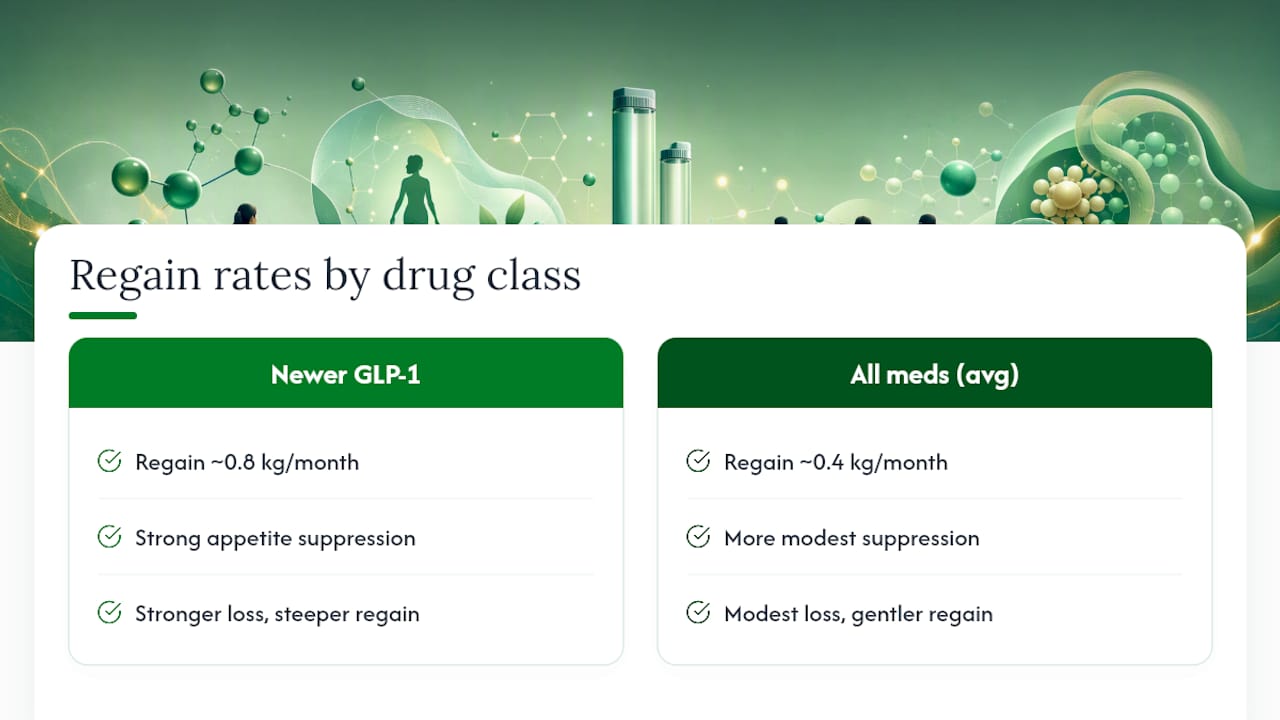
That gap likely reflects how effectively these newer agents suppress appetite while active. The stronger the appetite suppression during treatment, the larger the gap between “on drug” hunger levels and “off drug” hunger levels, which may translate into a sharper rebound. Older weight-management medications, which generally produce more modest weight loss to begin with, may show slower regain simply because there’s less distance to travel back.
This doesn’t mean older or different medications are inherently better for long-term maintenance. It means the tradeoff looks different: stronger initial results with a steeper regain curve if discontinued without a plan, versus more modest results with a gentler regain pattern. For patients weighing options, this is a conversation worth having directly with a clinician rather than assuming one drug class is universally superior for keeping weight off long term.
The lifestyle changes you make while taking semaglutide do more work after you stop than most people expect. Since the drug’s appetite-suppressing effect naturally makes it easier to eat less, that window is the best opportunity to build habits that don’t depend on the medication to sustain themselves.
Protein intake stands out as particularly important. Higher protein consumption supports satiety independent of GLP-1 activity and helps preserve lean muscle mass during weight loss, which matters because muscle loss during rapid weight reduction can lower resting metabolic rate. Fiber-rich foods work similarly, slowing digestion and extending fullness in a way that partially mimics, though doesn’t replace, what the medication does pharmacologically. The guide to eating well on semaglutide covers specific food choices that support this approach during active treatment.
Resistance training deserves equal weight in this conversation, and it’s often underemphasized. Building or maintaining muscle mass while losing fat helps protect metabolic rate in a way that cardio alone doesn’t. People who start resistance training only after stopping semaglutide are playing catch up; starting during treatment, when appetite is more manageable and energy for consistent workouts tends to be higher, sets a stronger foundation for the transition period.

Chronic use of semaglutide for weight management is generally considered appropriate for eligible patients under ongoing clinical supervision, but long-term safety data beyond a few years is still accumulating, and weight cycling, the pattern of losing and regaining weight repeatedly, carries its own considerations worth understanding.
Repeated cycles of loss and regain have been associated in various contexts with metabolic strain, though the research specific to GLP-1 medication cycling is still developing compared to older weight-cycling literature from diet-based studies. This is one reason clinicians increasingly favor a stable, sustainable approach, whether that means staying on an appropriate maintenance dose long term or building a robust off-ramp, over a pattern of starting and stopping repeatedly without a plan.
Ongoing monitoring matters more the longer someone stays on the medication. Regular check-ins allow a clinician to track for rare but serious side effects, adjust dosing as needed, and reassess whether continued treatment still aligns with a patient’s health goals. The WHO’s framing of obesity as a chronic disease supports the case for treating semaglutide, when appropriate, as a long-term management tool rather than a short course meant to be discontinued once a goal weight is hit. That framing shifts the safety conversation from “how long is too long” toward “how well is this being monitored,” which is a more useful question for most patients and clinicians navigating this together.
The conventional advice around semaglutide has always leaned too hard on the number on the scale and not hard enough on what happens after the prescription ends. Most of what gets discussed publicly focuses on how much weight someone can lose, and comparatively little attention goes to the fact that stopping is itself a clinical event that deserves as much planning as starting did.
Here’s what the evidence actually supports: regain is common, it’s often fast, and it’s driven by biology reasserting itself, not by a lack of discipline. That reframing matters because it changes what “success” should mean. A person who loses 20% of their body weight and stabilizes at a 12% net loss two years later, even after some regain, has still achieved something meaningful. Treating any regain as total failure ignores what the STEP 1 data and the broader review actually show: partial, durable loss is a realistic and worthwhile outcome, not a consolation prize.
If there’s one priority worth acting on, it’s this: build your maintenance plan before you need it, not after the scale starts moving the wrong direction.
— Bryan
Stopping semaglutide without a plan is where most of the regain risk lives. Connecting with a clinician who can map out a tapering schedule, discuss maintenance dosing if it fits your goals, and set a follow-up cadence can help catch regain early instead of discovering it months later on a bathroom scale.

A first visit typically includes a review of your treatment history, a conversation about your goals for the transition, and a personalized plan covering dosing, lifestyle supports, and next check-in dates. RoenRx’s semaglutide for weight loss program handles the clinical oversight and prescription logistics, so you’re not managing a taper on guesswork.
Costs and insurance coverage vary depending on your plan and prescription needs, and a licensed clinician is the right person to walk you through what applies to your situation. If you’re approaching the end of a semaglutide course, or you’ve already noticed some regain and want a plan instead of a guess, you can start a telehealth visit and get a personalized transition plan built around your history.
The findings in this article draw on peer-reviewed trial data, a large-scale systematic review, and clinical guidance from established health institutions.
This article is general information, not a substitute for advice from a qualified doctor. Consult a qualified healthcare professional about your own circumstances before acting on anything here.
For most people, yes. The STEP 1 trial extension found participants regained about 66% of their prior weight loss within a year of stopping, though many still maintained a meaningful net loss.
Reduced appetite and quieter “food noise” are common effects, since the drug mimics a hormone that signals fullness to the brain and slows digestion, which many people experience as a mental and physical relief from constant hunger thoughts.
Not necessarily, but stopping without a plan tends to lead to faster regain than tapering with clinician support; some people benefit from ongoing maintenance dosing, which is a decision best made with a care team like the one available through RoenRx’s semaglutide program.
Current evidence doesn’t support a permanent metabolic reset; appetite and satiety hormones tend to shift back toward pre-treatment patterns after the drug clears, which is why regain rates average around 0.8 kg per month for newer GLP-1 agents once stopped.