SSRIs target serotonin alone; SNRIs act on both serotonin and norepinephrine. Neither class beats the other for every patient, so the real question isn’t “which is better” but which fits your symptoms. A few fast signals guide that call:
Choosing between an SSRI and an SNRI depends on symptom pattern, tolerability, and health history, not on one class being universally stronger than the other.
| Point | Details |
|---|---|
| No universal winner | Major reviews find no clinically meaningful superiority for either class in most patients with depression. |
| Norepinephrine changes the profile | SNRIs add potential benefits for pain and energy but carry a higher blood pressure risk. |
| Expect a multi-week timeline | Partial relief often takes 2 to 4 weeks; full effect can take 6 to 8 weeks at therapeutic dose. |
| Tapering prevents withdrawal | Stopping either class abruptly can trigger discontinuation symptoms; supervised tapering reduces that risk. |
| Get a personalized read | RoenRx telehealth visits let a licensed clinician match your symptom cluster and history to the right starting medication. |
This article is general information, not a substitute for advice from a qualified doctor. Consult a qualified healthcare professional about your own circumstances before acting on anything here.
The two classes overlap in what they treat but diverge in mechanism, side effect profile, and how safely you can stop them.
| Factor | SSRIs | SNRIs |
|---|---|---|
| Mechanism | Blocks serotonin reuptake | Blocks serotonin and norepinephrine reuptake |
| Typical indications | Depression, anxiety disorders, OCD, PTSD | Depression, anxiety disorders, chronic pain (neuropathy, fibromyalgia) |
| Common side effects | Nausea, sexual dysfunction, sleep changes | Same as SSRIs, plus higher blood pressure and jitteriness |
| Discontinuation risk | Moderate, worse with shorter half-life drugs | Often higher, especially with venlafaxine |
| Key precautions | Bleeding risk, some QT concerns | Blood pressure monitoring, same serotonin syndrome risk |
| Onset | 2 to 4 weeks for early relief | Similar timeline, sometimes faster energy effects |
The norepinephrine boost is the whole story here: it can lift energy and dull pain signals, but it’s also why SNRIs come with a blood pressure warning that SSRIs mostly skip.
SSRIs block the reabsorption of serotonin in the brain, leaving more of it available in the synapse. SNRIs do that too, but they also block norepinephrine reuptake. Serotonin shapes mood, sleep, appetite, and sexual function. Norepinephrine governs attention, energy, and pain signaling, which is why adding it into the mix changes what a patient actually feels.
That second mechanism explains several downstream effects:
Pro Tip: Clinicians often start SNRIs at a low dose and raise it slowly over one to two weeks specifically to blunt that early activation. If you feel jittery in the first few days, it’s often the dose, not a sign the drug is wrong for you.
Both classes are FDA-approved workhorses for major depressive disorder and most anxiety disorders, including generalized anxiety disorder, panic disorder, and social anxiety. Some SSRIs also carry approvals for OCD and PTSD.
SNRIs carry an edge that SSRIs don’t: solid evidence for chronic pain conditions like diabetic neuropathy and fibromyalgia, since the norepinephrine pathway dampens pain signaling in the spinal cord.
| Symptom pattern | Class often preferred |
|---|---|
| Anxiety-dominant depression | SSRI |
| Depression plus chronic pain | SNRI |
| Low energy and poor concentration | SNRI |
| Well-tolerated first-line need | SSRI |
You’ll recognize most of these by brand name even if the generic sounds unfamiliar.
SSRIs:
SNRIs:
These are class examples, not a personal recommendation. The right one for you depends on your history, other medications, and how your body responds.
Nausea, sleep disruption, sexual dysfunction, and mild dizziness show up across both classes fairly often. FDA consumer guidance lists these as the most commonly reported issues with antidepressants generally. SNRIs add a distinct wrinkle: a somewhat higher chance of elevated blood pressure and that wired, activated feeling in the first couple of weeks.
Any combination of agitation, high fever, rapid heart rate, and muscle rigidity after starting or increasing a dose needs emergency evaluation. That’s the classic serotonin syndrome triad, and it doesn’t wait for a scheduled appointment.
Pro Tip: If you stop either class abruptly, expect the possibility of flu-like symptoms, dizziness, and irritability. Discontinuation syndrome is well documented, and a supervised taper over several weeks avoids most of it.
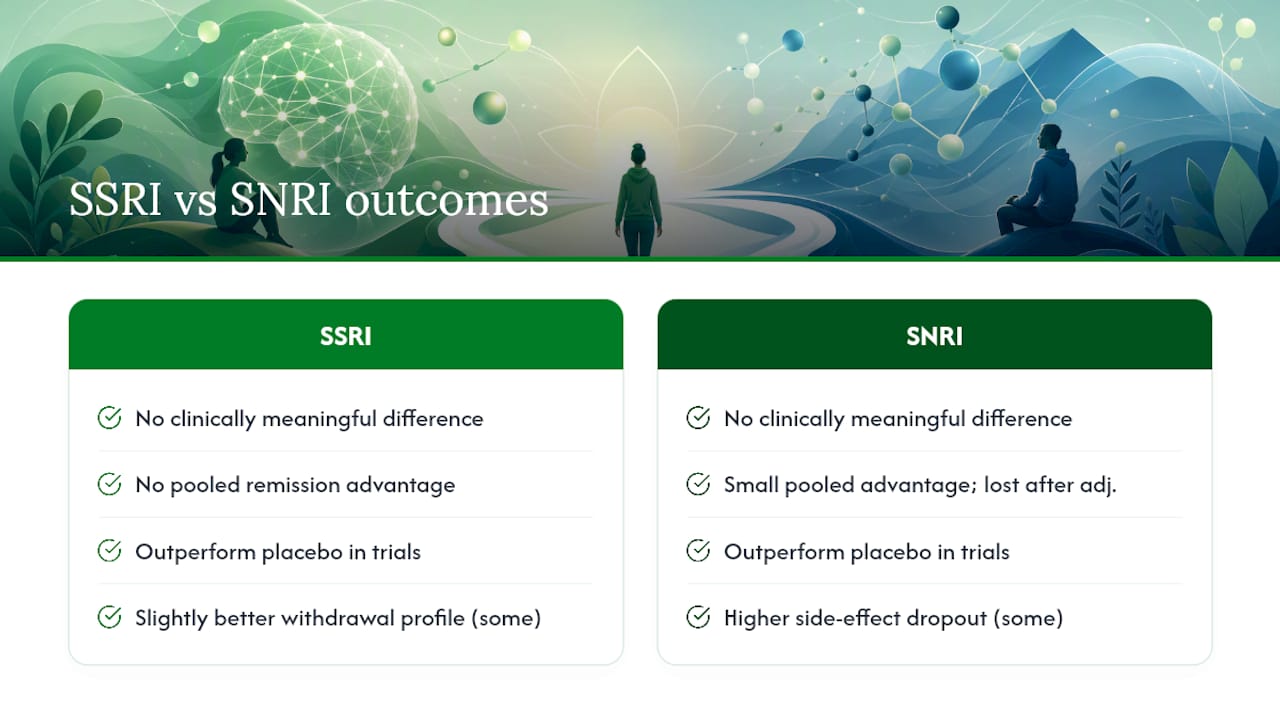
No. A major head-to-head meta-analysis found no clinically meaningful difference between SSRIs and SNRIs for major depressive disorder overall.
The finding in numbers: some pooled analyses showed a small remission advantage for SNRIs, but researchers judged the gap unlikely to matter clinically once they adjusted for publication bias. In other words, a statistically detectable edge on paper doesn’t translate into a noticeably better outcome for the average patient.
For generalized anxiety disorder, the picture is similar: pooled randomized trials show both classes outperform placebo, with SSRIs showing a slightly better withdrawal profile in some analyses and SNRIs showing higher dropout from side effects in others. Short trial durations and inconsistent reporting limit how far any of these numbers can be trusted.
Clinicians weigh several factors before writing that first prescription, and the decision usually looks like this:
Bring these questions to your own appointment:
Many people cycle through more than one medication before landing on something that works and feels tolerable. That’s normal, not a failure of the first choice.
Partial relief often shows up within a few weeks. Full effect at a therapeutic dose can take over a month, which is longer than most people expect.
Think of it as three checkpoints: week 0 is the starting dose, weeks 1 to 2 bring the early side effects that usually settle, and weeks 4 to 8 are when you and your prescriber judge whether it’s actually working.
Combining an SSRI or SNRI with another serotonergic drug, or with an MAOI, raises the risk of serotonin syndrome sharply. That combination is dangerous enough that MAOIs are treated as an absolute contraindication. SNRIs carry their own added flag: regular blood pressure checks, since even moderate doses can push readings up in some patients.
Pregnancy and breastfeeding decisions around either class should never happen in isolation. Coordinate with an obstetric provider before starting, stopping, or switching, since the risk calculus changes across trimesters.
Before assuming failure, confirm the dose was adequate and given long enough, usually the full 6 to 8 weeks. From there, options include:
Any switch should be planned around the current drug’s half-life, since some SNRIs and short half-life SSRIs carry a higher discontinuation risk if stopped too fast.
My take: the SSRI-versus-SNRI debate matters less than getting the symptom picture right and staying honest about tolerability. Persistence and consistent follow-up, more than the specific drug class, tend to separate people who find relief from those who give up too early.
Reading about mechanisms and side effects only gets you so far. What actually moves the needle is a clinician who reviews your specific symptoms, medication history, and cardiovascular risk before recommending SSRI or SNRI options tailored to you.

RoenRx connects you with licensed prescribers through secure messaging, without the weeks-long wait typical of in-person psychiatry scheduling. You can discuss your history, get a personalized plan, and have prescriptions delivered without leaving home. Start a telehealth consultation for anxiety and depression care to get a plan built around your actual symptoms rather than a generic starting point.
Doctors often reach for an SNRI when depression comes with chronic pain, low energy, or poor concentration, since the added norepinephrine effect can help with those symptoms beyond mood alone.
Venlafaxine has a reputation for a rougher discontinuation experience due to its short half-life, which is why clinicians taper it more slowly than many other antidepressants.
Venlafaxine and duloxetine both have strong evidence for anxiety disorders, though pooled trial data show SSRIs and SNRIs perform similarly overall for generalized anxiety disorder.
SNRIs carry a somewhat higher chance of elevated blood pressure and discontinuation symptoms, but neither class is inherently more dangerous when properly monitored by a clinician.
Yes. A licensed clinician through RoenRx can review your symptoms and history over secure messaging to recommend a starting medication and manage prescription delivery.