Yes, telehealth can diagnose and treat a urinary tract infection for most otherwise healthy adults. A clinician reviews your symptoms through a chat, phone, or video visit and can send antibiotics to your pharmacy the same day, often without requiring an in-person urine test. That’s not a loophole. It’s now backed by formal clinical guidance.
The Ann Arbor triage framework, developed by a RAND/UCLA expert panel, spells out exactly when a telehealth clinician can treat empirically and when someone needs to be routed to an in-person visit instead. A large retrospective study backs this up with real outcome data, and the CDC’s antibiotic stewardship guidance shapes how responsible telehealth providers decide who gets a prescription and who doesn’t.
Here’s what makes telehealth UTI treatment work when it’s done right:
If your symptoms sound routine, starting a visit is usually just a matter of filling out an intake form with your symptom history, allergies, and pharmacy of choice. If you’re not sure whether you fit the “routine” category, keep reading. The next few sections walk through exactly how the visit works, who should skip it, and what the evidence actually shows.
Telehealth safely diagnoses and treats routine UTIs for most healthy adults, but red flags and certain patient groups still require in-person evaluation.
| Point | Details |
|---|---|
| Telehealth works for classic symptoms | Otherwise healthy, nonpregnant adults with typical cystitis symptoms often qualify for same-day empiric antibiotics. |
| Red flags mean in-person care | Fever, flank pain, vomiting, or blood in urine require same-day in-person or emergency evaluation. |
| Age changes the risk | Adults aged 65 and older showed a higher adjusted failure risk via telehealth compared to primary care in one large study. |
| Prep speeds up your visit | Have your symptom timeline, allergy list, antibiotic history, and pharmacy details ready before starting intake. |
| RoenRx routes by risk, not convenience | RoenRx triages each case toward empiric treatment, testing, or in-person referral rather than defaulting to a prescription. |
The flow is more structured than people expect, and that structure is exactly why it works, as explained in Telehealth Mental Health Session Setup Made Easy – iMind Mental Health Solutions. It follows the same logical decision tree used in primary care triage, just delivered through a screen instead of a waiting room.
Here’s the typical sequence:
Timing is one of the biggest draws. Triage decisions often happen within minutes to a couple of hours, and same-day prescriptions are common for straightforward cases. Compare that to the typical urgent care visit, where you might wait an hour just to be seen.
Expect the clinician to ask about your specific symptoms (burning, urgency, frequency, suprapubic pain), whether you could be pregnant, any antibiotics you’ve taken recently, drug allergies, and how many UTIs you’ve had in the past year. Chronic conditions like diabetes or kidney disease usually come up too, since they change which antibiotics are safe.

Pro Tip: Before you start your intake form, pull up your pharmacy’s name, address, and phone number, plus a quick list of any medications you’re currently taking. Clinicians move faster when they don’t have to chase down basic details, and that shaves real time off your visit.
Telehealth works best for people whose symptoms fit a predictable pattern, and it works worst for people whose situation adds risk the clinician can’t fully assess through a screen. The Ann Arbor guidance draws that line based on sex, age, symptom pattern, and history, not just how bad you feel.
Good candidates for a virtual visit typically include:
In-person evaluation is usually the better call for:
Watch for signs that point toward a kidney infection rather than a simple bladder infection: fever, flank pain, nausea or vomiting, visible blood in the urine, or feeling generally unwell beyond the usual UTI discomfort. Any of those means same-day in-person care, not a telehealth queue.
The panel behind the Ann Arbor guidance used a formal scenario-rating process, the RAND/UCLA Appropriateness Method, to sort dozens of patient presentations into “treat empirically,” “test first,” or “see in person” categories. That level of rigor is part of why major health systems have started adopting it as a standard rather than a suggestion.
The short version: telehealth performs about as well as in-person primary care for most adults, with one notable exception. A 2025 retrospective cohort study comparing outcomes found no statistically significant difference in clinical failure between telehealth and primary care visits for average-risk patients.
The adjusted relative risk of treatment failure for telehealth versus primary care came in at 0.87 (95% CI: 0.70 to 1.08), meaning telehealth was not meaningfully worse for the typical patient. But the same study found a higher failure rate among patients 65 and older who were treated through telehealth, with an adjusted relative risk of 1.45 (95% CI: 1.12 to 1.87).
That age gap is the single most important nuance in the whole evidence base, and it’s exactly why guidance like Ann Arbor’s routes older adults toward in-person evaluation rather than a chat-based visit.
| Study Element | Finding |
|---|---|
| Comparison | Telehealth vs. primary care for UTI treatment |
| Overall failure risk (adjusted RR) | 0.87 (95% CI: 0.70, 1.08) |
| Failure risk in patients 65+ (adjusted RR) | 1.45 (95% CI: 1.12, 1.87) |
| Interpretation | No meaningful difference for average-risk adults; higher risk for older adults via telehealth |
Separate research on large direct-to-consumer telemedicine platforms found high agreement between what patients reported and what clinicians ultimately diagnosed, with nitrofurantoin as the most commonly prescribed antibiotic, a choice consistent with standard guideline recommendations. The same analysis flagged a real weak spot: urine culture collection was uncommon, and some higher-risk patients still received antibiotics without it.
That gap is exactly what antibiotic stewardship is meant to close. The CDC notes that a substantial share of outpatient antibiotic courses prescribed for suspected UTI turn out to be unnecessary, which is why standardized triage algorithms matter as much as speed. A well-built telehealth workflow doesn’t just get you a prescription fast. It’s built to stop one from being written when it isn’t actually warranted.
Pricing varies by provider and whether you’re paying out of pocket or through insurance, but virtual UTI visits are generally priced as a flat, disclosed fee rather than an open-ended bill. Some health system telehealth pages list visit fees around $39 for a straightforward virtual UTI consult, which gives you a rough sense of scale compared to an urgent care copay or an ER visit.
A few things shape what you’ll actually pay:
Once a prescription is approved, it’s typically e-prescribed straight to a local pharmacy for same-day pickup, or shipped to your home through a mail-order pharmacy partner. The main source of delay isn’t usually the telehealth visit itself. It’s pharmacy stock or, occasionally, a prior authorization requirement from your insurer. Reading through how prescriptions get filled after an online visit before you start can save you a surprise trip to a second pharmacy.
A little prep turns a 15 minute visit into a 5 minute one, and it also improves the odds that the clinician makes the right call on the first try.
When you describe your symptoms, specificity matters more than intensity. “Burning when I urinate, going every hour, and a dull ache above my pelvic bone since yesterday” gives a clinician far more to work with than “it really hurts down there.” The Ann Arbor triage model leans heavily on symptom-pattern specificity, so precise language is what actually gets you a faster, safer decision.
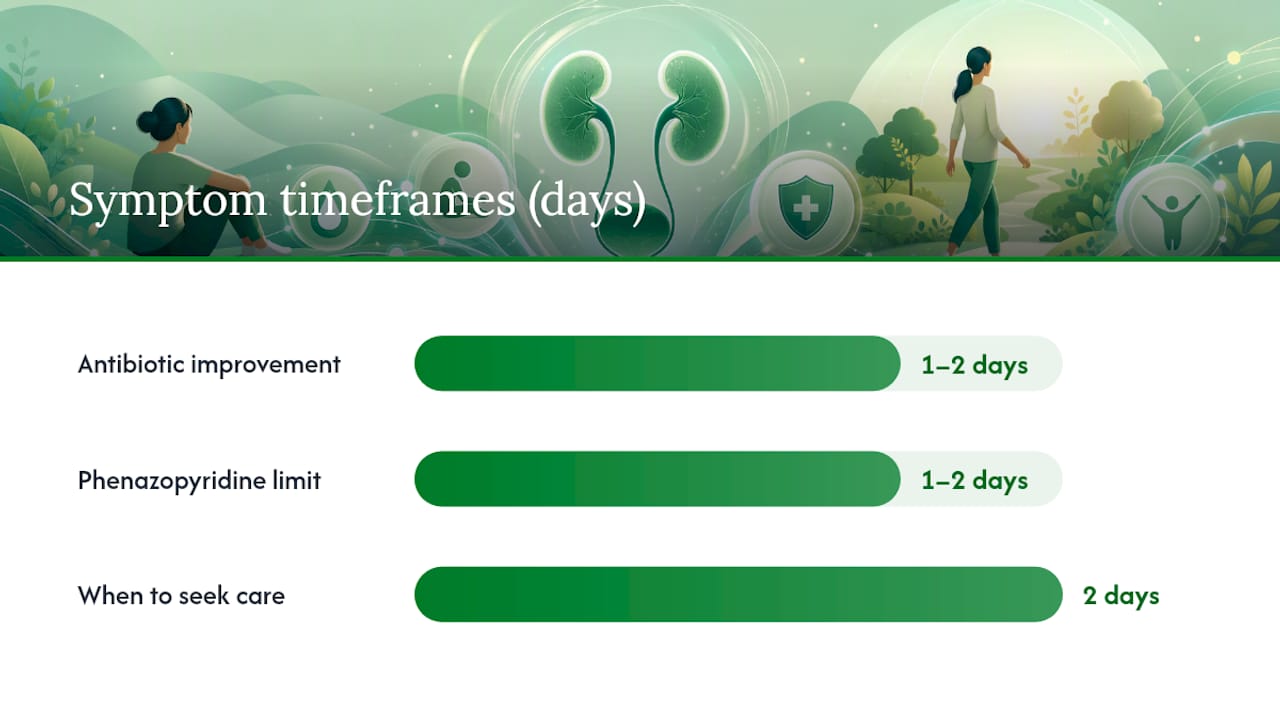
Antibiotics don’t work instantly, and most people notice meaningful improvement within one to two days of starting treatment, not the first dose. In the meantime, there’s a safe way to manage the discomfort.
If symptoms haven’t improved within two days of starting antibiotics, or if they get worse at any point, that’s your signal to seek additional care rather than wait it out. Fever, flank pain, or vomiting after starting treatment warrants same-day in-person evaluation, not a follow-up message the next morning.
Pro Tip: Keep a simple note on your phone tracking your symptoms day by day. If you need a follow-up visit, being able to say “burning was an 8 out of 10 on day one, down to a 3 by day three” gives your clinician something concrete to act on.
Telehealth for UTI care gets dismissed sometimes as a shortcut, but the data doesn’t support that framing for the average patient. What it actually is, when built correctly, is a faster front door into the same triage logic a good primary care clinic already uses.
RoenRx’s approach leans on that same triage logic rather than skipping it. Clinicians ask the same targeted questions an in-person visit would, route higher-risk patients toward testing or referral instead of a reflexive prescription, and keep pharmacy fulfillment simple so a same-day diagnosis doesn’t turn into a three-day wait for medication. The point isn’t to replace judgment with speed. It’s to remove the friction around a decision that, for most patients, doesn’t actually require an exam room.
Every visit runs on informed consent, and readers curious about exactly what that covers can review RoenRx’s telehealth consent policy before booking. Follow-up matters just as much as the initial visit. If symptoms don’t improve on schedule, that’s a message to your care team, not a reason to tough it out alone.
RoenRx built its UTI care pathway around the same principle behind everything else in this article: speed shouldn’t come at the cost of judgment. You start with an online intake covering your symptoms, history, and pharmacy preference, a licensed clinician reviews it, and if your case fits the profile for empiric treatment, your prescription goes out to your chosen pharmacy the same day, with home delivery available where it makes sense.
If your situation calls for testing or an in-person referral instead, that’s exactly what you’ll get. The goal is matching you to the right level of care, not pushing every visit toward a prescription. RoenRx offers both membership access for ongoing care needs and options for a single visit, with fees disclosed upfront so you’re not guessing what a prescription will ultimately cost.
If you’re dealing with UTI symptoms right now, you can start a visit through RoenRx and get matched with a clinician today. For a broader look at what RoenRx covers beyond urinary health, from primary care to prescription management, the full service overview is worth a look before you sign up.
This article is general information, not a substitute for advice from a qualified doctor. Consult a qualified healthcare professional about your own circumstances before acting on anything here.
Yes. For otherwise healthy, nonpregnant adults with classic symptoms and no recent antibiotic use, telehealth clinicians can often diagnose and prescribe antibiotics without an in-person visit, following triage guidance like the Ann Arbor framework.
A telehealth visit lets a licensed clinician evaluate your symptoms remotely and, if appropriate, send an antibiotic prescription to your pharmacy the same day. You still need a clinician’s evaluation, just not a physical exam room.
Conditions like yeast infections, interstitial cystitis, and certain sexually transmitted infections can cause similar burning or urgency without being a bacterial UTI, which is one reason clinicians ask detailed symptom questions before prescribing.
Many telehealth providers, including RoenRx, will prescribe antibiotics for a UTI when your symptoms and history fit an established empiric-treatment profile. If your case involves red flags or higher-risk factors, the clinician will typically order testing or refer you for an in-person visit instead.