The most common tirzepatide side effects are nausea, vomiting, diarrhea, constipation, decreased appetite, and injection-site reactions. Most occur during dose escalation and ease over time. The most important immediate actions: stay hydrated, eat smaller meals, and contact your clinician if symptoms are severe or persist beyond 48 hours.
Call your clinician if you experience:
Go to the ER immediately for:
To report a serious adverse event, use the FDA MedWatch online portal. Reporting helps the FDA track new safety signals for all patients.
Tirzepatide’s most common side effects are gastrointestinal, peak during dose escalation, and are manageable with dietary adjustments, hydration, and clinician-guided titration.
| Point | Details |
|---|---|
| GI events are dose-related | Trial rates: 20.4% on placebo, 37.1% at 5 mg tirzepatide, 39.6% at 10 mg, and 43.6% at 15 mg. |
| Timing: escalation phase | Most nausea, vomiting, and diarrhea occur during dose increases and typically ease at maintenance. |
| Serious red flags | Severe abdominal pain, neck lump, anaphylaxis, or confusion from low blood sugar require emergency care. |
| Home management works | Small meals, hydration, bland foods, and rotating injection sites reduce most common symptoms. |
| RoenRx telehealth support | RoenRx provides virtual initiation, titration check-ins, and messaging with clinicians to manage side effects safely. |
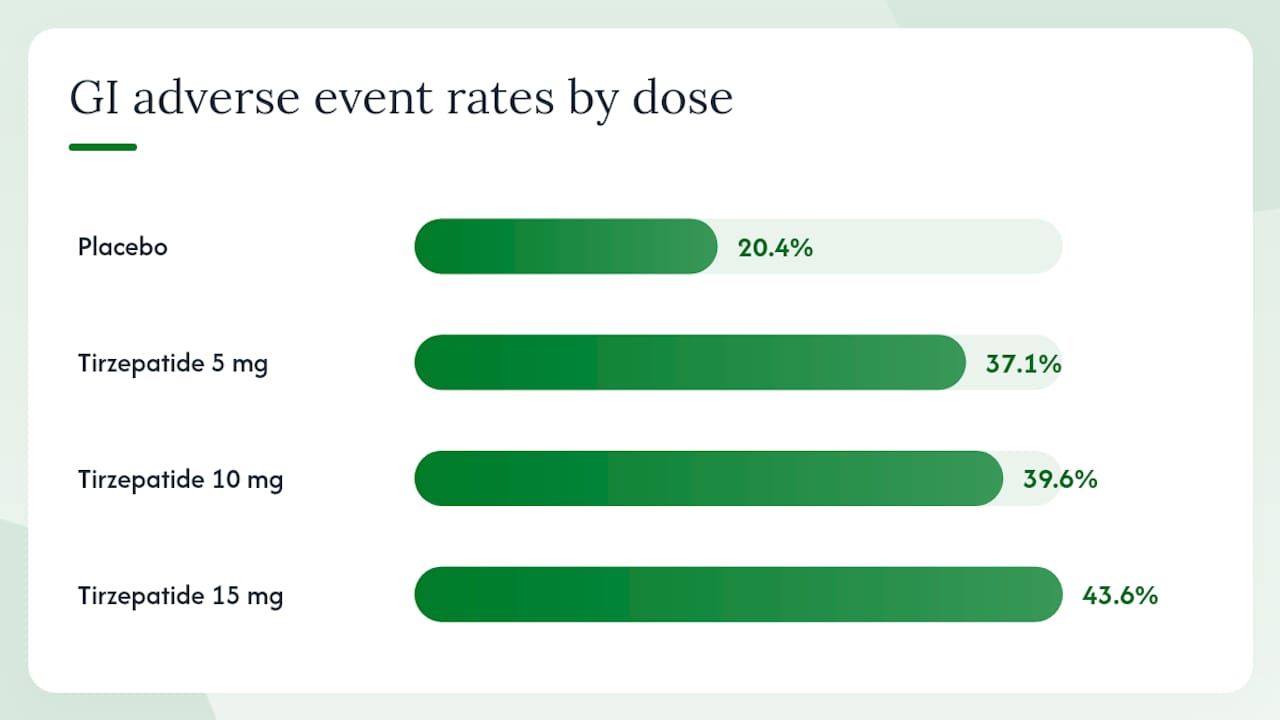
In pooled placebo-controlled trials, gastrointestinal adverse events occurred far more often on tirzepatide than on placebo: placebo 20.4%, Mounjaro 5 mg 37.1%, 10 mg 39.6%, and 15 mg 43.6%. The pattern is clear: higher doses bring higher rates, but the absolute jump from 5 mg to 15 mg is roughly 6 percentage points, not a dramatic cliff.
Discontinuation rates due to GI adverse reactions followed the same dose-dependent pattern, increasing with dose but remaining relatively low overall. That means the large majority of people on the highest dose tolerated it well enough to stay on therapy.
Timing matters as much as frequency. Most GI symptoms cluster during the escalation phase, when the body is adjusting to each new dose level. Once a maintenance dose is reached, many patients see a meaningful reduction in symptoms over the following weeks.
| Adverse Reaction | Tirzepatide (pooled) | Placebo |
|---|---|---|
| Nausea | Most common GI event | Lower rate |
| Diarrhea | Frequent, dose-related | Lower rate |
| Vomiting | Common during escalation | Lower rate |
| Decreased appetite | Reported across doses | Lower rate |
| Constipation | Reported across doses | Lower rate |
| Injection-site reactions | Mild, localized | Comparable |
Key figure: GI adverse events affected 20.4% of placebo patients, 37.1% at 5 mg, 39.6% at 10 mg, and 43.6% at 15 mg tirzepatide in pooled controlled trials, with most events occurring during dose titration.
For a deeper look at how the two U.S. brands compare on dosing and labeling, the Mounjaro vs. Zepbound breakdown covers the key differences.
Both Mounjaro (tirzepatide for type 2 diabetes) and Zepbound (tirzepatide for weight management) share the same active molecule, so their common adverse reaction profiles are nearly identical. A systematic review of tirzepatide adverse events confirmed that nausea, vomiting, dyspepsia, decreased appetite, and diarrhea are the most frequently reported effects across trials and postmarketing data.
Why these symptoms happen: Tirzepatide activates both GLP-1 and GIP receptors, which slows gastric emptying and suppresses appetite through central nervous system pathways. Food sits in the stomach longer, which triggers nausea, burping, and a feeling of fullness after small amounts. The intestinal effects explain loose stools or, paradoxically, constipation in some patients.
Common symptoms to expect:
Injection-site reactions deserve a specific note. Zepbound prescribing data shows that patients who develop anti-tirzepatide antibodies report injection-site and hypersensitivity reactions more frequently than those without antibodies, though most reactions are mild and localized. Rotating injection sites every week reduces local irritation. For technique guidance, the injection-site care guide for subcutaneous GLP-1 medications applies directly here.
Practical self-care for GI symptoms:
Dietary choices make a real difference. The guidance on what to eat during GLP-1 therapy maps directly to tirzepatide management.
Pro Tip: Schedule your weekly injection on a day when you can rest and eat lightly for the following 24 hours. Many patients find that timing the dose before a lower-activity day reduces how disruptive early nausea feels.
Most tirzepatide side effects are manageable. A smaller set require prompt medical attention, and a few are genuine emergencies.
Acute pancreatitis. The FDA prescribing information for Mounjaro includes a warning about pancreatitis, with postmarketing reports documented after approval. The warning sign is severe, persistent abdominal pain that often radiates to the back, sometimes with vomiting. Stop the medication and go to the ER.
Acute kidney injury (AKI). Postmarketing reports link severe GI adverse events (heavy vomiting or diarrhea leading to dehydration) with AKI. The mechanism is straightforward: dehydration reduces kidney perfusion. This is why hydration is not optional advice but a clinical priority.
Thyroid C-cell tumor risk. The FDA boxed warning for both Mounjaro and Zepbound flags a signal from rodent studies showing thyroid C-cell tumors at clinically relevant exposures. Whether this risk translates to humans is not yet established, but the warning is serious enough to make tirzepatide contraindicated in anyone with a personal or family history of medullary thyroid carcinoma (MTC) or Multiple Endocrine Neoplasia type 2 (MEN2). Watch for a lump or swelling in the neck, hoarseness, difficulty swallowing, or persistent shortness of breath.
Gallbladder disease. Rapid weight loss from any cause increases gallstone risk, and GLP-1/GIP receptor agonists may contribute independently. Symptoms include right upper abdominal pain, nausea after fatty meals, and jaundice.
Severe hypoglycemia. Tirzepatide alone rarely causes dangerous low blood sugar. The risk rises sharply when it is combined with insulin or sulfonylureas. Clinicians typically reduce insulin or sulfonylurea doses when starting tirzepatide.
Severe hypersensitivity and anaphylaxis. Rare but documented. Symptoms include hives, facial swelling, throat tightening, and difficulty breathing. Treat as an emergency.
Severe GI reactions and ileus. Rare cases of severe vomiting, constipation progressing to bowel obstruction, and ileus have been reported. Peer-reviewed case reports of unanticipated adverse events reinforce that while most adverse events are mild to moderate, unexpected serious events do occur post-approval and warrant clinical vigilance.
Red flag summary: Severe abdominal pain, neck lump, signs of anaphylaxis, or confusion from low blood sugar all require emergency care, not a wait-and-see approach.
ER now:
Call your clinician urgently:
If heading to the ER, bring a list of all current medications and recent labs. That information directly affects how clinicians assess pancreatitis, AKI, or hypoglycemia.
Absolute contraindications:
Precautions requiring clinician discussion:
Drug interactions that raise side-effect risk:
Clinician discussion prompts before starting:
Stepwise home management for common symptoms:
For nausea and vomiting:
For diarrhea:
For constipation:
For injection-site reactions:
When to call your clinician (not the ER, but do not wait):
When to go to the ER:
Pro Tip: Screenshot or print this checklist and keep it with your medication. At a telehealth visit, reading from a dated symptom log is far more useful to your clinician than trying to recall when symptoms started.
Stopping tirzepatide is not associated with classic withdrawal symptoms the way some medications are. There is no physical dependence in the pharmacological sense. What patients do experience is a return to baseline physiology, which can feel significant after months on the drug.
What typically happens after stopping:
Planning a safe stop:
There is no medically defined “tirzepatide withdrawal syndrome,” but the appetite and metabolic changes after stopping are real and worth planning for with your care team.
Reporting adverse events is not just a bureaucratic step. It is how the FDA detects new safety signals that were not visible in pre-approval trials. MedlinePlus provides clear instructions: report serious or unexpected side effects to FDA MedWatch at 1-800-FDA-1088 or online at fda.gov/medwatch.
Trusted U.S. sources for tirzepatide safety information:
For telehealth patients, three practical steps:
For context on how newer weight-loss peptides compare in terms of safety reporting, this overview of emerging GLP-1 class agents covers the broader post-approval safety communication landscape.
Most people starting tirzepatide think of the dose-escalation schedule as a calendar exercise: take 2.5 mg, wait four weeks, increase, repeat. The trial data tell a different story. The escalation phase is when the drug is most likely to cause problems, and it is also when most patients have the least contact with their prescribers.
That gap is where things go wrong. Dehydration from unmanaged vomiting becomes kidney injury. Nausea that could have been addressed with a dietary tweak or a short antiemetic course instead leads to a dose hold or discontinuation. The patients who do best are not necessarily those with the mildest side effects. They are the ones who communicate early and have a care team that responds quickly.
Telehealth changes that equation in a meaningful way. A brief message exchange two weeks after a dose increase costs almost nothing in time or effort, but it catches the patient who is quietly white-knuckling through nausea and skipping meals. That early intervention prevents the cascade: dehydration, electrolyte imbalance, kidney stress.
The thyroid and pancreatitis warnings deserve respect, not panic. The MTC signal comes from rodent data at high doses; human evidence is not established. Pancreatitis is rare. But both require that patients know the symptoms and act on them immediately rather than waiting to see if things improve. That knowledge is the whole point of a pre-treatment conversation with a clinician.
Shared decision-making before the first injection, a clear escalation plan, and a low-friction way to reach your care team during titration: those three things account for most of the difference between a smooth experience and a difficult one.
Managing tirzepatide well means having clinical support that matches the drug’s titration schedule, not just a prescription and a follow-up appointment three months later. RoenRx provides virtual initiation appointments, dose-by-dose titration follow-up, lab coordination, and direct messaging with your care team between visits.

For patients starting Mounjaro or Zepbound, that means a clinician reviews your baseline health, sets a titration plan suited to your history, and stays reachable when nausea, injection-site reactions, or blood-sugar questions come up at 10 PM on a Tuesday. Prescriptions are delivered to your door. No waiting rooms, no appointment delays. If you are ready to start or want to discuss whether tirzepatide is right for you, begin your online intake at RoenRx today.
This article provides general health information and is not a substitute for professional medical advice. Confirm current prescribing guidelines and your individual suitability with a licensed clinician or pharmacist.
The following primary and peer-reviewed sources informed this article. Check FDA updates regularly and report new or unexpected adverse events to MedWatch.
Prescribing information and regulatory sources:
Manufacturer patient resources:
Peer-reviewed literature:
Consumer health synthesis:
Nausea, diarrhea, vomiting, constipation, and decreased appetite are the most frequently reported tirzepatide side effects. They occur more often during dose escalation and typically ease once a stable dose is reached.
Avoid high-fat, greasy, and spicy foods, especially during dose increases, as they worsen nausea and GI discomfort. Also avoid skipping hydration, lying down right after eating, and combining tirzepatide with insulin or sulfonylureas without clinician-adjusted dosing.
Appetite returns to pre-treatment levels within days to weeks, and weight regain is common without sustained dietary changes. People with type 2 diabetes may need medication adjustments as blood glucose levels rise again after stopping.
Clinical trials show meaningful weight loss over months of treatment, with results continuing to accumulate through the titration period and beyond. Individual results depend on dose reached, dietary habits, and how well GI side effects are managed during escalation.
Tirzepatide is contraindicated for anyone with a personal or family history of medullary thyroid carcinoma or MEN2, and for those with known serious hypersensitivity to the drug. People who are pregnant, breastfeeding, or have significant kidney impairment or a history of pancreatitis need clinician evaluation before starting.