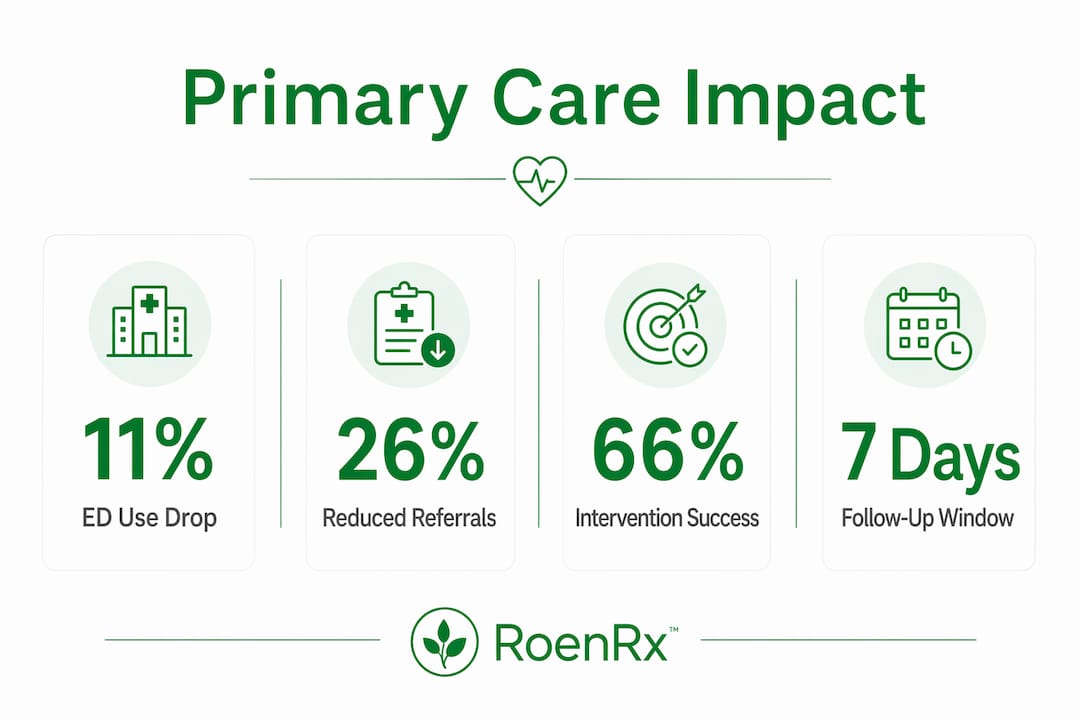
Adults with a regular primary care clinician are 11% less likely to visit the emergency department and 20% less likely to be hospitalized than those without one, according to a Milbank Memorial Fund analysis of 2016–2022 data. That gap is not a coincidence. Research from the Robert Graham Center, foundational work by primary care scholar Barbara Starfield, and CMS program evaluations all point to the same conclusion: consistent primary care prevents the kind of acute crises that send people to the ER in the first place. The core mechanisms are straightforward.
The evidence base here is unusually consistent. Across observational studies, natural experiments, and systematic reviews, one pattern holds: stronger primary care ties mean fewer emergency visits.
The Milbank Memorial Fund’s analysis of chronic-disease populations is the most direct U.S. data point. Adults with a usual source of primary care were 11% less likely to have an ED visit and 20% less likely to be hospitalized. Those numbers come from real-world utilization data spanning 2016–2022, not a controlled trial, which means they reflect actual patient behavior across a broad population.
A controlled natural experiment published in PLOS Medicine found a 26.4% reduction in patient-initiated ED referrals for minor problems when patients gained increased access to primary care. That study is notable because it isolated access as the variable, not just insurance status or demographics.
A retrospective study published in Medical Care examined community-based integrated primary care clinics that navigated uninsured patients into care. Those patients had roughly 29% fewer ED visits and 43% lower direct ED costs at one to two years compared with usual care. For a population with no regular source of care, those are large effects in a short window.
A PMC systematic review of non-ED interventions found that about two-thirds of studied interventions reduced ED use, with reductions ranging from 1% to 80% depending on the intervention type. Managed care models with primary care gatekeeping showed reductions in 10 of 12 studies. Patient education interventions showed the largest magnitude of reduction in any single study. The review also flagged that simply adding capacity without improving access coordination can have the opposite effect, a finding worth keeping in mind.
Government sources reinforce the picture. ODPHP literature summaries document that having a usual source of primary care increases receipt of evidence-based preventive services like blood pressure screening and immunizations, which in turn prevents some acute emergencies. CMS has built this logic into its transformation programs, explicitly targeting avoidable ED visits as a quality and cost metric.
Knowing the numbers is one thing. Understanding the mechanism is what makes the evidence actionable.
When a patient can book a same-day or next-day appointment, a lot of problems that would otherwise land in the ER get handled in the office instead. Ear infections, urinary tract infections, worsening asthma, blood pressure spikes — these are all primary-care-substitutable visits. The PLOS Medicine experiment showed that when booking friction fell, patients substituted primary care for minor ED visits at a measurable rate. Simply having a listed primary care physician is not enough if scheduling takes three weeks; the access has to be real and timely.

A clinician who has seen you six times over two years knows what your “normal” looks like. That relationship makes it far easier to catch a subtle change in breathing, a new medication interaction, or a gradual cognitive decline before it becomes a crisis. Multiple observational studies find that continuity of clinician correlates with lower ED use and hospitalizations, and the effect is stronger for patients with chronic conditions and older adults. Continuity also builds trust, which means patients are more likely to call the office first rather than defaulting to the ER at 10 PM.
Most avoidable ED visits are not random. They are the downstream result of a chronic condition that was not well controlled: a diabetic patient whose A1C drifted, a heart failure patient who gained five pounds of fluid over two weeks, a COPD patient who ran out of a maintenance inhaler. Primary care’s contribution to population health is built on exactly this: early management, medication optimization, and monitoring that intercepts problems before they require emergency intervention. Structured chronic disease management, including regular labs, medication reviews, and proactive follow-up, is the operational version of that principle.

Hospital discharge is one of the highest-risk moments in a patient’s care. Without a follow-up appointment within seven to fourteen days, patients frequently return to the ED with the same problem. Transitional care programs that connect patients to primary care immediately after discharge reduce both readmissions and ED returns. The same logic applies to specialty referrals: a primary care clinician who actively coordinates with cardiologists, endocrinologists, and behavioral health providers prevents the gaps where patients fall through and end up in the ER.
Patients who understand their conditions make better decisions about when to call the office versus when to go to the ED. A patient with heart failure who knows to weigh themselves daily and call if they gain more than two pounds in a day is far less likely to show up in the ER with acute pulmonary edema. Proactive primary care activities — self-management education, structured quality reviews, and post-hospitalization outreach — reduce the chance that an acute issue escalates to an emergency.
Pro Tip: Proactive outreach after hospital discharge is one of the highest-yield interventions in primary care. A phone call or telehealth visit within 48–72 hours of discharge catches medication confusion, identifies early warning signs, and dramatically reduces the chance of a bounce-back ED visit. Programs that formalize this step consistently show reductions in 30-day readmissions.
The research does not just describe mechanisms in the abstract. Several specific program types have been evaluated with measurable outcomes.
Integrated community-based primary care and navigation programs are among the most evidence-supported models for high-need populations. The Medical Care study of community-based clinics that actively navigated uninsured patients into primary care found roughly 29% fewer ED visits and 43% lower direct ED costs within one to two years. The key design feature was navigation: someone actively connecting patients to care, not just making a clinic available.
Patient-centered medical homes (PCMH) operationalize many of the mechanisms described above. Core PCMH attributes that reduce ED use include team-based care with care managers, open-access scheduling, proactive outreach for high-risk patients, and integrated behavioral health. The care manager role is particularly important for patients with multiple chronic conditions who would otherwise fall through the cracks between appointments.
Transitional care interventions focus specifically on the post-discharge window. Structured follow-up within seven days, medication reconciliation, and a clear point of contact for questions all reduce the probability of an ED return visit. These programs are well-supported in the literature and are increasingly embedded in value-based care contracts.
Telehealth and after-hours access address the time-of-day problem. Many low-acuity ED visits happen on evenings and weekends when primary care offices are closed. Extending access through telehealth or after-hours nurse lines gives patients an alternative that is faster, cheaper, and more appropriate for their problem.
One honest trade-off: expanding access meaningfully requires real capacity. The PLOS Medicine process evaluation found that a large access-expansion program added roughly 35 hours of appointments per week per practice, generating about 33,000 additional appointments and $4.8 million in costs while averting approximately 11,000 ED visits. The math can still favor expansion, but it requires upfront investment and workforce planning.
The benefits of primary care are not evenly distributed, and that asymmetry matters for policy and for individual patients.
Patients with chronic disease show the clearest and most consistent declines in ED use when they have a usual source of primary care. The Milbank analysis found the 11% lower ED odds specifically in adults with chronic conditions. Children with chronic illness show similar patterns. The more complex the condition, the more a consistent primary care relationship matters.
Uninsured and low-income populations stand to gain the most from navigation to primary care, precisely because they are the most likely to use the ED as a default. The Medical Care study focused on uninsured adults, and the effect sizes were substantial. Medicaid and Medicare populations also benefit, though access barriers within those programs, including appointment wait times measured in weeks in some markets, can blunt the effect.
Older adults benefit from continuity in particular. The combination of multiple chronic conditions, polypharmacy, and higher baseline risk means that a clinician who knows the patient’s history can prevent a disproportionate number of crises.
Equity considerations run through all of this. Minority and low-income populations are more likely to lack a usual source of care, more likely to face transportation and language barriers, and more likely to rely on the ED as their primary point of contact with the healthcare system. Targeted outreach, enrollment assistance, and removing structural access barriers produce outsized benefits precisely because the baseline gap is largest in these groups.
Having a usual source of primary care is not just a quality-of-life convenience. For patients with chronic disease, it is a measurable protective factor against the kind of acute crises that end in an emergency room visit. The populations who lack that source are the same ones who bear the highest burden of preventable ED use.
The headline numbers from the research pool give a concrete picture of what to expect.
| Study / Source | Population | Effect on ED Use | Follow-Up |
|---|---|---|---|
| Milbank Memorial Fund (2016–2022) | Adults with chronic disease, U.S. | 11% lower ED odds; 20% lower hospitalizations | Multi-year observational |
| Medical Care (BCC navigation program) | Uninsured adults | ~29% fewer ED visits; 43% lower direct ED costs | 1–2 years |
| PLOS Medicine (access experiment) | General primary care patients | 26.4% reduction in patient-initiated minor ED referrals | Program evaluation period |
| PMC systematic review | Multiple populations | 1%–80% reductions across intervention types | Varied |
A few things stand out in this data. First, the effects are real but not uniform. The 11% figure from Milbank reflects a broad chronic-disease population; the 29% figure from Medical Care reflects a targeted navigation program for uninsured adults, a higher-need group with more room to improve. Second, the timeline for seeing change is typically months to one to two years for program evaluations, not decades.
Cost implications follow a consistent pattern: short-term primary care expansion costs money upfront. The PLOS Medicine program added $4.8 million in appointment costs while averting roughly 11,000 ED visits. Whether that math works depends on how you value an averted ED visit, but ED visits are expensive, and the avoided downstream hospitalizations add further savings. The long-term cost case for primary care investment is well-supported in the literature.
The 11% lower ED odds for adults with chronic disease comes from a multi-year analysis of real U.S. utilization data — not a modeled projection.
Primary care handles a wide range of acute and chronic problems, but it is not a substitute for emergency care when the situation is genuinely urgent. Go to the ER or call 911 immediately for:
If you are not sure whether something is an emergency, call 911 or go to the nearest ED. Do not wait for a telehealth appointment or a callback when the situation could be life-threatening.
Pro Tip: Save your primary care clinician’s after-hours line in your phone. For situations that feel urgent but are not clearly life-threatening, a quick call can help you decide whether the ER is actually necessary — and often, it is not.
The evidence is strong, but it is worth being clear about what primary care cannot fix on its own.
Workforce shortages and appointment backlogs are the most immediate structural barrier. The U.S. faces a well-documented primary care physician shortage, and in many markets, getting a new-patient appointment takes weeks. Appointment backlogs and access friction are key drivers of ED reliance in Medicaid and managed care populations. Having insurance does not guarantee timely access.
Social determinants of health — transportation, housing instability, food insecurity, language barriers — drive ED use in ways that primary care alone cannot address. A patient who cannot get to a clinic, cannot take time off work, or cannot communicate with their clinician will use the ED regardless of what their insurance card says.
Behavioral and perceptual factors also matter. Some patients perceive the ED as faster or more thorough than a primary care visit. Others have had negative experiences with primary care and default to the ER out of distrust or habit. Changing those patterns requires more than just making appointments available.
Payment and reimbursement structures create their own distortions. Primary care is chronically underfunded relative to specialty and hospital care in the U.S. fee-for-service system. Clinicians who want to offer same-day access, care management, and proactive outreach often cannot afford to do so under standard reimbursement rates. Value-based care models that pay for outcomes rather than volume are a structural fix, but adoption is uneven.
The PMC systematic review found that about two-thirds of non-ED interventions reduced ED use, but one-third did not. Adding capacity without improving coordination can even increase ED use in some contexts. The evidence supports primary care investment strongly, but it also shows that implementation quality matters enormously.
The access problem is where telehealth has the clearest and most immediate impact. When a patient can see a clinician the same day from their phone, the calculus on whether to go to the ER for a minor problem changes completely. Virtual primary care services address the most common reason people end up in the ER for non-emergencies: they could not get a timely appointment anywhere else.
RoenRx operationalizes several of the mechanisms described in this article. Same-day virtual appointments address the access gap directly. Integrated messaging with care teams supports the continuity function — patients can ask questions, report worsening symptoms, or request medication adjustments without waiting for a scheduled visit. Primary care prescriptions and medication management through the platform address one of the most common drivers of avoidable ED visits: medication lapses and confusion.
For patients managing chronic conditions, the combination of on-demand access and ongoing messaging creates something close to the continuity model the research supports. A patient who can message their care team when their blood pressure spikes or their symptoms change is far less likely to end up in the ER with a preventable acute event.
Practical steps to use virtual primary care to avoid unnecessary ED visits:
One honest scope note: telehealth complements in-person and emergency care; it does not replace it. The red flags listed earlier in this article require in-person emergency evaluation regardless of telehealth availability.
Regular primary care measurably reduces avoidable ER visits through access, continuity, and chronic disease management, with the strongest effects in patients with chronic conditions.
| Point | Details |
|---|---|
| Chronic disease patients benefit most | Adults with chronic disease are less likely to have an ED visit with a usual source of primary care. |
| Navigation programs work fast | Community-based navigation for uninsured adults cut ED visits significantly within 1–2 years. |
| Access is the first lever | A considerable reduction in minor ED referrals followed increased primary care access in a controlled experiment. |
| Barriers limit scale | Workforce shortages, appointment backlogs, and social determinants mean primary care reduces but does not eliminate ED use. |
| RoenRx virtual primary care | Same-day virtual visits and integrated messaging address the access and continuity gaps that drive avoidable ER visits. |
The research on why primary care reduces ER visits is about as consistent as healthcare evidence gets. The mechanisms are well-understood, the effect sizes are meaningful, and the populations who benefit most are identifiable. What the literature also makes clear, though, is that the effect depends entirely on whether patients can actually get timely primary care when they need it.
That is the part most policy discussions underweight. Telling someone to “see their primary care doctor” when the next available appointment is six weeks out is not a solution. The studies that show the largest reductions in ED use are the ones that solved the access problem first, whether through navigation programs, open-access scheduling, or telehealth. The 11% lower ED odds from Milbank and the 29% reduction from the Medical Care navigation study both reflect situations where access was real, not theoretical.
For patients, the practical implication is this: the relationship with a primary care clinician is worth building before a health crisis, not during one. Continuity compounds over time. A clinician who has seen you twice is useful; one who has seen you twelve times over three years is genuinely protective.
Getting timely primary care is the single biggest factor separating patients who avoid the ER from those who end up there for a preventable problem. RoenRx makes that access concrete: same-day virtual appointments, direct messaging with your care team, and primary care prescriptions managed through one platform. No six-week wait, no driving across town, no sitting in a waiting room.

RoenRx is built for the access gap the research identifies. Chronic condition management, medication oversight, and on-demand visits for acute problems that do not require the ER — all available from your phone or computer. When symptoms change or a question comes up between visits, the messaging function keeps your care team in the loop without requiring a new appointment.
This is not a substitute for emergency care when you genuinely need it. But for the wide category of problems that primary care handles well, and handles better than the ER, getting started with RoenRx is a practical first step toward the kind of continuity the evidence supports.
This article is general health information, not medical advice. For your specific situation, consult a qualified healthcare professional or contact your primary care clinician directly.