Yes, Zepbound usually requires a prescriber-submitted prior authorization, and most insurers approve it fastest when the submission arrives complete the first time. That means dated BMI measurements, ICD-10 comorbidity codes, documented weight-management participation, a full prior-medication history, and a Letter of Medical Necessity attached from the start. Skip any one of those and the review clock resets.
TL;DR:
- Most insurance approvals require complete documentation on first submission, including recent BMI measurements, ICD-10 codes, and detailed weight management records.
- Insurers generally approve Zepbound when patients have a BMI of 30 or higher, or 27 with a qualifying comorbidity, but specific rules vary by plan.
- Clear, date-specific records of prior medication trials and participation in weight-loss programs significantly reduce denial risk.
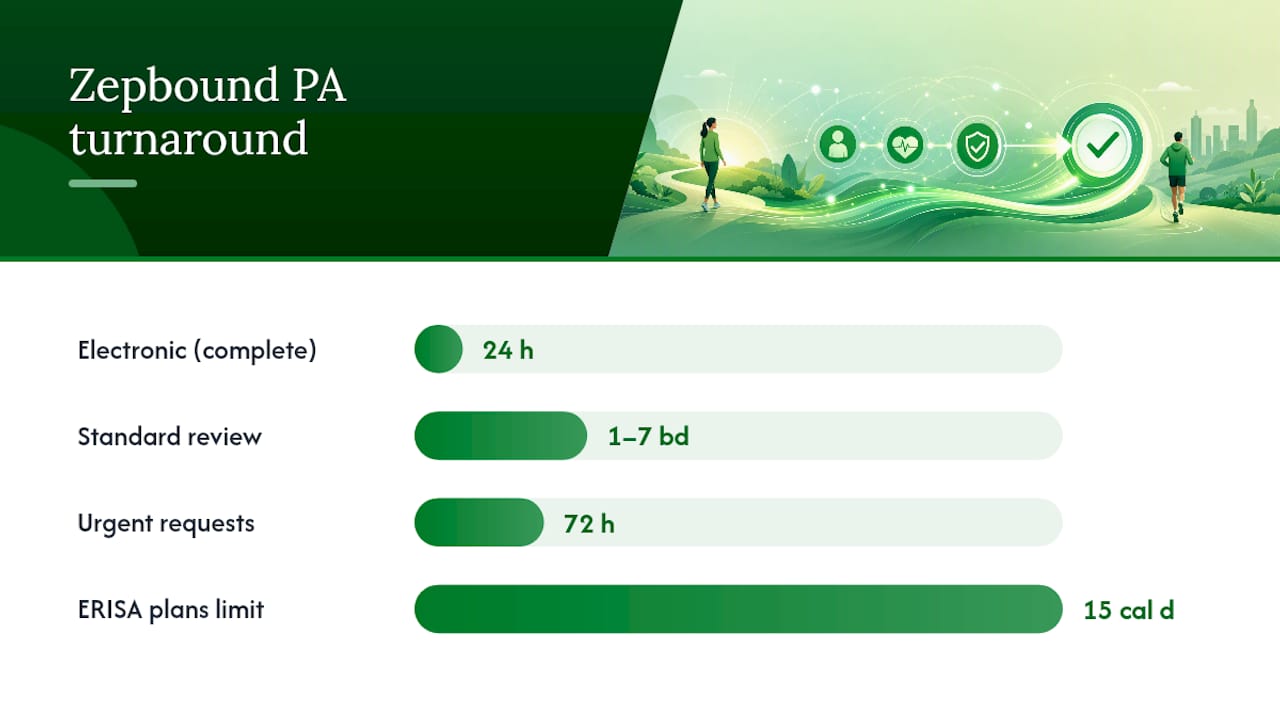
- Electronically submitted prior authorizations with all supporting documents can be approved within 24 hours to a week, with urgent requests responded to in three days.
- Denials often stem from missing or vague documentation; appealing requires attaching stronger evidence and detailed clinical rationale.
Most commercial plans use a two-track eligibility test, and it mirrors the clinical thresholds the CDC’s adult BMI categories define for obesity and overweight status. You clear the bar with a BMI of 30 or higher on its own, or a BMI of 27 or higher paired with at least one qualifying comorbidity.
Insurers accept a fairly consistent list of comorbidities, though the exact wording varies by plan:
Sleep apnea claims deserve special attention. Insurers reviewing Zepbound for OSA often want objective testing, not just a patient-reported diagnosis, so a polysomnography result or home sleep test score strengthens that specific pathway considerably. Obesity-only claims lean harder on the lifestyle-program documentation instead, while type 2 diabetes claims often want recent labs showing inadequate control on prior therapy.
None of this is universal. Every plan runs its own version of these rules through its pharmacy benefit manager, and some PBMs have pulled Zepbound from standard formularies entirely or added step-therapy requirements that push patients toward a different GLP-1 first. Check the specific plan’s formulary and PA policy before assuming any threshold applies. The AASM’s Zepbound Prior Authorization Resource Guide breaks down how these criteria differ across payers in more detail.
A prior authorization packet lives or dies on paperwork specificity. Vague notes get denied; dated, quantified records get approved. Here’s the sequence a prescriber’s office should follow when assembling the file:
Pro Tip: Insurers frequently reject a plain attestation like “patient tried diet and exercise” because it has no dates or metrics behind it. Attach actual visit notes or a program completion summary instead — that single swap resolves one of the most common denial triggers.
Lilly’s own Zepbound access and coverage resources include an LMN template built around this exact structure, which saves a prescribing office from drafting one from scratch.
Turnaround depends heavily on how the request gets submitted and how complete it is on arrival.
By the numbers: decision windows for Zepbound PA requests typically range from 24 hours up to 7 business days for standard review, tightening to 72 hours when the request is marked urgent.
Track status through the pharmacy, the insurer’s member portal, or the prescriber’s office, since all three usually see updates at slightly different times. If ten business days pass with no word, call the insurer directly and ask for the reference number and the specific reason for the delay before assuming a denial.
Most Zepbound denials trace back to a documentation gap rather than a genuine ineligibility finding. Before drafting an appeal, read the denial letter line by line and match it against what was actually submitted.
Once the gap is identified, the appeal process follows a fairly standard sequence: gather the missing records, attach a stronger LMN with explicit clinical rationale tying the diagnosis to the treatment, and request a peer-to-peer review between the prescriber and the plan’s medical director if the denial persists. Healthcare outlines patient rights during this process, including internal and external review options.
If the denial cites a formulary exclusion or step-therapy requirement rather than a documentation problem, the fix looks different. That calls for a formulary exception request, which needs to show medical necessity for Zepbound specifically over the plan’s preferred alternative, often by documenting a prior failed trial of that alternative or a contraindication to it.
A clean prior authorization submission depends on both sides showing up prepared. Here’s how to split the work.
Before the appointment, patients should bring:
The prescriber’s office should, in turn:
Telehealth visits add one extra step worth planning for in advance: getting outside records transferred before the visit, not after. Pro Tip: Ask your telehealth provider’s team to request prior primary-care records and program documentation the same day you schedule your intake. That head start is often the difference between a same-week PA submission and a two-week delay while records get chased down.
The manufacturer and government sources below carry the actual forms and policy language cited throughout this guide.
Prior authorization delays almost always come from fragmented records: one clinic has the labs, another has the sleep study, and nobody has pulled it together into one packet. RoenRx’s model addresses that directly through same-day visits, in-app messaging with the care team, and a documentation workflow built to collect outside records before the prescriber ever drafts the LMN. When a prescriber has everything in one place from the first visit, the submission goes out complete instead of piecemeal, which is the single biggest lever over approval speed.
— Bryan
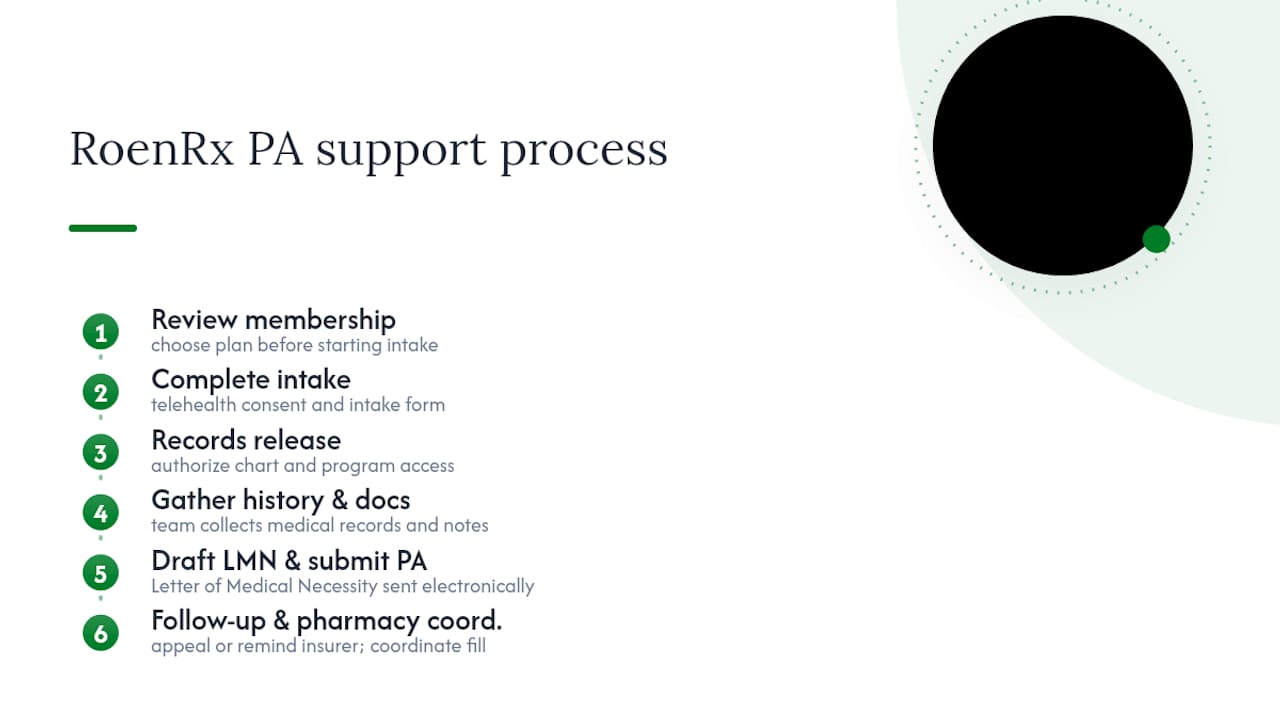
RoenRx handles the parts of this process that eat the most time: intake, documentation collection, LMN drafting, electronic PA submission, and coordinating with the pharmacy once approval comes through. Instead of juggling records between a primary care office, a specialist, and an insurer’s portal, you work with one care team that already knows what the PA packet needs.
This fits best for U.S. adults who want a coordinated telehealth path to Zepbound without chasing down their own chart notes and program records from three different providers. RoenRx’s team gathers your medical history, drafts the Letter of Medical Necessity, and submits the prior authorization electronically, then follows up if the insurer stays silent past the expected window. If you’ve tried a different GLP-1 before, RoenRx can also help document that history to strengthen a Zepbound versus alternative comparison for the insurer.
Start by reviewing RoenRx’s membership options and completing intake, which includes telehealth consent and a records-release step so your care team can begin building your PA packet right away.
This article is general information, not a substitute for advice from a qualified doctor. Consult a qualified healthcare professional about your own circumstances before acting on anything here.
Submit a PA with a documented obstructive sleep apnea diagnosis, ideally backed by polysomnography or a home sleep test score, plus the ICD-10 code G47.33 and a Letter of Medical Necessity connecting the OSA diagnosis to expected treatment benefit.
State Medicaid programs set their own formulary and PA rules independently, so requirements vary widely by state; check the specific state Medicaid drug coverage page or CMS resources for the current policy.
Most complete electronic submissions get a decision in 24 hours to 7 business days, urgent requests within 72 hours, and ERISA-regulated plans are capped at 15 calendar days for standard requests.
Missing or undated documentation, especially lifestyle-program participation records without visit notes or dates, is the most frequent and most correctable cause of denial.
Yes, RoenRx’s care team collects documentation, drafts the Letter of Medical Necessity, and submits the prior authorization electronically as part of its Zepbound intake process.