Buspirone is an FDA-approved treatment for generalized anxiety disorder (GAD) and a legitimate non-addictive alternative to benzodiazepines — if you have GAD and need long-term symptom control without sedation or dependence risk, it deserves a serious conversation with your clinician. RoenRx offers telehealth evaluations that can determine whether buspirone fits your situation, without the wait of a traditional psychiatry referral.
Buspirone works best for people who:
A few things to know upfront: buspirone is not a rescue medication. It will not calm a panic attack in the moment. The FDA maximum dose is 60 mg/day, and drug interactions — particularly with CYP3A4 inhibitors and other serotonergic agents — require a thorough medication review before starting.
Buspirone is an FDA-approved, non-addictive treatment for GAD that requires consistent daily dosing and 2–4 weeks before anxiolytic effects appear, making clinician oversight and realistic expectations the two most important factors in successful treatment.
| Point | Details |
|---|---|
| Primary indication | Buspirone is FDA-approved for GAD; not effective for panic disorder or as-needed use. |
| Onset timeline | Anxiolytic effects typically appear in 2–4 weeks; full response may take 8–12 weeks. |
| Dosing range | Start at 7.5 mg twice daily; therapeutic range is 20–45 mg/day; FDA max is 60 mg/day. |
| Key safety checks | Review all medications for CYP3A4 and serotonergic interactions; avoid grapefruit juice; disclose substance-use history. |
| RoenRx telehealth | RoenRx offers same-day virtual evaluations for anxiety, with prescription delivery and follow-up monitoring built in. |
Buspirone, sold under the brand name BuSpar, is an azapirone-class anxiolytic. Unlike benzodiazepines (think diazepam or lorazepam) or SSRIs, it belongs to its own pharmacological category. The FDA approved it specifically for anxiety disorders, with GAD as the primary indication.
Clinically, buspirone tends to occupy a second-line position. Most guidelines recommend SSRIs or SNRIs as first-line pharmacotherapy for GAD. Buspirone steps in when SSRIs are not tolerated, when benzodiazepines are inappropriate, or when a clinician wants to augment an existing antidepressant without adding dependence risk. The Psychopharmacology Institute positions it explicitly as a second-line option when SSRIs fail or benzodiazepines are contraindicated.
Where buspirone fits well:
Where it does not fit:
The UW Psychiatry Consultation Line reinforces this: clinicians often choose buspirone specifically because it lacks abuse potential, making it a safer long-term option when preventing secondary dependence is a high priority.
Buspirone is a partial agonist at the 5-HT1A serotonin receptor. That phrase matters more than it sounds. Partial agonism means it activates the receptor, but not fully — it modulates serotonin activity rather than flooding the system. Over time, this recalibrates the serotonin signaling that drives chronic anxiety.
Here is the key contrast with other options:
The practical implication: buspirone is a foundation medication. It builds anxiolytic effect gradually, which is exactly why it cannot substitute for a benzodiazepine in an acute crisis — but also why it can be taken daily for months without the tolerance and withdrawal concerns that complicate long-term benzodiazepine use.
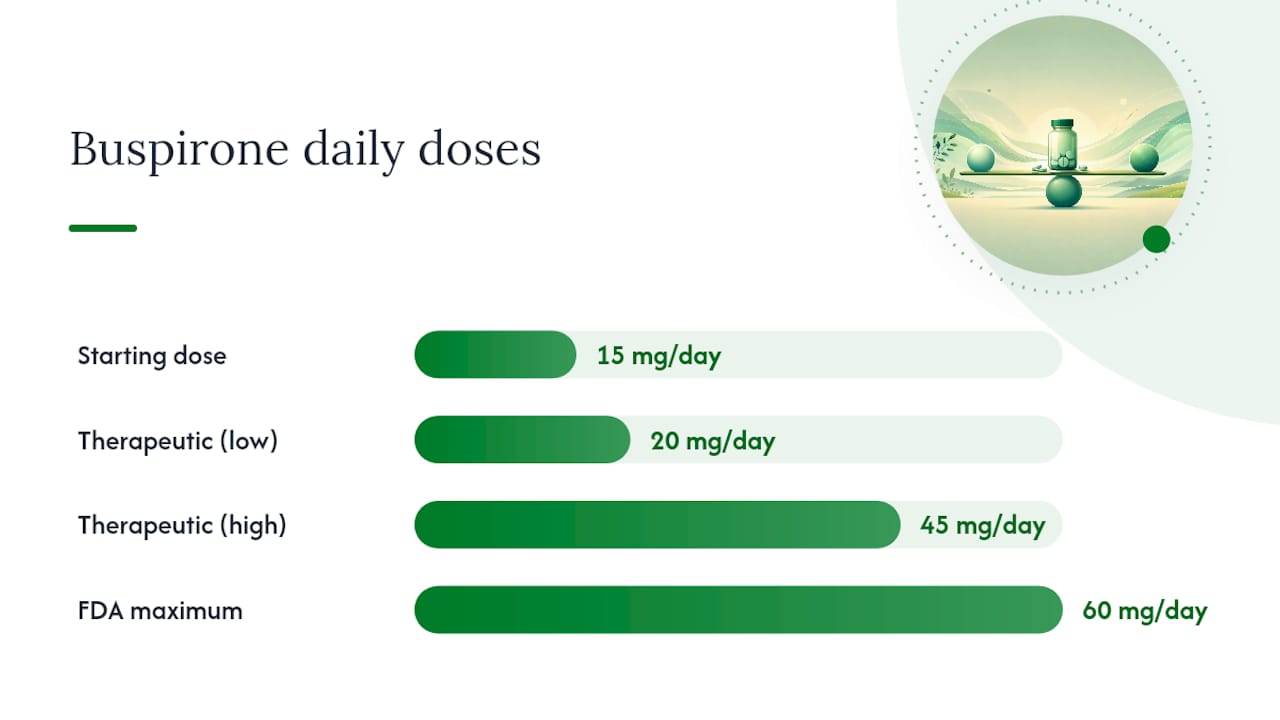
Therapeutic doses of buspirone commonly fall between 20–45 mg/day, with the FDA ceiling at 60 mg/day.
Starting low and titrating slowly is standard practice. Mayo Clinic guidance recommends beginning at 7.5 mg twice daily, with the clinician adjusting every few days as tolerated.
| Parameter | Details |
|---|---|
| Starting dose | A typical low starting dose taken twice daily |
| Titration | Increase by 5 mg every 2–3 days as tolerated |
| Common therapeutic range | 20–45 mg/day |
| FDA maximum dose | 60 mg/day |
| Dosing schedule | BID or TID (three times daily) |
| Half-life consideration | Short half-life often requires TID dosing at higher doses |
Because buspirone has a short half-life and undergoes significant first-pass hepatic metabolism, skipping doses or taking it erratically produces inconsistent blood levels — which translates directly to inconsistent symptom control. Some patients do better on a three-times-daily schedule at higher doses for this reason.
Practical administration notes:
Pro Tip: Set a phone alarm for each dose time and decide on day one whether you will always take buspirone with a meal or always on an empty stomach. That single habit prevents the blood-level swings that make the medication feel like it is not working.
The most common reason people quit buspirone too early is unmet expectations. Clinical anxiolytic effects typically appear in 2–4 weeks, and some patients need 8–12 weeks at a therapeutic dose before experiencing the full benefit. That timeline is not a sign the medication is failing — it reflects how 5-HT1A receptor modulation works.
Clinicians typically track response using validated tools like the GAD-7 (a seven-question self-report scale) or the Hamilton Anxiety Rating Scale (HAM-A). A reasonable follow-up cadence is every 2–4 weeks during titration, then monthly once a stable dose is established.
When to reassess or consider switching:
| Feature | Buspirone | Benzodiazepines | SSRIs |
|---|---|---|---|
| Onset of anxiolytic effect | 2–4 weeks | Minutes to hours | 2–6 weeks |
| Dependence risk | Very low | High with chronic use | Low |
| Sedation | Minimal | Significant | Variable |
| Appropriate for acute rescue | No | Yes | No |
| Long-term use | Yes | Caution | Yes |
One nuance worth knowing: patients who have recently been on benzodiazepines may find buspirone less effective initially. The 5-HT1A receptor system takes time to re-sensitize after GABA-dominant pharmacotherapy. Clinicians often allow a washout period before starting buspirone in this scenario.
Most people tolerate buspirone reasonably well. The side effect profile is notably cleaner than benzodiazepines in terms of cognitive and psychomotor impairment. That said, adverse effects do occur, and a few warrant prompt attention.
Common side effects (reported frequently in clinical trials):
These often improve within the first 1–2 weeks as the body adjusts. Taking buspirone with food can reduce nausea.
Less common but notable:
Clinicians should monitor young adults for new or worsening suicidal ideation when initiating any anxiolytic or antidepressant therapy, consistent with FDA black-box guidance for this age group. If you or someone you know experiences sudden mood changes, increased agitation, or thoughts of self-harm after starting buspirone, contact a clinician immediately.
When to seek urgent care:
Buspirone does not cause the respiratory depression associated with benzodiazepines, which is one reason it is considered safer for patients with certain medical histories — but it is not without risk, particularly when combined with other medications.
Before starting buspirone, a complete medication review is non-negotiable. The most clinically significant interactions fall into four categories.
Major interaction categories:
Grapefruit juice inhibits CYP3A4 in the gut wall and can meaningfully increase buspirone blood levels. Patients should avoid it or consume it consistently and inform their clinician.
Contraindications and precautions to flag:
What your clinician should ask during evaluation:

The evidence base for buspirone in GAD is older but consistent. Randomized controlled trials from the 1980s and 1990s demonstrated efficacy for GAD roughly comparable to benzodiazepines, with a more favorable side-effect profile for long-term use. The UW Psychiatry Consultation Line cites these trials and notes average therapeutic doses of 20–45 mg/day — a range that aligns with current prescribing practice.
Guideline positioning places buspirone as second-line to SSRIs, primarily because SSRIs also treat comorbid depression and have a broader evidence base across anxiety subtypes. Buspirone’s advantage shows up in specific clinical scenarios:
For a broader comparison of antidepressant options for anxiety, the Wellbutrin vs. Zoloft comparison covers how different agents stack up when SSRIs are the primary consideration.
Pro Tip: When combining buspirone with an SSRI, start buspirone at the lowest dose and titrate slowly. Monitor for signs of serotonin syndrome at each follow-up — particularly agitation, tremor, and diaphoresis — especially in the first 4 weeks of combination therapy.
Clinical anxiolytic effects from buspirone typically appear in 2–4 weeks, with full response sometimes requiring 8–12 weeks at a therapeutic dose of 20–45 mg/day.
Getting started requires a proper clinical evaluation — not just a prescription. Here is what to prepare and what to expect.
Appointment checklist:
How prescriptions typically work:
Cost and insurance notes: Buspirone is available as a generic, which keeps costs low at most pharmacies. Check GoodRx or your insurance formulary for current pricing — cash prices for generic buspirone are often under $20 per month at major pharmacy chains.
Telehealth is a practical option for most buspirone evaluations. GAD is well-suited to virtual assessment, and follow-up visits can happen via messaging or video without the scheduling delays of in-person psychiatry. Use this telehealth mental health checklist to prepare for your first virtual visit. If your situation involves complex comorbidities or recent psychiatric hospitalization, in-person evaluation is the safer starting point.
Buspirone gets underused, and the reason is almost always the same: patients expect it to feel like something. Benzodiazepines produce a noticeable effect within an hour. Buspirone produces nothing you can feel acutely — which leads many people to conclude it is not working and stop before it has had a real chance.
The framing matters enormously here. Buspirone is not a drug you take and feel. It is a drug you take consistently for weeks and then notice, one day, that the baseline hum of anxiety has quieted. That is a fundamentally different experience than rescue medication, and patients who understand that distinction upfront are far more likely to stay on it long enough to benefit.
The population where buspirone genuinely shines is also underappreciated. For someone with GAD and a history of alcohol use disorder, the calculus is not even close: a non-scheduled, non-addictive anxiolytic with a clean long-term safety profile is almost always the right call. The untreated anxiety that results from avoiding all pharmacotherapy because of addiction concerns carries its own serious risks.
One practical note on combination therapy: adding buspirone to an SSRI is a reasonable move when residual anxiety persists at an adequate SSRI dose, but it requires patience. The combination does not produce synergy overnight. Give it 6–8 weeks before concluding it has not helped.
If you have read this far and think buspirone might be worth discussing, the main barrier for most people is access — not the medication itself. Traditional psychiatry referrals can take weeks or months. RoenRx connects you with an experienced clinician via a same-day or next-day virtual visit, reviews your full history, and, if appropriate, issues a prescription with delivery directly to your door.

The workflow is built for this: intake covers your symptom history, current medications, and relevant health background. Your clinician evaluates whether buspirone fits your clinical picture, explains the titration plan, and schedules follow-up to monitor your response. No waiting room, no referral chain. You can review what a telehealth visit involves at the RoenRx telehealth consent page before you book. For anxiety care specifically, visit the RoenRx anxiety prescriptions page to start your intake today.
The clinical guidance in this article draws from the following primary sources:
Buspirone is a well-established, FDA-approved option for generalized anxiety disorder and is particularly useful for patients who need a non-addictive, non-sedating long-term treatment. It is less effective for panic disorder or situational anxiety and does not work as a rescue medication.
Clinical anxiolytic effects typically appear within 2–4 weeks of starting buspirone at a therapeutic dose, with some patients needing up to 8–12 weeks for full benefit. It produces no meaningful acute effect, so it is not suitable for immediate anxiety relief.
SSRIs and SNRIs are generally preferred as first-line pharmacotherapy for GAD because they also address comorbid depression and have a broader evidence base across anxiety disorders. Buspirone is second-line, used when SSRIs are not tolerated or benzodiazepines are contraindicated.
The most common downsides are the delayed onset (weeks before noticeable relief), the need for consistent twice- or three-times-daily dosing, and reduced effectiveness in patients recently using benzodiazepines. Common side effects include dizziness, nausea, and headache, particularly early in treatment.
Yes. GAD is well-suited to virtual evaluation, and clinicians at telehealth services like RoenRx can assess your history, prescribe buspirone if appropriate, and manage follow-up remotely. Visit the RoenRx anxiety prescriptions page to start an intake.
This article provides general health information and is not a substitute for professional medical advice. Consult a qualified clinician or pharmacist before starting, stopping, or changing any medication. Confirm current prescribing guidelines with your provider or the FDA.