Untreated anxiety is defined as an anxiety disorder that receives no professional intervention, and it reliably worsens over time through biological and behavioral reinforcement. Anxiety disorders affect about one-third of US adults, making this one of the most common and most neglected mental health conditions in the country. The core problem is not just that symptoms persist. Without treatment, anxiety actively recruits your brain and body into patterns that make recovery harder with every passing month. Understanding why untreated anxiety worsens is the first step toward breaking that cycle.
Anxiety starts as an adaptive response. At moderate levels, it sharpens focus and improves performance. The Merck Manual describes an efficiency curve where anxiety becomes maladaptive once it crosses a threshold, impairing both cognition and physical functioning. The problem is that most people never recognize when they have crossed that line.
The primary driver of escalation is avoidance behavior. When anxiety makes a situation feel threatening, the natural response is to avoid it. That avoidance brings short-term relief, which teaches the brain that the threat was real. Avoidance reinforces fear pathways, shrinks your comfort zone, and makes the original trigger feel even more dangerous the next time you encounter it. Over months and years, the list of situations you can tolerate without panic gets shorter and shorter.

Chronic stress compounds this by flooding the body with cortisol. Prolonged cortisol production causes systemic inflammation, which creates a feedback loop where the body stays in a state of physiological alarm even when no real threat exists. The brain then habituates to this elevated state and treats it as normal, which is perhaps the most insidious part of the progression. When high anxiety feels like your baseline, you stop recognizing how impaired you actually are.
Self-medication makes the cycle worse. Many people turn to alcohol or nicotine to blunt anxiety symptoms. Substances like alcohol create rebound anxiety that elevates baseline anxiety once the substance wears off, while simultaneously increasing dependency risk. The short-term relief is real. The long-term cost is a higher floor of anxiety and a new addiction to manage.
Key mechanisms that drive escalation:
Pro Tip: If you notice your “normal” feels more tense than it used to, that shift is a clinical signal, not a personality trait. Anxiety that feels ordinary is often anxiety that has been untreated long enough to become your baseline.
The physical consequences of ignoring anxiety are not secondary effects. They are direct outcomes of a stress response that never fully shuts off. The cardiovascular system takes the hardest hit. Chronic anxiety increases risk of cardiovascular disease, hypertension, and in severe cases, premature mortality. That is not a metaphor for feeling stressed. It is a measurable increase in arterial inflammation and blood pressure driven by sustained cortisol exposure.
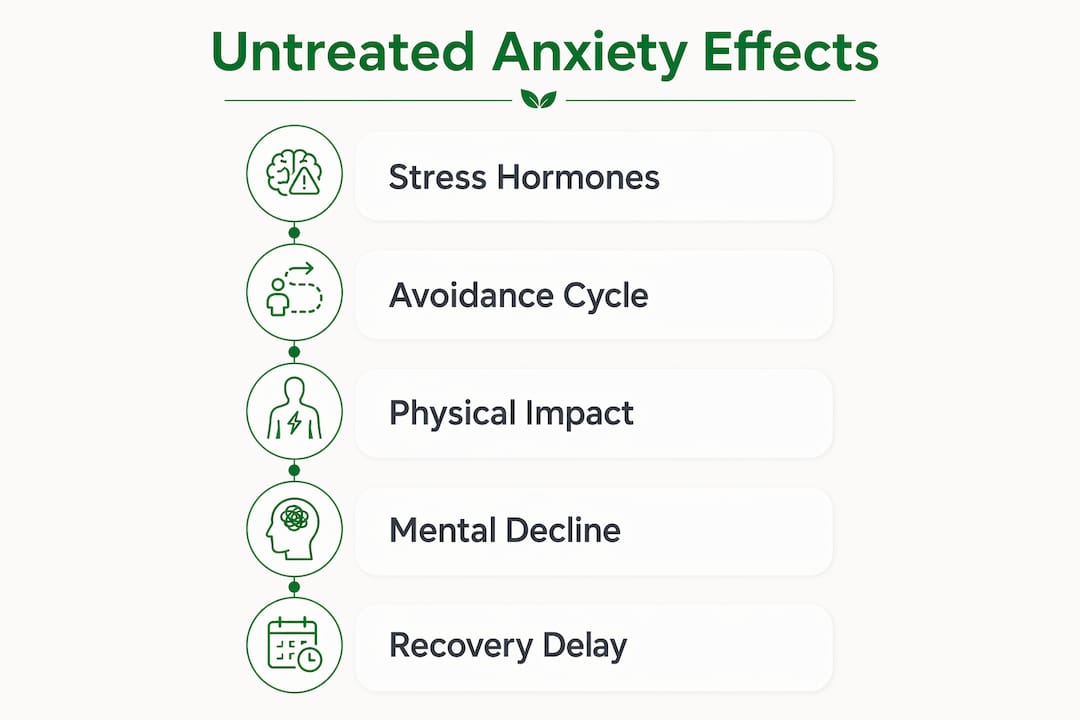
Sleep is another early casualty. Anxiety activates the sympathetic nervous system, the same system responsible for the fight-or-flight response, making deep sleep physiologically difficult. Poor sleep then raises cortisol levels the next day, which feeds more anxiety. The cycle is self-sustaining and gets harder to interrupt the longer it runs.
Physical symptoms that accumulate with untreated anxiety include:
The connection between anxiety and heart health is well documented and often underestimated. People who want to understand the anxiety-cardiovascular link in greater depth will find that the mechanisms overlap significantly with other stress-related conditions. The body does not compartmentalize anxiety. Every system pays a share of the cost.
Learning daily anxiety management strategies can reduce the physiological burden before it compounds into chronic illness. The earlier those strategies are applied, the less physical damage accumulates.
The effects of untreated anxiety on daily functioning are gradual enough that most people adapt around them rather than address them. Concentration drops first. Anxiety floods working memory with threat-related thoughts, leaving less cognitive bandwidth for tasks that require focus. Work performance suffers, deadlines feel harder to meet, and small decisions start to feel disproportionately stressful.
Social life contracts next. Anxiety makes social situations feel risky, so people withdraw. That withdrawal reduces the social support that buffers against depression, creating a compounding problem. People with untreated anxiety disorders are at least twice as likely to develop major depression. That statistic reflects a real clinical pattern where one untreated condition creates the conditions for a second.
The consequences of ignoring anxiety in daily life include:
The false belief that anxiety can be managed through willpower or avoidance is one of the most damaging misconceptions in mental health. Avoidance-based coping does not reduce anxiety over time. It teaches the brain that the world is more dangerous than it is, and that lesson gets harder to unlearn with each repetition.
The clinical concept of duration of untreated illness, known as DUI, measures how long a person lives with a disorder before receiving treatment. Shorter DUI significantly improves prognosis, and reducing the gap between onset and treatment is now a health policy priority in psychiatry. Every month of untreated anxiety is not neutral time. It is time during which the brain is learning and reinforcing patterns that make recovery slower.
Early treatment works through several mechanisms:
Medications and behavioral therapies each have strong evidence bases. Exploring anxiety medication options early gives people more choices before symptoms become severe enough to require more intensive intervention.
Pro Tip: You do not need to be in crisis to seek treatment. The best time to address anxiety is before it has reshaped your daily life. Waiting for a breaking point is itself a form of avoidance.
Untreated anxiety worsens through reinforcing biological and behavioral cycles that become harder to interrupt the longer they run, making early professional intervention the single most effective way to protect both mental and physical health.
| Point | Details |
|---|---|
| Avoidance drives escalation | Each avoided situation strengthens fear pathways and shrinks your tolerance over time. |
| Physical health is directly at risk | Chronic cortisol from untreated anxiety raises cardiovascular disease and hypertension risk. |
| Depression risk doubles | People with untreated anxiety are at least twice as likely to develop major depression. |
| DUI predicts outcomes | Shorter duration of untreated illness directly improves recovery prognosis. |
| Early treatment interrupts the cycle | Behavioral therapy and medication work best before anxiety patterns become deeply entrenched. |
The most common thing I hear from people who finally seek help is some version of “I thought it would pass on its own.” That belief is understandable. Anxiety does fluctuate. There are good weeks and bad weeks, and the good weeks create the illusion that the problem is resolving. It is not.
What actually happens during those good weeks is that you have successfully avoided enough triggers to keep anxiety below the threshold where it becomes unbearable. That is not recovery. That is a shrinking life. The comfort zone gets smaller, the list of safe situations gets shorter, and the brain gets better at generating fear responses to a wider range of stimuli.
The other thing I want people to understand is that anxiety becoming “normal” is not a sign that you have adapted. It is a sign that your brain has recalibrated its baseline upward. You are not tougher than anxiety. You have just stopped noticing how much it is costing you, in sleep, in relationships, in the work you are not doing, and in the physical symptoms you are attributing to other causes.
Seeking help early is not weakness. It is the most direct path to getting your full life back. The effective daily management of anxiety is a learnable skill, not a personality trait you either have or do not. Professional support makes that learning faster and more durable.
— Bryan
Anxiety that goes untreated does not stay the same. It compounds. Roenrx offers online anxiety treatment with same-day appointments, direct messaging with care teams, and prescription delivery to your door, removing the barriers that keep most people from getting help.
Getting started takes minutes. Roenrx’s licensed providers review your symptoms, discuss treatment options, and build a care plan around your schedule, not around a waiting room. The telehealth consent process is straightforward and fully explained before any treatment begins. If you have been living with anxiety longer than you should have, Roenrx is built for exactly that moment when you are ready to do something about it.
Untreated anxiety reinforces avoidance behaviors, elevates baseline cortisol, and significantly increases the risk of developing depression, cardiovascular disease, and substance use disorders. The longer anxiety goes untreated, the harder the patterns become to reverse.
Anxiety worsens without treatment because avoidance behavior strengthens fear pathways in the brain, and chronic stress keeps cortisol elevated, which the brain eventually treats as its new normal. Both mechanisms make symptoms more severe and harder to self-recognize over time.
Untreated anxiety directly increases risk of hypertension, coronary artery disease, sleep disruption, digestive problems, and immune suppression through sustained cortisol-driven inflammation. These are not stress metaphors. They are documented physiological outcomes.
Shorter duration of untreated illness is one of the strongest predictors of better recovery outcomes in anxiety disorders. Reducing the gap between symptom onset and professional treatment is a clinical priority because early intervention interrupts reinforcing cycles before they become entrenched.
Both behavioral therapy and medication have strong evidence bases, and the right approach depends on symptom severity and individual response. Many people benefit from a combination, and a licensed provider can help determine which path fits your specific situation.