The national Ozempic shortage is over. The FDA declared the semaglutide injection shortage resolved on February 21, 2025, and that determination still stands. That said, some pharmacies still run out of specific doses, especially starter pens, so if your local drugstore says “out of stock,” that’s a distribution hiccup, not a return of the national shortage. Skip any compounded version being sold without a documented clinical reason.
TL;DR:
- The FDA confirms that manufacturer supply now meets current demand, although local stockouts still occur due to distribution issues and demand spikes.
- The shortage primarily stemmed from increased off-label weight-loss prescribing and manufacturing limits, lasting about three years before being officially resolved.
- Compounded semaglutide is now legally limited to documented cases with specific patient needs, as unregulated sources pose safety and dosing risks.
- Patients should directly verify NDC-level stock with pharmacies, especially for starter doses, and consider telehealth options for urgent prescription adjustments.
- Availability and insurance coverage for alternative GLP-1 medications vary, and coordinated communication with healthcare providers remains crucial for managing ongoing access.
The FDA’s decision memorandum didn’t just note improvement. It concluded that manufacturer supply meets or exceeds current demand across the approved semaglutide injection presentations, covering both Ozempic and Wegovy. Novo Nordisk had been signaling improved manufacturing output for months before that ruling, and the agency cross-checked those claims against real order and fulfillment data before making the call official.
Two independent sources back this up. The ASHP’s shortage detail page tracks presentation-by-presentation availability and hasn’t flagged an active national shortage since the FDA ruling. Meanwhile, the GLP-1 shortage tracker data pulled from FDA’s own shortage API in mid-2026 shows no active semaglutide injection records, though the same tracker flags uneven distribution at the pharmacy level.
Here’s the shorthand version of where things stand:
CNN’s coverage of the announcement captured the public reaction well: cautious relief, tempered by patients who’d already been burned by empty pharmacy shelves for two years straight.
The shortage traced back to a collision between medical need and manufacturing capacity. Ozempic’s diabetes indication created steady demand, but off-label prescribing for weight loss exploded starting in 2021 and 2022, pulling supply in two directions at once. Novo Nordisk’s production lines couldn’t scale fast enough, and the FDA first listed semaglutide injection as officially short in 2022.
The timeline from there:
That last step matters more than people realize, and it’s the piece most patients miss when they’re still hunting for a cheap workaround.
“Resolved” is a national supply designation, not a promise that every pharmacy shelf in America is stocked. The FDA measures whether manufacturers can meet aggregate demand across the country. It doesn’t track whether your specific CVS on Main Street has your specific dose sitting in the refrigerator this Tuesday.
That gap explains most of the confusion. Manufacturers and distributors have historically prioritized shipping 1 mg and 2 mg maintenance pens over 0.25 mg and 0.5 mg starter doses, because maintenance volume is higher and more predictable. If you’re a new patient starting titration, you’re statistically more likely to hit a stockout than someone refilling an established maintenance dose.
Practical breakdown by scenario:
Quick fact check: the shortage that started with a single FDA listing in 2022 lasted roughly three years before the February 2025 resolution order closed the book on it nationally.
Short answer: mostly no, and the FDA has been direct about it. When the agency clarified compounding policy as supply stabilized, it confirmed that the broad enforcement discretion compounders relied on during the shortage no longer applies. Compounded semaglutide is now legal only in narrow, documented cases, such as a patient needing a formulation or dose that isn’t commercially manufactured, with a prescriber’s justification on file.
Outside that narrow lane, compounded product carries real risk. A public-health analysis from George Mason University points out that unregulated compounding facilities don’t face the same purity and dosing controls as FDA-approved manufacturing, and mislabeled concentration has already caused documented dosing errors elsewhere in the GLP-1 category.
Red flags worth memorizing:
Pro Tip: If a website sells semaglutide without ever asking about your medical history, that’s your answer. Legitimate prescribers always ask first, and you can read more on compounded semaglutide safety risks before you consider any alternative source.
Getting a fill in 2026 usually comes down to persistence and knowing which questions to ask, not luck.
A few extra things worth doing while you’re at it:
For a broader search strategy across chains and independent pharmacies, this guide on finding Ozempic stock walks through which locations tend to restock fastest.
If your dose is genuinely unavailable, other approved GLP-1 and dual-agonist medications exist, and some patients tolerate a switch without issue. That said, dosing conversion isn’t one-to-one between drugs, and the decision belongs to your prescriber, not a pharmacist improvising at the counter.
On the cost side, three paths matter most:
Ask your clinician directly: what’s the equivalent starting dose if I switch, how will we monitor side effects during the transition, and what paperwork does insurance need before approving it. For a full cost breakdown by scenario, this Ozempic pricing guide covers what patients without coverage typically pay.
The FDA’s resolution order was the right call based on aggregate data, but it undersells how uneven the on-the-ground experience still is. Two patients in the same city can have wildly different refill experiences depending on which pharmacy chain they use and whether they’re titrating or maintaining. That’s not a supply problem anymore. It’s a distribution and communication problem, and it’s the piece most coverage glosses over once the word “resolved” hits a headline.
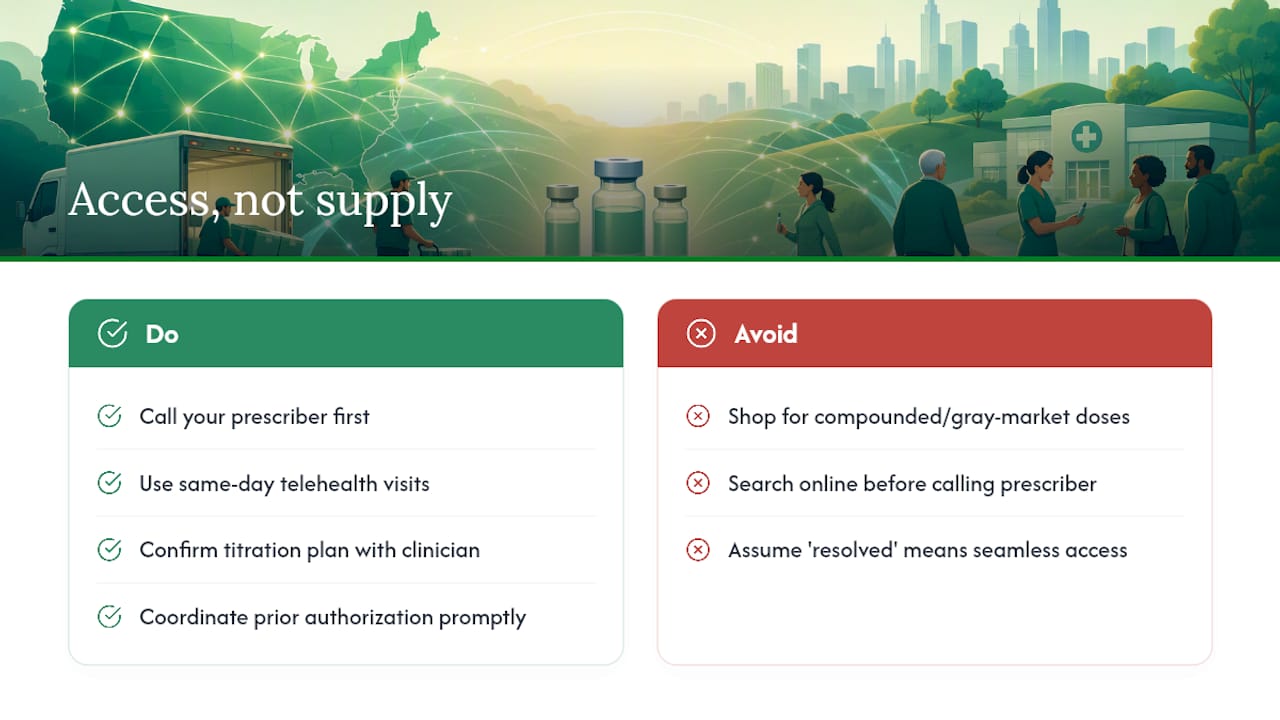
The bigger issue I’d flag for 2026 is what the shortage trained patients to do: shop for compounded shortcuts instead of calling their prescriber. That habit outlasted the actual scarcity, and it’s exactly the behavior the FDA’s compounding crackdown is trying to reverse. Generic semaglutide remains unavailable domestically, and patent protections mean that won’t change soon, so the temptation toward gray-market alternatives isn’t going away either. The patients who come out ahead are the ones who treat their prescriber’s office, not a search engine, as the first call when a pharmacy comes up empty.
Telehealth has a real role here, mainly because it collapses the time between “my dose isn’t available” and “here’s what we do next.” A same-day virtual visit lets a clinician adjust a prescription, coordinate prior authorization, or confirm a titration plan without the usual multi-week wait for an in-person appointment. That responsiveness matters more during uneven supply than it does when everything’s running smoothly.
— Bryan
Some telehealth services offer clinician responses the same day instead of the multi-week wait typical of many in-person offices. When a pharmacy dose is delayed, the gap between problem and solution can cost patients weeks, often due to delays in communication with healthcare providers rather than medication availability.
A typical process involves booking a virtual visit, having a clinician review current doses and history, and arranging prescription fulfillment and home delivery. Patients mid-titration whose starter pen is backordered may discuss supervised alternatives with their care providers. Direct communication with care teams may help expedite prior authorization paperwork compared to waiting on insurance hold lines. Start with RoenRx’s telehealth consent page to see how a visit works and get your prescription conversation moving today.
This article is general information, not a substitute for advice from a qualified doctor. Consult a qualified healthcare professional about your own circumstances before acting on anything here.
Prices haven’t dropped significantly since the shortage resolved, since no generic version exists domestically and Novo Nordisk sets list pricing; savings mostly come from the NovoCare card or insurance negotiation rather than market competition.
Medicare Part D coverage depends on your plan and whether the prescription is for diabetes versus weight loss, but the Medicare GLP-1 Bridge pilot offers reduced-cost access for eligible beneficiaries through the end of 2027.
No generic semaglutide is available in the U.S. yet, and patent protections are expected to keep it off the domestic market for several more years, even though lower-cost versions have appeared in some other countries.
There’s no single “lower-cost twin” of Ozempic, since compounded versions now carry real legal and safety risk outside narrow documented exceptions; the safer route is discussing other approved GLP-1 options, insurance-negotiated pricing, or a same-day telehealth visit through a service like RoenRx to explore what your coverage actually supports.
Local stockouts usually reflect distribution timing or a run on starter-dose pens, not a return of the national shortage, since manufacturers still prioritize shipping maintenance doses over titration strengths in routine restocking.