Start with steady extra fluids, gradual fiber plus light movement, and if that’s not enough, begin a scheduled polyethylene glycol (PEG 3350) regimen. Watch your response using the Bristol Stool Chart, give lifestyle changes 48 to 72 hours to work, and contact your provider or a RoenRx clinician if you develop severe pain, vomiting, or a bloated abdomen that won’t pass gas.
TL;DR:
- If lifestyle changes fail within 72 hours, start polyethylene glycol (PEG 3350) rather than delaying treatment, as it typically produces results in 2 to 4 days.
- Hydration is the foundation of relief, requiring deliberate water intake and pairing fluids with fiber to prevent bloating and enhance bowel movement effectiveness.
- Post-meal walks stimulate gut activity through the gastrocolic reflex and are more effective than exercise at other times, especially when combined with gradual fiber increases.
- For severe or persistent symptoms, such as inability to pass gas, blood in stool, or worsening pain, immediate medical evaluation is necessary to rule out obstruction or impaction.
- Telehealth services provide a quick way to review symptoms, prescribe OTC treatments, or adjust semaglutide dosing, reducing the delay until proper management of constipation.
The fastest path combines three low-risk moves at once instead of trying them one at a time. Extra fluids alone rarely fix semaglutide-induced constipation, but they make everything else you try actually work.
Here’s what to do over the next 24 to 72 hours:
Lifestyle changes for constipation relief work best when you stack them in the right order, not randomly. Here’s a practical sequence that lines up with what gastroenterologists and endocrinologists actually recommend for GLP-1 patients.
Fix hydration first, before anything else. Aim for an adequate daily fluid intake spread throughout the day, adjusted to your individual needs. Cleveland Clinic notes that GLP-1 drugs suppress the thirst signal along with appetite, so dehydration sneaks up on people who feel fine. Pair every fiber increase with a glass of water, since fiber without fluid just adds bulk to an already slow-moving system.
Titrate fiber over two weeks, not two days. Days 1 through 4, add one fiber-rich food daily: a handful of oats, two prunes, half a cup of berries. Days 5 through 8, layer in a second source, like a kiwi or a serving of lentils. By days 9 through 14, you’re eating fiber at most meals without the bloating that comes from ramping up too fast. Cleveland Clinic’s guidance backs this gradual approach specifically because rapid fiber increases while under-hydrated tend to worsen bloating and discomfort rather than relieve it. Our guide on what to eat on semaglutide breaks down specific foods that work well without triggering nausea.
Move your body after meals, not before. Short walks are the single most consistently supported movement intervention for constipation, and expert guidance points to post-meal walking specifically because it takes advantage of the gastrocolic reflex, the reflex that triggers colon activity after eating. A few gentle yoga poses, like a seated twist or knees-to-chest, can help too, especially if walking isn’t practical.
Fix your toileting posture and timing. Try to go at the same time each day, ideally 20 to 30 minutes after a meal. Put your feet on a low stool so your knees sit above your hips. This position straightens the angle between your rectum and anus, which makes passing stool physically easier.
Track what’s happening with the Bristol Stool Chart. Types 1 and 2 mean you’re constipated and it’s time to act. Types 3 and 4 are normal. Writing down where you land each day, rather than guessing, tells you and your provider whether what you’re doing is working.
Consider probiotics as a minor assist, not a fix. The evidence here is modest at best. Some people notice softer stools with regular probiotic use, but don’t expect probiotics to solve constipation caused by delayed gastric emptying on their own.
Pro Tip: Set a phone reminder for water every two hours during your first month on semaglutide. By the time you feel thirsty, you’re often already a step behind on hydration, and that gap is where most constipation starts.
Polyethylene glycol, sold generically or as PEG 3350, is the medicine most experts reach for first. AAFP guidance identifies it as the preferred first-line OTC pharmacologic option for GLP-1 associated constipation, with an escalation path that starts at lifestyle changes and moves to osmotic laxatives before anything stronger.
Why PEG first? It draws water into the colon without stimulating the bowel wall directly, which means gentler, more predictable results than stimulant laxatives. Expect it to take 2 to 4 days to fully regularize things once you start a scheduled dose, so don’t judge it after one day.
A sensible starting approach:
PEG 3350 typically brings regularity within 2 to 4 days when used on a scheduled basis, according to clinical reviews of laxative options.
If you have kidney disease, take multiple medications that affect electrolytes, or have a history of bowel obstruction, consult your healthcare provider before starting any laxatives due to potential dosing and safety considerations.
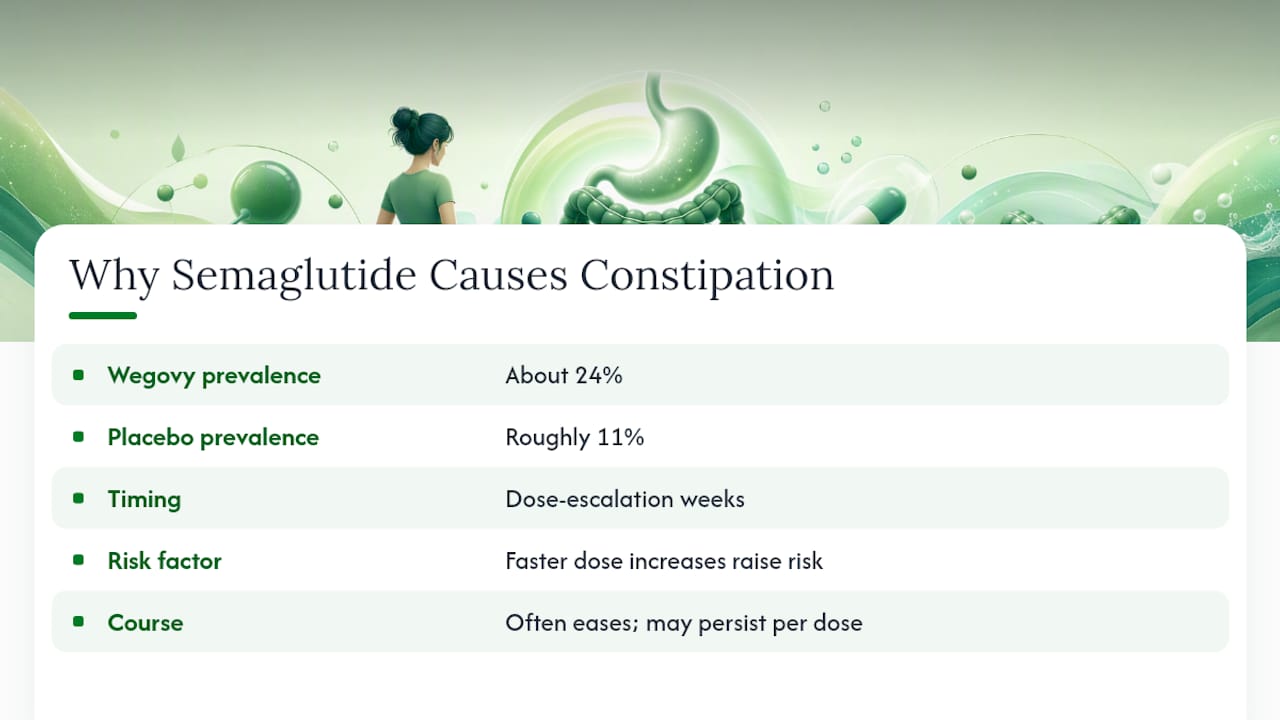
Semaglutide slows gastric emptying and overall gut motility. That’s part of how it helps you feel full longer, but the same mechanism that curbs appetite also gives your colon less signal to move things along, and clinical reviews describe this slowed transit as the central driver behind GLP-1 related constipation.
In pooled obesity trials for Wegovy, constipation showed up in about 24% of people on the drug versus roughly 11% on placebo, making it one of the more common side effects reported, alongside nausea. Most people notice it during dose-escalation weeks, when the gut is adjusting to a new level of the medication, and the same source notes that faster dose increases tend to raise GI side-effect risk. Our breakdown of the semaglutide dosing schedule explains how escalation timing affects side effects more broadly. For many people, constipation eases somewhat as the body adjusts, but for a real share of patients it persists at each new dose level, which is exactly why ongoing management, not just waiting it out, matters.
Most semaglutide-related constipation responds to the steps above within a few days. But certain symptoms mean you need medical evaluation now, not after trying another home remedy.
Call your provider or seek urgent care if you have:
These can signal obstruction or fecal impaction, which needs prompt evaluation rather than another day of home treatment.
When you reach out, give your provider specifics: how many days since your last bowel movement, your Bristol Stool Chart score, whether you’re vomiting, and whether your abdomen feels tighter than usual. That level of detail lets a clinician skip the guesswork and decide quickly whether you need imaging, a medication adjustment, or a change to your semaglutide dose. Our semaglutide side effects overview covers other symptoms worth tracking alongside constipation.
Semaglutide constipation is manageable, but knowing when lifestyle steps are enough versus when you need a prescription adjustment isn’t always obvious from home. Telehealth companies connect patients on GLP-1 therapy with clinicians who can review symptoms through messaging, recommend an appropriate OTC regimen, and adjust prescriptions when needed, without a waiting room in between.
Telehealth works well for the majority of constipation cases, the ones without red flags, where you mainly need guidance on timing, dosing, or whether to escalate treatment. It’s not a substitute for an emergency room visit if you’re vomiting repeatedly or in severe pain. For everything short of that, a same-day message to a care team beats sitting on the problem for a week hoping it resolves on its own.
Most people treat semaglutide constipation like an inconvenience to tolerate rather than a side effect worth managing actively. That’s backwards. Trial data show it affects roughly a quarter of people on Wegovy, which makes it common enough that “just wait it out” shouldn’t be anyone’s actual plan.
The conventional advice, drink more water and eat more fiber, isn’t wrong, but it’s incomplete on its own. Fiber without a hydration plan makes bloating worse, not better. That’s the gap most generic advice misses: sequencing matters as much as the interventions themselves.
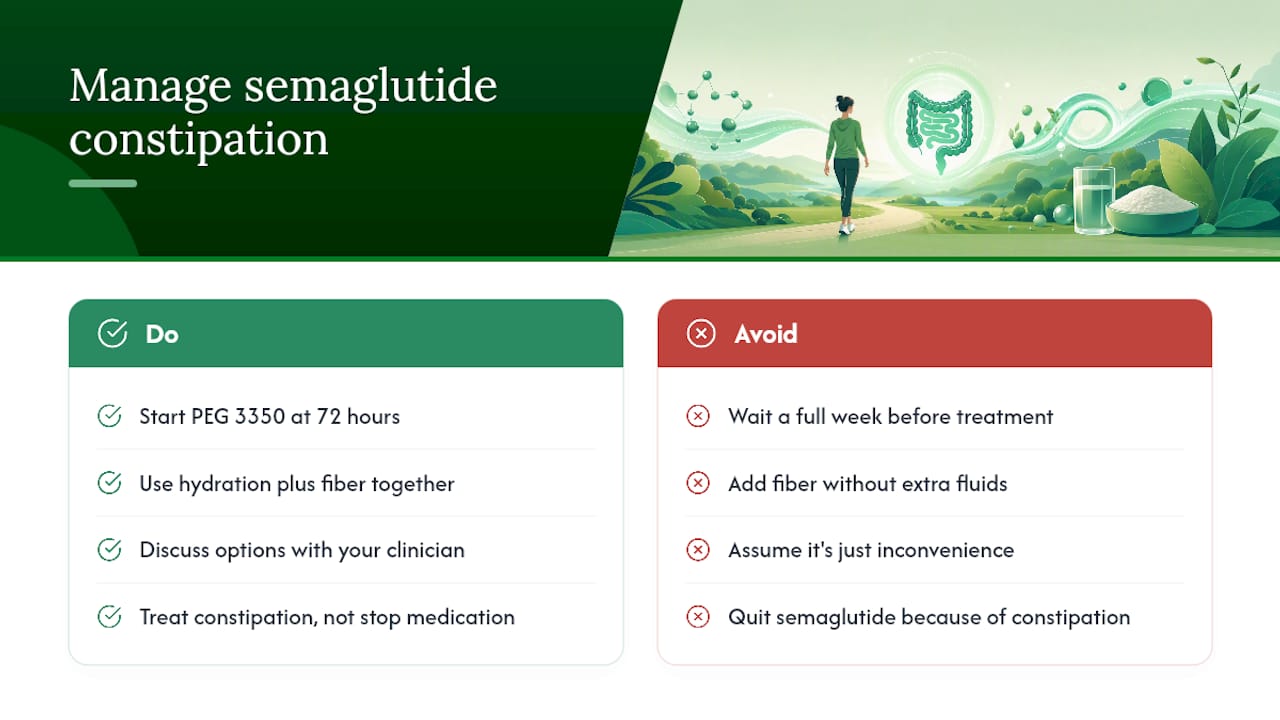
Here’s what I’d prioritize differently than most guides: don’t wait a full week to try PEG 3350. If hydration and fiber haven’t moved the needle by 72 hours, start it. It’s gentle, well-tolerated, and the evidence behind it as a first-line option is solid. Waiting longer just means more discomfort with no added benefit.
And don’t treat this as a reason to quit semaglutide. Constipation is a side effect to manage, not a signal to abandon a medication that’s working for you. That distinction is where a clinician who knows your history earns their value.
— Bryan
Some telehealth services put a clinician review one message away instead of a scheduled office visit weeks out. If constipation, nausea, or another semaglutide side effect is dragging on longer than it should, care teams can review your symptoms, recommend or prescribe the right OTC or maintenance regimen, and adjust your treatment plan through same-day messaging and telehealth visits.

This matters most for the gray-zone cases: not an emergency, but not something you want to just push through for another week either. Certain virtual healthcare platforms offer prescription delivery built in so you’re not making a separate pharmacy trip on top of everything else. If you’re dealing with ongoing GI side effects from semaglutide, start your telehealth consult and get a clinician looking at your specific situation today.
There’s no clinically established technique for relieving constipation. If you’ve seen this online, it likely refers informally to toilet positioning tricks like using a footstool to straighten the rectal angle, which can help with straining but won’t resolve GLP-1 related constipation on its own.
There’s no single normal frequency, but going more than three days without a bowel movement, or straining significantly when you do go, is a signal to start hydration, fiber, and movement steps right away rather than waiting further.
This is an informal term some patients use for a homemade combination of prune juice, apple juice, and a small amount of bran cereal, meant to soften stool naturally. It’s not a standardized medical treatment, and PEG 3350 has stronger evidence behind it as a first-line option.
Beyond three days without a bowel movement, especially with bloating or discomfort, it’s time to start PEG 3350 or contact your provider rather than waiting longer. Longer gaps combined with vomiting, severe pain, or an inability to pass gas need prompt medical evaluation.
Yes. RoenRx clinicians can review your symptoms through messaging or a telehealth visit and recommend or prescribe appropriate treatment, including adjusting your semaglutide regimen if constipation persists despite OTC measures.