Yes, you can get a tretinoin online prescription through a licensed telehealth visit, but only after a clinician reviews your health history and photos. Topical tretinoin is a prescription-only medication in the United States. It’s not sold over the counter, and no legitimate platform will hand you a prescription without some form of medical screening first.
If you’re ready to start, here’s what that actually looks like:
Most people move through this in a day or two, not weeks.
Getting tretinoin online requires a licensed clinician’s review of your health history and photos, and safety screening for pregnancy or contraindications determines eligibility before any prescription is written.
| Point | Details |
|---|---|
| Prescription is required | Topical tretinoin is not sold over the counter in the U.S. and needs a licensed clinician’s review. |
| Photos speed up approval | Clear, unfiltered photos in good lighting reduce delays in clinician review and dose adjustments. |
| Pregnancy screening is mandatory | Tretinoin is contraindicated in pregnancy, and legitimate platforms always ask about pregnancy or breastfeeding status. |
| Expect a rough first month | Peeling and irritation are common in weeks one to four; visible results usually take 8 to 12 weeks. |
| RoenRx offers same-day review | RoenRx pairs same-day clinician review with ongoing messaging and pharmacy or mail delivery for fulfillment. |
Telehealth platforms handle tretinoin visits one of two ways: asynchronous questionnaires you fill out on your own time, or live video consults with a clinician. Photos matter in either format because a dermatology-trained reviewer needs to see your actual skin, not just read a description of it.
A typical intake asks for:
The clinician reviewing your file is checking for contraindications and deciding whether your case can be safely managed remotely or needs an in-person exam. Once approved, your prescription routes to a local pharmacy for pickup or a mail-order pharmacy for delivery, and refills typically follow the same asynchronous review process.
Pro Tip: Take your intake photos in daylight near a window, without makeup or filters. Reviewers move faster on clear images, and blurry or heavily edited photos are one of the top reasons visits get delayed.
Pregnancy screening isn’t optional. Tretinoin is contraindicated during pregnancy, and any legitimate provider will ask directly about pregnancy and breastfeeding status before prescribing, according to a tretinoin telehealth overview from Walgreens. Beyond that, a handful of situations tend to push a visit toward an in-person exam instead of a remote prescription:
Clinicians default to safety first. If your history raises a flag, they’re more likely to ask follow-up questions or refer you out than to guess. That’s the system working correctly, not a red flag on the platform’s end.
Formulation depends largely on your skin type. Cream bases tend to suit dry or sensitive skin because they add moisture while delivering the active ingredient. Gels absorb faster and work well for oily or acne-prone skin, though they can feel drying for some people. Lotions sit somewhere in between.
Strength matters just as much as formulation. Common concentrations of tretinoin are available in several dosage strengths, and clinicians typically start with a lower strength as appropriate, according to FDA labeling for topical tretinoin.
The first two to four weeks are the rough patch. Expect some dryness, peeling, and mild redness as your skin adjusts. This is often called “retinization,” and it’s a normal part of how tretinoin works at the cellular level, per clinical research on retinoid mechanisms. Visible improvement in acne or texture usually takes 8 to 12 weeks, sometimes longer.
If irritation gets severe, Cleveland Clinic recommends backing off frequency or adding a gentle moisturizer as a buffer before applying tretinoin. Contact your clinician promptly for blistering, signs of infection, or a reaction that doesn’t calm down within a few days. Hold off on harsh exfoliants and introduce other active ingredients slowly. Your skin barrier needs time to catch up.
Pro Tip: If your face feels raw, try the “sandwich method”: moisturizer first, then tretinoin, then moisturizer again. It buys your skin a buffer without canceling out the medication.

Not every telehealth site is built the same. A few criteria separate the reputable ones from the ones cutting corners.
A little prep work shaves real time off the process.
Pro Tip: Some platforms ask for periodic follow-up photos to track how your skin is tolerating the medication, not just at intake. Keep the same lighting setup so your progress photos are actually comparable over time, per Walgreens’ telehealth guidance on tretinoin.
RoenRx runs on the same principles that make telehealth prescribing legitimate in the first place: real clinician oversight, a thorough intake, and follow-up that doesn’t disappear after your first message.
These aren’t features bolted on for marketing. They’re the same criteria dermatology organizations recommend for evaluating any telehealth provider.
Costs break into two buckets: the consultation and the medication itself. Telehealth visits for tretinoin typically bundle the clinician review into a membership fee or a one-time consultation charge, depending on the platform. The prescription itself is usually cheap in generic form, often cheaper than many people expect for a prescription-strength product.
Insurance coverage is inconsistent. Some plans cover tretinoin when it’s prescribed for acne, especially in patients under a certain age, but coverage for anti-aging use is far less reliable since insurers often classify that as cosmetic. If your plan doesn’t cover it, generic tretinoin without insurance tends to run affordably at most pharmacies, though prices vary by dose, formulation, and location.
A few things worth checking before you commit to a platform:
The bottom line: don’t assume insurance will cover it, but also don’t assume it will be expensive without insurance. Ask both questions before you finish your intake.
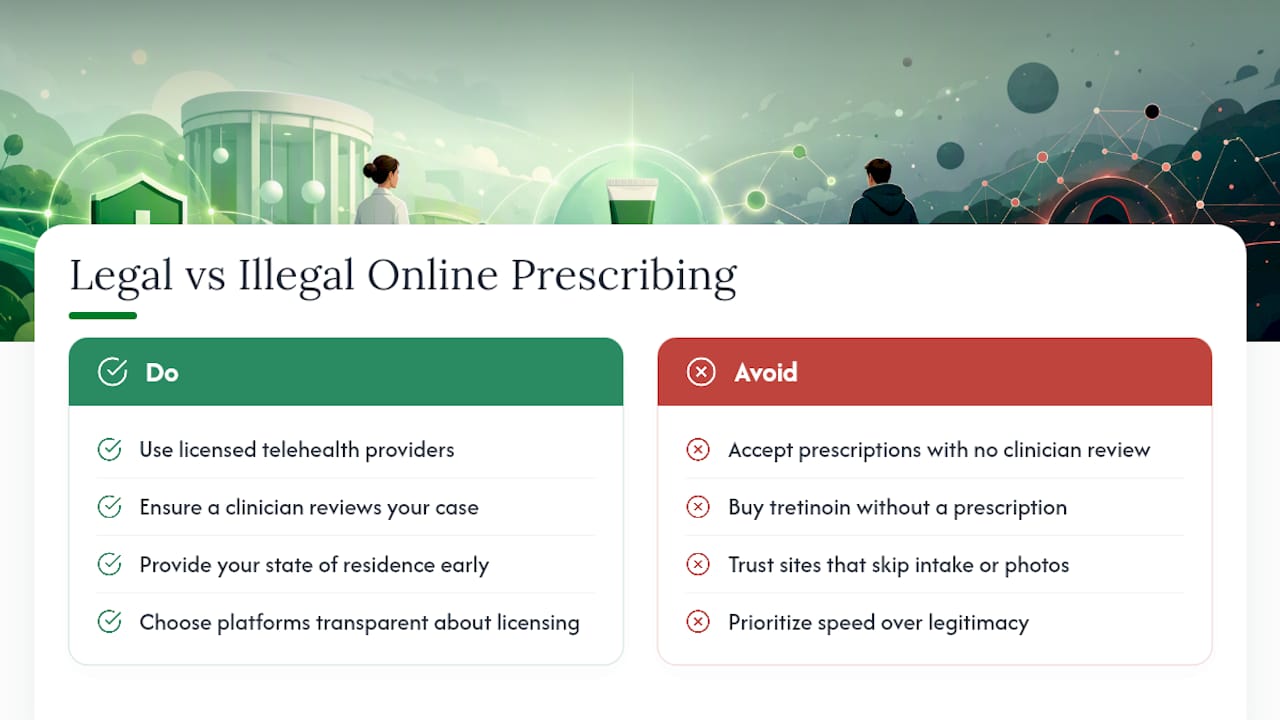
Yes, in the United States, licensed telehealth providers can legally prescribe tretinoin after a medical evaluation, the same way an in-person dermatologist would. The legal requirement isn’t about the delivery method. It’s about whether a licensed clinician actually reviewed your case before writing the prescription.
That said, prescribing rules vary somewhat by state. Some states require a more thorough evaluation process for certain medications, and telehealth platforms must have clinicians licensed in the state where the patient is physically located at the time of the visit. This is why a legitimate platform asks for your state of residence early in the intake process. It’s not a formality. It determines which clinician on their team is even legally allowed to review your case.
What’s never legal, regardless of state, is a platform issuing a prescription with no clinician review at all, or a business selling tretinoin directly without a prescription. If you come across a site offering to just ship you tretinoin with no questionnaire, no photos, and no clinician involved, that’s outside the bounds of how prescription medication is supposed to work in the U.S. Stick with platforms that are upfront about their licensing and their screening process, and don’t treat speed as more important than legitimacy.
Your intake questionnaire, medical history, and skin photos all count as protected health information, which means legitimate telehealth platforms are required to handle them under HIPAA. That covers how your data is stored, who can access it, and how it’s transmitted between you and your care team.
A few practical things to look for before you upload anything personal:
Photos are the part people worry about most, understandably. A reputable platform stores them within a secured patient record tied to your account, accessible only to your care team, not shared for marketing or sold to advertisers. If a platform’s privacy policy is vague, hard to find, or missing entirely, that’s worth treating as seriously as a shallow medical questionnaire. Both are signs the business hasn’t invested in the parts of telehealth that don’t show up in a slick homepage.
Prescribing tretinoin online only works when convenience doesn’t come at the expense of a real clinical review. That balance is what should determine which platform gets your information and your prescription. Patients consistently report that having a care team reachable after the first visit, not just at intake, is what makes remote treatment feel trustworthy over months of use, not just for one appointment.
— Bryan
RoenRx skips the waiting room without skipping the screening. You complete an intake, upload your photos, and a clinician reviews your case, often with a same-day appointment instead of a multi-week wait for a dermatology office slot.

Once you’re approved, your care team stays reachable through in-app messaging if irritation shows up or your dosing needs adjusting, and your prescription routes to your preferred pharmacy or ships directly to you. Start by reviewing the telehealth consent process, then head to the RoenRx home page to begin your intake. Most visits move from submission to prescription in a day or two, not weeks.
For deeper reading, see FDA tretinoin labeling, the Mayo Clinic overview, AAD’s retinoid guidance, and DailyMed’s product information.
This article is general information, not a substitute for advice from a qualified doctor. Consult a qualified healthcare professional about your own circumstances before acting on anything here.
Yes. Topical tretinoin is a prescription-only medication in the United States and isn’t available over the counter at any strength.
Common side effects include dryness, peeling, redness, and increased sun sensitivity, especially during the first few weeks, according to Mayo Clinic. Severe reactions like blistering or signs of infection warrant prompt contact with your clinician.
There’s no true over-the-counter tretinoin. What’s sold without a prescription is retinol, a weaker, related compound that works more slowly and at lower potency than prescription tretinoin, per AAD.
No. Retin-A is a brand name for prescription tretinoin and requires a prescription from a licensed clinician, whether through an in-person visit or a telehealth consultation like the ones RoenRx offers.