Most people who start tretinoin begin purging within a few weeks, hit peak breakouts around the first one to two months, and see clear improvement within three months. Moisturizer and sunscreen ease the discomfort but rarely shorten the process itself. If your skin is still getting worse past week 12, with no signs of turning a corner, that’s the point to call a prescriber instead of waiting it out.
TL;DR:
- The tretinoin purge occurs because the medication accelerates skin cell turnover, causing microcomedones to surface within two to four weeks, especially in areas with pre-existing congestion.
- About 4 to 8 weeks is the typical duration of the purge, peaking between weeks 3 and 6 with increased redness, peeling, and breakouts, before gradual improvement begins.
- If breakouts or skin worsening continue past 12 weeks without improvement or worsen weekly, a healthcare professional should be consulted to rule out other issues.
- Slowing the introduction of tretinoin, sticking to simple routines, and using barrier support help manage irritation during the purge.
- Persistent redness, burning, blistering, or worsening symptoms beyond the expected timeline indicate the need for medical evaluation, not just waiting it out.
A tretinoin purge is the accelerated emergence of acne that was already forming under your skin before you ever applied the cream. Tretinoin doesn’t create new problems out of nowhere. It speeds up the surfacing of microcomedones, the microscopic clogged pores that were sitting quietly under the surface, sometimes for months, waiting to become visible pimples anyway.
This is a documented phase of retinoid therapy, not a rare side effect or a sign you’re doing something wrong. Clinical reviews of topical retinoids in acne treatment describe this early flare as a predictable part of how the medication works, tied directly to how it changes skin cell behavior.
Here’s what tends to happen during that window:
The prevalence context matters here: purging is common enough that dermatology guidance treats it as an expected part of starting acne treatment, not an exception. That’s also exactly why so many people quit in week 3 or 4, right when the medication is doing what it’s supposed to do. Understanding that this phase has a beginning, middle, and end changes how tolerable it feels.
Tretinoin works by binding to retinoic acid receptors in your skin cells, which speeds up how fast those cells divide and shed. That single mechanism explains almost everything about the purge, including its timing.
Normal skin cell turnover takes roughly 28 to 40 days. Once tretinoin is in the picture, that cycle can compress to around 14 to 21 days in the early weeks of treatment. Your skin is essentially fast-forwarding through a process that would have happened anyway, just spread out over a much longer stretch.

That compression is the whole story behind why breakouts cluster instead of trickling in one at a time. Microcomedones that might have surfaced gradually over two or three months instead get pushed to the surface within a matter of weeks, all competing for the same real estate on your face.
A few points worth holding onto:
The compression effect in numbers: Standard skin cell turnover runs about 28 to 40 days. Under tretinoin, that early-phase turnover can drop to roughly 14 to 21 days, according to clinical reviews of retinoid pharmacology. That near doubling in speed is why lesions that would have appeared over months instead show up within weeks.
This is also why dermatologists rarely recommend jumping straight to nightly use. Slower introduction gives your skin’s barrier a chance to adjust to the accelerated cycle instead of getting hit with the full effect at once.
This is the part most people actually want: a realistic map of what happens and when, so you’re not guessing whether what you’re seeing is normal.
Days 1 to 7: adjustment, not purge yet. Your skin is getting used to the medication. Expect mild tingling, tightness, or dryness after application, but not necessarily visible breakouts. This is the wrong week to judge whether tretinoin is “working” either way. Apply a pea-sized amount to fully dry skin every other night, and keep everything else in your routine minimal.
Week 2 to 4: the purge phase begins. This is when most people notice whiteheads, small papules, and visible peeling starting to show up, often in the same areas where they’ve broken out before. MedlinePlus lists this kind of temporary acneiform flare as an expected reaction to topical tretinoin, alongside irritation and peeling. Keep your routine boring on purpose: gentle cleanser, tretinoin, moisturizer, and sunscreen the next morning. Do not add new products right now, no matter how tempting it is to “fix” the breakout with something else.
Week 4 to 6: peak breakout window. This is usually the roughest stretch, and it’s also the point where the highest concentration of microcomedones surfaces at once. Redness, active lesions, and peeling tend to cluster here more than at any other stage. Resist picking at anything. Popping a purge lesion early tends to prolong healing and raises the odds of scarring or lingering dark marks. Stick with barrier support: a fragrance-free moisturizer applied generously, and strict sun protection, since peeling skin burns more easily.
Week 6 to 8: stabilization sets in. Fewer new lesions appear, and the ones that are already there start healing faster than new ones form. This is the turning point that convinces most people to stick with treatment. If your skin is tolerating tretinoin well by this stage, and you’ve been using it every other night, this is a reasonable point to consider stepping up to three nights a week under a prescriber’s guidance.
Week 8 to 12: visible clearance. Texture starts to smooth out, post-inflammatory marks from the purge begin to fade, and new breakouts become rare. Pooled trial data on tretinoin follow this same pattern: early worsening followed by lesion counts that end up better than baseline once you get past the initial flare. If you’re not seeing steady week-over-week improvement by the end of this window, that’s the point to check in with whoever prescribed it, rather than assuming more time alone will fix it.
Pro Tip: Take a photo under the same lighting once a week, same angle, same time of day. It’s nearly impossible to judge your own progress day to day because the improvement is gradual, but a week 3 photo next to a week 9 photo usually makes the timeline obvious in a way your memory won’t.
Not every flare during tretinoin treatment is a purge, and mixing up an adverse reaction with a normal purge phase can lead you to either quit too early or push through something that actually needs medical attention.
Location is the first clue. A genuine purge shows up where you already had acne. New lesions in places you’ve never broken out before, like your jawline suddenly flaring when your history has always been forehead and nose, point toward something else, whether that’s a new irritant, a hormonal shift, or an unrelated skin issue.
Lesion character matters just as much. Purge lesions look and feel like your typical acne: whiteheads, small papules, the occasional deeper cyst if that’s your pattern. Burning that persists at rest, rather than the brief sting right after application, or any blistering, is not typical purge behavior and deserves a second look.
Time trend is the most reliable signal of all. A purge should trend better week over week once it passes its peak, even if the improvement is gradual. Breakouts that keep escalating past the 8 to 12 week window, without any plateau or turn for the better, suggest either an incorrect diagnosis or a reaction that isn’t part of the expected process.
Quick comparison, roughly 6 to 12 weeks is the window most sources cite for resolution of a normal purge, based on clinical retinoid literature:
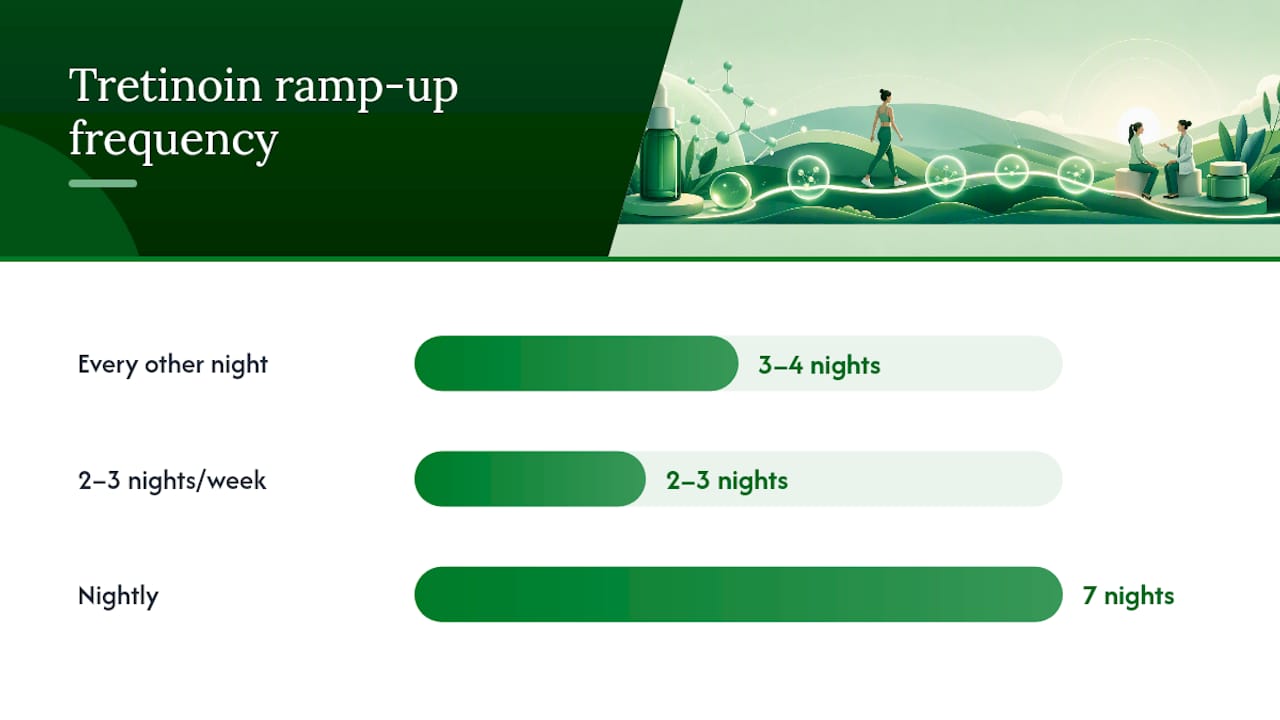
Slowing down your ramp-up is the single most effective way to make the purge tolerable. Instead of nightly use from day one, most dermatology guidance recommends starting every other night, moving to 2 to 3 nights a week once your skin adjusts, and only going nightly when you’re clearly tolerating it well.
Application technique matters more than people expect. A pea-sized amount covers the whole face, applied to skin that’s completely dry, since damp skin absorbs more of the medication and increases irritation. If your skin is especially reactive, the “sandwich method,” moisturizer, then tretinoin, then another layer of moisturizer, can blunt some of the sting without meaningfully reducing effectiveness.
Barrier support isn’t optional during this phase. A fragrance-free, non-comedogenic moisturizer applied generously, both before and after tretinoin if needed, keeps peeling from turning into raw, painful patches. Mayo Clinic’s guidance on tretinoin specifically flags redness and peeling as expected effects that respond to consistent barrier care and sun protection.
Sunscreen every single morning is mandatory, not optional, since tretinoin-treated skin is more sensitive to UV damage and sunburns faster.
A few more rules worth following through this window:
Pro Tip: If your skin is flaking so much that makeup won’t sit right, that’s a sign to dial back frequency for a week, not a sign the product has stopped working. Reducing frequency temporarily protects your barrier without losing the underlying benefit.
Eight to 12 weeks without steady improvement, or breakouts that get worse every single week past your expected peak, is the clearest signal that something beyond a normal purge might be happening. That’s the point to stop guessing and get a professional read.
Certain symptoms warrant a call regardless of where you are in the timeline: intense burning that doesn’t ease up between applications, blistering, a rash that’s spreading rather than staying in your usual acne zones, or any sign of secondary infection like warmth, swelling, or pus.
Before that appointment, a little preparation goes a long way. Bring weekly photos if you have them, a list of every product you’re using alongside tretinoin, the exact strength and frequency you’ve been applying, and a rough log of when symptoms started and how they’ve changed.
A prescriber has several options depending on what they see:
If you’re not already working with a clinician, starting tretinoin through a telehealth provider gives you a direct line to ask these questions instead of guessing alone through the worst weeks.
The hardest part of the tretinoin purge isn’t the peeling or the breakouts. It’s the psychological toll of watching your skin get worse while trusting that it’s supposed to. That’s a legitimately difficult thing to sit through, and I don’t think enough guides say that plainly.
What the clinical trial data actually suggests is reassuring: early worsening often predicts a better outcome later, not a worse one. That’s counterintuitive, but it’s consistent across the research.
My honest advice is to document everything, keep your regimen boring during the peak weeks, and loop in a prescriber the moment the timeline stops making sense rather than waiting for certainty.
— Bryan
Figuring out the right tretinoin strength, ramp-up schedule, and when a breakout has crossed from “normal purge” into “something’s off” is hard to do alone, especially at week 5 when your skin looks worse than when you started. You can connect with a clinician through messaging and same-day virtual appointments, avoiding long waits for in-person dermatology appointments just to ask whether what you’re seeing is expected.

Before your visit, pull together what you’d want any prescriber to see: weekly photos, the exact tretinoin strength and frequency you’ve been using, and a short log of when symptoms started and how they’ve shifted. A clinician can review that history, adjust your dosing schedule if the purge is dragging on, or prescribe supportive treatment if your skin needs a break from irritation without abandoning the regimen entirely. If you’re ready to get a prescriber’s eyes on your timeline, you can start a telehealth visit and get a plan built around where your skin actually is right now.
This article is general information, not a substitute for advice from a qualified doctor. Consult a qualified healthcare professional about your own circumstances before acting on anything here.
Most people purge for about 4 to 8 weeks, with the full process resolving by 6 to 12 weeks depending on how much congestion was present before starting treatment.
The purge typically peaks between weeks 3 and 6, when the highest number of microcomedones surface at roughly the same time.
The rough patch often called the “tretinoin uglies,” the combination of peeling, redness, and breakouts, usually runs from around week 2 through week 6 before visibly settling down.
Breakouts persisting well beyond the typical 12 week purge window usually mean something other than purging is at play, whether that’s a new irritant, hormonal acne, or an underlying skin condition, and it’s worth having a clinician reassess your case.
Yes, peeling is a well documented and expected side effect of tretinoin as it speeds up skin cell turnover, and it typically eases once your skin adjusts around week 6 to 8.