Yes, PDE5 inhibitors commonly cause mild, short-lived side effects, and rarely cause serious events that need urgent care. A VigiBase analysis of nearly 32,000 men taking these drugs found headache in about 10.4% of reported reactions and abnormal vision in roughly 8.4%. Most of that resolves within hours as blood vessels relax and return to normal.
The rare stuff is where you can’t afford to shrug it off. Priapism (an erection lasting more than four hours), sudden vision loss in one eye, or sudden hearing loss are medical emergencies, not “wait and see” situations. So is chest pain after taking sildenafil, tadalafil, or vardenafil, especially if you’ve also taken a nitrate.
Quick fact: In the FAERS-based safety analysis of PDE5 inhibitors reported to the FDA, distinct safety signals emerged for each drug, including priapism specifically flagged for tadalafil, underscoring that side effect patterns aren’t identical across the drug class.
A telehealth provider like RoenRx can help you sort a normal headache from a real emergency fast, which matters more than most people realize when symptoms show up outside office hours.
Most PDE5 inhibitor side effects are mild, dose related, and resolve within hours, while a small set of rare events demand immediate emergency care rather than a wait-and-see approach.
| Point | Details |
|---|---|
| Common reactions are frequent but mild | Headache and abnormal vision were reported in roughly 10.4% and 8.4% of adverse event cases in the largest pharmacovigilance review, and both usually fade within hours. |
| Priapism is a true emergency | Any erection lasting four or more hours needs immediate emergency evaluation, not a call to your doctor the next morning. |
| Nitrates are an absolute no | Combining nitrates with any PDE5 inhibitor can cause life-threatening blood pressure drops, with no safe dose of either drug together. |
| Vision or hearing changes mean stop now | Sudden vision loss, sudden hearing loss, or chest pain after dosing all require stopping the drug and seeking urgent medical evaluation. |
| Drug choice affects side effect pattern | Sildenafil shows the strongest visual side effect link, tadalafil’s long half-life extends both benefits and side effects, and vardenafil carries its own distinct signal profile. |
| RoenRx supports safer ongoing use | RoenRx offers medication review, same-day clinician messaging, and prescription delivery, which helps catch interactions and side effects earlier in treatment. |
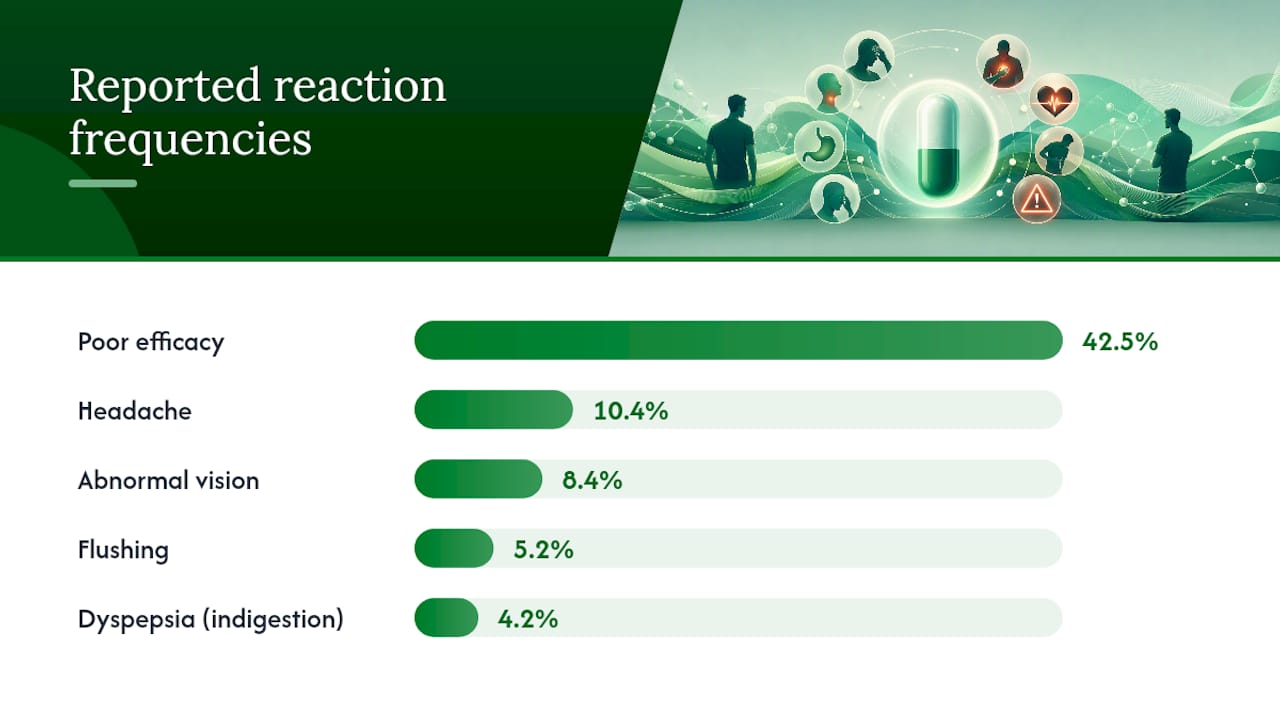
The most frequently reported reaction in that VigiBase pharmacovigilance review wasn’t a side effect at all. It was poor drug efficacy, cited in 42.5% of reports. Right behind it came the symptoms most people associate with these medications: headache at 10.4%, abnormal vision at 8.4%, flushing at 5.2%, and dyspepsia (indigestion) at 4.2%.
Nasal congestion and mild muscle aches, sometimes described as back pain, round out the list clinicians see most in practice. None of this is random. Sildenafil, tadalafil, and vardenafil work by blocking the PDE5 enzyme, which allows blood vessels to relax and improves blood flow, including to the penis. That same relaxation happens in vessels throughout your body, which is why a dilated blood vessel in your head produces a headache and dilated vessels in your face produce that warm, flushed feeling.
The visual symptoms come from a different quirk of the pharmacology. PDE5 inhibitors aren’t perfectly selective. They cross-react to a small degree with PDE6, an enzyme active in the retina, and that off-target effect can cause a temporary blue or green tint to vision, increased light sensitivity, or blurring. A narrative review of visual side effects notes these effects tend to track with dose. Higher doses of sildenafil in particular are more likely to produce the classic blue-tinted vision than lower doses.
Most of these reactions follow a predictable arc:
Pro Tip: Staying well hydrated and avoiding a large, fatty meal right before dosing can blunt both the headache and the indigestion for a lot of people. It’s not a guarantee, but it’s a low-effort first move before assuming you need a different medication entirely.
Persistent symptoms deserve a second look. If a headache lasts more than a day, if visual changes don’t clear within a few hours, or if indigestion is bad enough to make you avoid the medication altogether, that’s a signal to talk to your prescriber about a dose adjustment or a switch to a different PDE5 inhibitor. You can read more about how sildenafil dosing and tadalafil dosing typically get adjusted for tolerability.
Priapism, a penile erection that persists for four hours or longer without ongoing stimulation, is the adverse event that separates PDE5 inhibitors from a routine nuisance drug. It’s uncommon, but it isn’t theoretical. The FAERS analysis of PDE5 inhibitor reports submitted to the FDA between 2010 and 2021 detected a specific safety signal for priapism tied to tadalafil, distinct from the signal patterns seen with sildenafil or vardenafil.

A pharmacovigilance “signal” is not the same as proof. Researchers use statistical tools like the proportional reporting ratio (PRR) and reporting odds ratio (ROR) to flag when a drug shows up disproportionately often alongside a specific adverse event, compared to all other drugs in the database. A signal tells you something is worth investigating. It does not, by itself, tell you the drug caused the event in a given patient, since people reporting to these databases often have other health conditions or take other medications that could contribute.
That distinction matters for how you should read headlines about drug safety databases, but it changes nothing about how you should respond if priapism actually happens to you.
What priapism requires, step by step:
The same FAERS review also found that serious outcomes, including hospitalization, appeared across the reports analyzed for this drug class, alongside other flagged issues like sexual disorders and, in some sildenafil reports, death. These outcomes were relatively rare against the total volume of prescriptions filled worldwide, but they’re the reason prescribers ask detailed health history questions before writing that first prescription rather than treating it as a routine refill.
Pro Tip: If you’ve had an erection lasting longer than 30 to 60 minutes past what’s typical for you, don’t wait to see if it becomes a “real” emergency at the four-hour mark. Call your care team or head to urgent care early. Faster intervention generally means a better outcome.
One other flagged concern worth a plain mention: some pharmacovigilance analyses have reported a possible association between PDE5 inhibitor use and melanoma. The evidence is mixed and confounded by factors like sun exposure among the population studied, and more research is needed before anyone can call it causal. It’s a reason for routine skin checks, not a reason to panic.
The blue tinting and light sensitivity covered earlier are common and harmless. A different category of eye and ear events is rare and potentially permanent, and the two should never be confused.
Non-arteritic anterior ischemic optic neuropathy, known as NAION, involves sudden vision loss in one eye caused by reduced blood flow to the optic nerve. Case reports have linked NAION to PDE5 inhibitor use, and the narrative review of visual side effects notes this remains a rare event set against the enormous number of prescriptions written for this drug class. Risk appears concentrated in men who already carry independent risk factors:
Sudden sensorineural hearing loss is a separate, similarly rare event reported with this drug class, sometimes accompanied by ringing in the ears or dizziness. Regulatory labeling treats both sudden vision loss and sudden hearing loss the same way: as reasons to stop the drug immediately and get evaluated without delay, because both can become permanent if treatment is delayed.
If you already have diagnosed optic nerve disease or a history of unexplained sudden hearing loss, tell your prescriber before starting any PDE5 inhibitor. That single conversation is the cheapest insurance policy available against a rare but life-altering complication.
Nitrates and PDE5 inhibitors are an absolute, non-negotiable contraindication. Both drug classes lower blood pressure by relaxing blood vessels, and combining them can trigger a severe, sudden drop in blood pressure that has caused fatal outcomes in documented cases. This isn’t a mild interaction to “monitor.” It’s one to avoid entirely, and drug labeling is explicit about it.
Nitroglycerin, isosorbide mononitrate, isosorbide dinitrate, and recreational nitrites like amyl nitrite (“poppers”) all fall under this ban. Cardiology literature describes the mechanism plainly: the combined vasodilating effect can precipitate profound, life-threatening hypotension, and there’s no dose of either drug that makes the pairing safe. If you take nitrates for chest pain, even occasionally, PDE5 inhibitors are off the table until your prescriber clears otherwise.
If chest pain develops after taking a PDE5 inhibitor:
Pro Tip: Keep a current medication list on your phone, including anything you take occasionally like nitroglycerin for angina. If you ever need emergency care, that thirty-second list could be the difference between a straightforward treatment plan and a dangerous guessing game.
This is also why a thorough prescriber does more than hand over a prescription. A responsible telehealth or in-person visit for erectile dysfunction should include a real conversation about cardiac history, current medications, and, for men with known heart disease, whether a stress test or cardiology clearance makes sense before starting therapy.
Nitrates get the headline warning, but they’re not the only interaction worth knowing before you start treatment.
CYP3A4 inhibitors change how your body processes PDE5 inhibitors. Drugs like ketoconazole, itraconazole, clarithromycin, and even grapefruit juice in large amounts can slow the breakdown of sildenafil, tadalafil, or vardenafil, letting more of the drug build up in your bloodstream than intended. That raises the odds of side effects, sometimes significantly. Anyone on a strong CYP3A4 inhibitor needs a prescriber-guided dose adjustment rather than a standard starting dose.
Alpha-blockers, commonly prescribed for enlarged prostate or high blood pressure, are another combination that needs careful handling. Both drug classes lower blood pressure, and taking them together can cause orthostatic hypotension, that dizzy, lightheaded feeling when standing up too fast. Prescribers typically manage this by staggering the timing of doses and starting with lower doses of the PDE5 inhibitor until tolerability is established.
Alcohol adds its own blood-pressure-lowering effect on top of the drug’s mechanism, and heavy drinking alongside a PDE5 inhibitor increases the odds of dizziness, flushing, and low blood pressure. Recreational drugs that affect the cardiovascular system, especially nitrite-based ones, carry the same absolute risk as prescription nitrates.
Pro Tip: Bring your complete medication and supplement list to every telehealth visit, including anything over-the-counter. A lot of dangerous interactions get missed not because patients hide anything, but because nobody asked about the daily allergy pill or the herbal supplement that happens to interact with the enzyme pathway these drugs use.
Certain health conditions raise the risk profile enough that a specialist should weigh in before you start, or that PDE5 inhibitors should be avoided altogether.
Conditions that warrant caution or specialist input:
Before writing a first prescription, a careful clinician typically checks baseline blood pressure, reviews your full medication list for the interactions covered above, and asks about eye history, particularly any prior sudden vision loss. That last question gets skipped more often than it should, given how directly it relates to NAION risk.
Referral to cardiology makes sense for men with known or suspected heart disease who haven’t been cleared for sexual activity recently. Referral to ophthalmology makes sense for anyone with a personal or strong family history of NAION or other optic nerve conditions. Neither referral needs to delay treatment by more than a visit or two in most cases, but skipping them entirely is where problems tend to originate.
Most side effects respond to simple adjustments. Skip heavy alcohol on the days you plan to take a PDE5 inhibitor, and follow your specific label’s guidance on food timing since it varies by drug. Over-the-counter pain relievers can handle a mild headache in most cases, though anyone with kidney issues should check with their prescriber before reaching for NSAIDs regularly.

Watch for red flags that OTC treatment shouldn’t mask: a headache accompanied by vision changes, neck stiffness, or confusion needs medical evaluation, not just an aspirin. If side effects persist across multiple doses or interfere with daily life, that’s the signal to revisit your prescriber about a lower dose or a switch to a different PDE5 inhibitor. This is a common, routine adjustment, not a sign that treatment has failed.
Pro Tip: Track your side effects for the first two or three doses in a simple note on your phone. Patterns that seem random in the moment often become obvious once you can see the timing next to what you ate, drank, or took alongside the medication.
A same-day appointment matters most exactly when you least expect to need one. RoenRx structures its erectile dysfunction care around that reality: a full medication review before your first prescription, ongoing messaging access to your care team, and prescription fulfillment that doesn’t require a separate pharmacy trip.
That structure matters because side effects rarely announce themselves on a convenient schedule. Someone noticing new visual changes on a Saturday afternoon, or wondering whether a headache warrants stopping treatment, benefits more from same-day clinician access than from a message left on an answering machine.
RoenRx’s model connects you with licensed clinicians who can review your full medication list for interactions like the CYP3A4 and alpha-blocker issues covered above, adjust your dose without requiring an in-person visit, or tell you directly that a symptom needs an emergency room rather than a chat message.
What that looks like in practice:
PDE5 inhibitors have been prescribed for decades now, and the long-term safety picture is reassuring for most users, with a few caveats worth knowing.
The bulk of long-term reporting continues to show the same pattern as short-term use: headache, flushing, and visual disturbances remain the most frequently reported reactions, and they don’t appear to worsen or accumulate with years of intermittent use. There’s no strong evidence that continued use causes progressive organ damage in men without pre-existing cardiac, hepatic, or renal disease.
The debated long-term signal is the possible melanoma association flagged in some pharmacovigilance reviews. It remains unresolved. Confounding factors, particularly the fact that men who use PDE5 inhibitors tend to be older and may have different sun exposure patterns than comparison groups, make it hard to isolate cause from coincidence. Until larger, controlled studies settle the question, the practical takeaway is routine skin monitoring rather than avoidance of the drug class.
Tolerance doesn’t appear to be a significant long-term issue either. Men generally don’t need escalating doses over years of use the way they might with some other medication classes, though effectiveness can decline as underlying cardiovascular or hormonal issues progress with age, which is a separate conversation from the drug losing potency itself. Regular check-ins with a prescriber remain the best way to catch that shift early and adjust treatment accordingly.
The three most prescribed PDE5 inhibitors share a mechanism, but their side effect profiles diverge in ways that matter for choosing between them.
Sildenafil carries the strongest association with visual side effects, including the classic blue tint, because of its relatively higher affinity for the off-target PDE6 enzyme compared to tadalafil. If you’re prone to visual disturbances or work in a field where color perception matters, that’s worth discussing with your prescriber directly.
Tadalafil’s defining trait is duration, staying active in your system for up to 36 hours, which is why it’s sometimes called the “weekend pill.” That long half-life means side effects like back pain and muscle aches, more commonly reported with tadalafil than the other two, can also linger longer once they start. The tradeoff is fewer dosing decisions and more spontaneity. Comparing daily versus as-needed tadalafil dosing is worth doing with your care team if side effect timing is a concern.
Vardenafil sits closer to sildenafil in duration but carries its own distinct signal profile. The FAERS safety analysis found vardenafil more associated with administration errors reported to the FDA than the other two drugs, a reminder that clear dosing instructions matter regardless of which medication you’re prescribed.
None of the three is universally “safer.” The right choice depends on your cardiovascular history, how your body handles each drug’s specific side effect pattern, and how your lifestyle fits with a short-acting versus long-acting option.
Side effect risk isn’t uniform across every patient, and age or organ function changes the calculation meaningfully.
Older men face a compounding effect: they’re more likely to have the cardiovascular disease, diabetes, or optic nerve risk factors that raise the odds of serious complications like NAION, and they’re more likely to be on other medications that interact with PDE5 inhibitors. That doesn’t mean PDE5 inhibitors are off-limits with age. It means the medication review step matters more, not less, for this group.
Hepatic impairment changes how these drugs are metabolized and cleared, and prescribers typically reduce starting doses for men with moderate liver impairment while avoiding these drugs altogether in severe cases. Renal impairment has a similar effect on clearance, particularly for tadalafil, and dose adjustments are standard practice rather than optional caution for men with reduced kidney function.
None of this should read as a reason to avoid treatment if you fall into one of these groups. It’s a reason to make sure whoever is prescribing your medication actually asks about your kidney function, liver history, and full medication list before defaulting to a standard starting dose that was tested primarily in healthier, younger patients.
The conventional advice on PDE5 inhibitor side effects tends to bury the real risk hierarchy under a wall of possible symptoms, treating a headache with the same gravity as priapism just because both appear on the same label insert. That flattening does readers a disservice. The pharmacovigilance data is actually reassuring once you separate frequency from severity: the common stuff is genuinely common and genuinely mild, while the dangerous stuff is genuinely rare.
What gets underestimated is how much the nitrate interaction depends on patients actually disclosing every medication they take, including occasional or recreational ones, and how often that disclosure gets skipped out of embarrassment rather than deception. That gap, not the drug’s pharmacology, is where the worst outcomes tend to originate.
If there’s one priority to take from this, it’s disclosure over discretion. Tell your prescriber everything you take, ask about your specific cardiac and eye history before starting, and treat any of the rare red flags as the emergency they are rather than something to text about in the morning.
Traditional ED care often means waiting weeks for an appointment, then hoping you remember every question when you finally get fifteen minutes with a doctor. RoenRx is built around a different pace: a full medication review before your first prescription, same-day messaging access to your care team when a side effect shows up unexpectedly, and prescription delivery that keeps treatment consistent instead of interrupted.

That access matters most in exactly the moments this article has covered, when you need to know quickly whether a symptom is a normal adjustment or a reason to seek emergency care. RoenRx’s clinicians can review your interaction risk with nitrates or alpha-blockers, adjust your dose without an office visit, and coordinate care if something more serious needs specialist attention. If you’re ready to start treatment or want a clinician to review your current medication list for safety, you can begin the telehealth consent process and get matched with a provider who handles both the prescription and the ongoing monitoring that goes with it.
This article is general information, not a substitute for advice from a qualified doctor. Consult a qualified healthcare professional about your own circumstances before acting on anything here.
The most common risks are headache, flushing, and temporary visual changes, while rare but serious risks include priapism, sudden vision or hearing loss, and dangerous blood pressure drops when combined with nitrates.
Men taking nitrates, those with a history of NAION or optic nerve disease, unstable cardiovascular disease, sickle cell disease, or severe liver or kidney impairment should avoid these drugs or get specialist clearance first.
No, coffee is not a PDE5 inhibitor. Caffeine has mild vascular effects of its own, but it works through entirely different pathways than prescription medications like sildenafil or tadalafil.
Yes, PDE5 inhibitors are typically taken as needed or on a set schedule and can be stopped at any time without a tapering process, though you should tell your prescriber if you’re stopping due to side effects so they can consider alternatives.
Mild side effects like headache and flushing are reported far more often than serious events, with pharmacovigilance data showing headache in roughly 10.4% of reported reactions while priapism and vision loss remain rare by comparison.