If you have no drug coverage, tirzepatide will likely cost you in a broad range depending on dose and where you buy it, and the lowest FDA-approved cash route is the manufacturer’s self-pay vial program. Compounded versions advertise lower prices but skip FDA approval, so they carry a different risk profile. Your fastest next move is checking the manufacturer’s self-pay page or talking to a telehealth prescriber before you commit to any pharmacy quote.
TL;DR:
- The FDA-approved self-pay vial program through Lilly is the most affordable and reliable option for uninsured patients, costing about $299 for the starter dose and $399 to $449 for higher doses.
- Refill timing and dose adjustments directly impact your self-pay price tier, so carefully coordinate order timing to avoid losing discounts or incurring additional costs.
- Compounded tirzepatide offers lower prices but carries higher risks due to lack of FDA approval and uncertain manufacturing quality controls.
- Manufacturer savings cards and FSA or HSA accounts can further reduce costs, but government-insured patients are ineligible for these discounts.
- A telehealth service like RoenRx provides a safe, clinical evaluation and prescription process that helps uninsured patients avoid risky or unverified sources and ensures proper treatment management.
Three things decide what you pay: which product you’re buying, which dose you’re on, and how the seller defines a “fill.” Get those three straight and every price quote you see starts to make sense.
Start with the vocabulary, because it’s where most confusion begins. List price is the manufacturer’s sticker price before any discount, sitting well above $1,000 a month for the branded pens. Cash price is what a pharmacy actually charges someone paying out of pocket, which can differ from the list price depending on the pharmacy’s own markup. Manufacturer self-pay pricing is a separate, lower tier that drugmakers offer directly to patients who lack coverage, bypassing the pharmacy counter entirely.
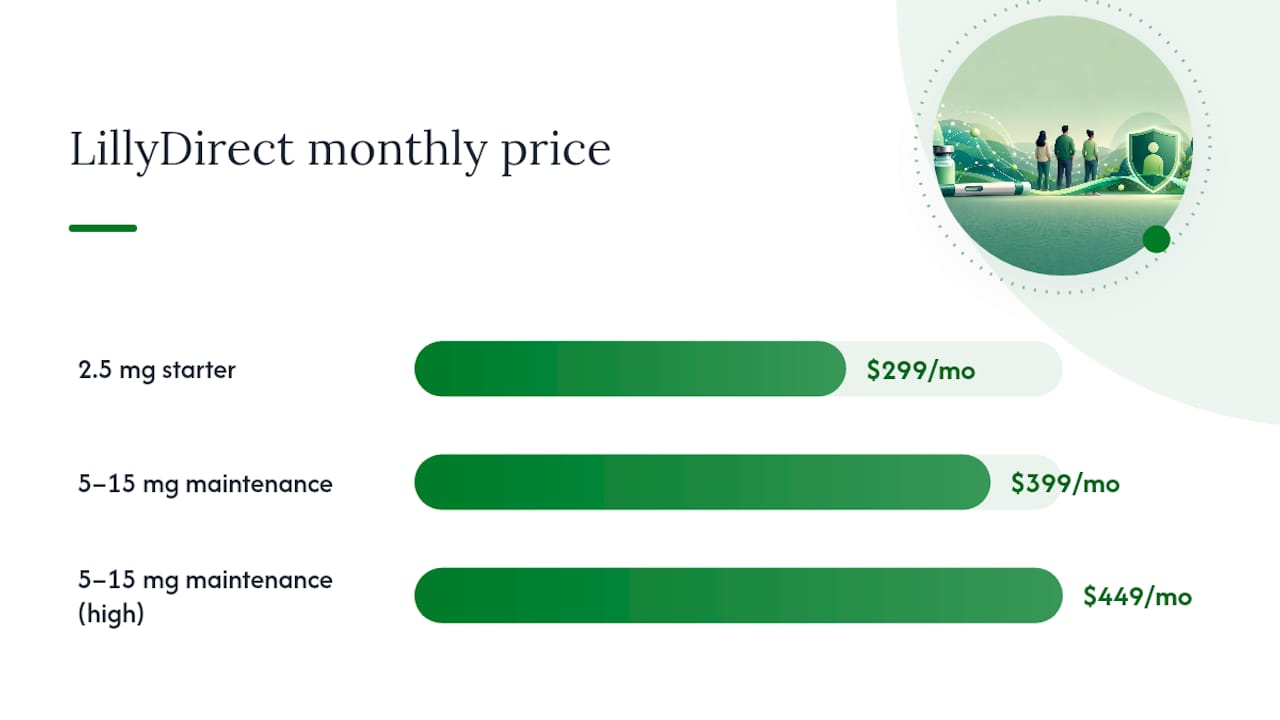
Dose matters just as much as which pricing tier you’re shopping. Tirzepatide starts at 2.5 mg and titrates up through 5 mg, 7.5 mg, 10 mg, 12.5 mg, and 15 mg. Under the manufacturer’s self-pay vial program, the starter 2.5 mg dose runs $299 a month, while the higher maintenance doses land between $399 and $449. That’s a meaningful spread, and it’s one reason two people on the “same drug” can report wildly different monthly bills.
Then there’s the supply definition, which trips up almost everyone at first. Manufacturer programs define a “fill” as a fixed quantity tied to a specific dose, not a generic 30-day supply. Refill too early or too late and you can knock yourself out of the pricing tier you were counting on. A few practical levers worth tracking:
Coverage status changes the whole calculation from a different angle. Patients on Medicare, Medicaid, or other government programs are typically excluded from manufacturer savings cards altogether, a policy detailed in CMS guidance on GLP-1 drug coverage. That exclusion doesn’t touch uninsured patients, who remain eligible for the self-pay program precisely because they have no third-party payer in the mix. If you’re uninsured but think you might qualify for Medicaid, it’s worth checking your state’s Medicaid overview before assuming cash-pay is your only option. Understanding your tirzepatide dosage schedule ahead of time also helps you anticipate which price tier you’ll be shopping in a few months, not just today.
The Zepbound self-pay vial program, ordered through LillyDirect, is the cheapest FDA-approved way to buy tirzepatide with no insurance. It skips retail pharmacy markup and prices each dose separately, which is why the numbers below run so much lower than a pharmacy counter quote.
Statistic Callout: The starter dose costs around $299 a month under the manufacturer’s self-pay program, while maintenance doses from 5 mg up to 15 mg generally fall within a price range near $399 to $449, according to Lilly’s official self-pay pricing page.
The catch is in the fine print, not the sticker price. Lilly defines each purchase as a single “fill” tied to a specific dose, and the program caps how often you can order within a given window. Order too soon after your last fill and you may be billed at a different rate or denied the discount entirely. There are also annual and monthly savings caps built into the terms, plus a hard exclusion: anyone enrolled in Medicare, Medicaid, TRICARE, or another government health program cannot use this self-pay pricing, even if they’d otherwise pay cash.
Getting the vial legally still requires a valid prescription. That means a licensed clinician has to evaluate you, confirm the medication is clinically appropriate, and send the prescription to a pharmacy or the manufacturer’s fulfillment system. Telehealth visits satisfy this requirement the same way an in-person appointment does, provided the prescriber is licensed in your state. Once the order ships, verify the packaging against the FDA-approved labeling to confirm you received the actual branded product, not a substitute. If you’re still working out your titration plan, the tirzepatide dosage guide walks through how dose increases typically get scheduled.
Compounded tirzepatide is advertised at prices well below the branded self-pay program, sometimes a fraction of the cost, because compounding pharmacies aren’t bound by the manufacturer’s dose-tier pricing structure. That savings comes with a trade-off you need to weigh honestly.
Compounded versions are not FDA-approved. The FDA has clarified its compounding policy as the national GLP-1 supply has stabilized, and the agency is explicit that compounded products skip the manufacturing, testing, and quality oversight that FDA approval requires. That doesn’t automatically make every compounded product unsafe, but it does mean you’re trusting a specific pharmacy’s quality controls instead of a federally reviewed manufacturing process.
Before using any compounding pharmacy, run through this checklist:
Pro Tip: Call the pharmacy directly and ask who their supervising pharmacist is. A legitimate compounding pharmacy answers that question in seconds; a storefront reselling from an unverified source usually hesitates or redirects you to a script.
Work through these in order. Each step either lowers the price further or protects you from paying more than you need to.
Pro Tip: Order refills right at the edge of your eligibility window, not early and not late. Ordering a few days ahead of your window closing can accidentally forfeit the discounted rate for that fill.
A legitimate prescription starts with an actual clinical evaluation, not just a form you fill out. A licensed clinician should review your medical history, current medications, and weight-related health markers before writing the prescription, whether that visit happens in person or through telehealth.
From there, three channels typically handle fulfillment:
State rules can add wrinkles, since some states restrict which types of clinicians can prescribe certain medications via telehealth. Before paying anyone, confirm the pharmacy’s license is active in your state and cross-check the product packaging against the FDA label to be sure you’re getting the approved formulation. Some telehealth services provide routes for exactly this purpose: connecting uninsured patients with licensed prescribers and coordinating fulfillment so you’re not left guessing whether a pharmacy or seller is legitimate. For a broader look at legitimate purchase channels, the guide to buying tirzepatide online breaks down what to verify before you order.
Three scenarios cover most of what uninsured patients actually pay.
Statistic Callout: Market reporting on tirzepatide cost routes confirms the same pattern the manufacturer’s own pricing shows: self-pay vials in the $299 to $449 range sit far below branded pen list prices exceeding $1,000 a month.
To budget annually, multiply your expected monthly fill price by 12, but build in a buffer for the first month or two while you’re still titrating up through lower, cheaper starter doses.
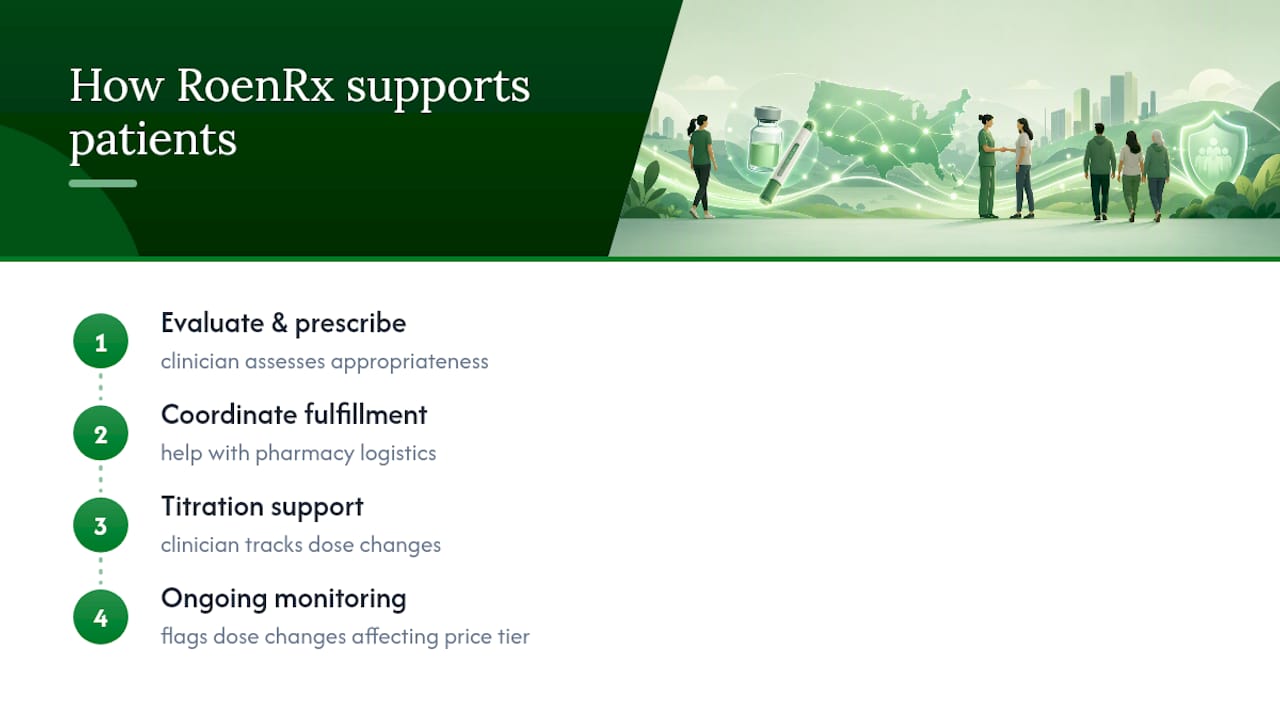
Cost clarity only matters if you can actually get the prescription safely, and that’s where certain telehealth models fit this need. Care teams can evaluate whether tirzepatide is appropriate for you, initiate a prescription, and help coordinate fulfillment so you’re not navigating pharmacy logistics alone. Approaches to titration support also matter here, since dose changes are exactly what shift your self-pay price tier month to month, and having a clinician track that alongside you reduces the odds of an unexpected billing surprise.
[Author credential and bio details for Bryan are not publicly listed.]
Ongoing monitoring is part of the value too. A clinician reviewing your progress can flag when it’s time to move doses, which directly affects which self-pay pricing tier you land in next. That kind of continuity is harder to get from a one-off prescription source with no follow-up built in.
If I were paying for tirzepatide out of pocket, I’d start with the FDA-approved self-pay route every time, even though the compounded price looks tempting on paper. The savings on compounded product aren’t worth the uncertainty of unverified sourcing when a legitimate, dose-priced alternative exists at $299 to $449 a month. If cost eventually pushes you toward a compounding pharmacy anyway, at least keep your prescriber in the loop. Tell them what you’re using and why, because continuity of care matters more than most people realize once dose adjustments or side effects enter the picture. Verify every credential you can before you pay anyone.
— Bryan
Some telehealth services give uninsured patients a direct path to a licensed prescriber without the wait times that push people toward riskier, unverified sources out of frustration. Instead of guessing which pharmacy or compounding source to trust, you get a clinical evaluation, a prescription pathway, and fulfillment coordination handled by one care team.
RoenRx is not insurance, and it doesn’t set manufacturer pricing. Before you pay for any fill, compare the current terms on the manufacturer’s self-pay page against what your RoenRx care team quotes you, since program terms shift periodically. What RoenRx does provide is the clinical access point: a same-day or near-term evaluation, an honest conversation about which dose fits your situation, and prescription coordination that keeps you from stalling out at the “I need a prescriber” stage. If you’re ready to find out whether tirzepatide fits your situation, you can start a telehealth consultation and get a clinical answer instead of another price-comparison rabbit hole.
Tirzepatide’s branded self-pay vials run $299 to $449 a month depending on dose, which is often comparable to or slightly higher than semaglutide’s cash-pay options, though exact pricing depends on which specific semaglutide product and program you’re comparing.
Wegovy’s list price sits above $1,000 a month for most doses, similar to other branded GLP-1 pens, though manufacturer savings programs can lower that for eligible cash-paying patients.
Ozempic’s cash price typically runs into the four figures monthly at list price, though it’s FDA-approved specifically for type 2 diabetes rather than weight loss, which affects how insurers and manufacturer programs treat coverage requests.
The manufacturer’s self-pay vial program, at $299 for the starter dose and $399 to $449 for maintenance doses, is currently the lowest-cost FDA-approved route, and a telehealth evaluation through a provider like RoenRx can get you the required prescription quickly.
Compounded products are cheaper but aren’t FDA-approved, so the price advantage comes with reduced manufacturing oversight, which is why the FDA recommends verifying pharmacy licensing and sourcing before committing to that route long-term.