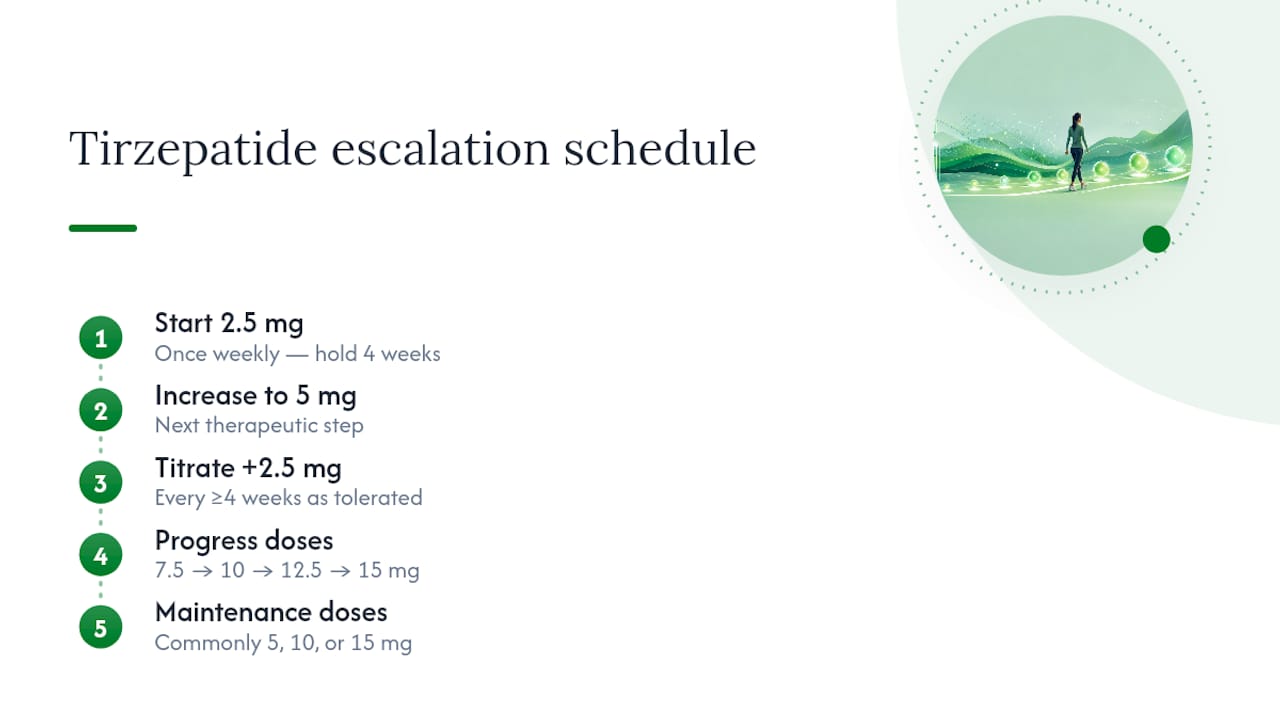
Tirzepatide starts at 2.5 mg once weekly for 4 weeks, then increases by 2.5 mg every 4 weeks (minimum) until you reach a maintenance dose of 5 mg, 10 mg, or 15 mg once weekly, the maximum approved dose. Every dose is a subcutaneous injection into the abdomen, thigh, or upper arm, given on the same day each week. The starting 2.5 mg dose exists only to ease your system into the medication; it isn’t a maintenance dose and won’t deliver full therapeutic effect on its own.
TL;DR:
- Patients typically start with 2.5 mg weekly for four weeks to allow their system to adjust and reduce nausea risk, not for therapeutic effect.
- Dose increases should be spaced at least four weeks apart, progressing from 5 mg up to a maximum of 15 mg based on tolerance and response.
- Flexibility exists in changing injection days, as long as there is a minimum of 72 hours between doses, but missing doses beyond four days requires skipping and resuming the regular schedule.
- Side effects like gastrointestinal discomfort often occur during dose escalation but tend to ease within a week or two; serious risks include thyroid tumors and pancreatitis, requiring close monitoring.
- Telehealth support from providers like RoenRx can help manage titration, side effects, and prescription schedules to improve adherence and safety throughout the process.
Every FDA-approved titration follows the same skeleton, whether your clinician is treating obesity or type 2 diabetes. You start low, hold for a month, then step up until you land on a dose you tolerate well and that does the job.
The prescribing information sets the first rule: 2.5 mg once weekly for 4 weeks, no exceptions. This isn’t a dose meant to control blood sugar or drive significant weight loss. It’s a runway. The gut needs time to adjust to a GLP-1/GIP dual agonist, and jumping straight to a therapeutic dose is a near-guarantee of nausea severe enough that patients quit.
After that first month, the FDA label calls for an increase to 5 mg once weekly. From there, your clinician can raise the dose in 2.5 mg increments, but never sooner than every 4 weeks, continuing to 7.5 mg, 10 mg, 12.5 mg, and finally 15 mg if needed. Maintenance typically settles at 5 mg, 10 mg, or 15 mg, chosen based on how well you’re tolerating the drug and how your weight or blood sugar is responding. The maximum approved dose is 15 mg once weekly.
Tolerability drives the pace more than a calendar does. If GI symptoms are rough at a given dose, the label supports holding there longer, or even dropping back to the previous dose, rather than pushing forward on schedule. Manufacturer guidance for Mounjaro reinforces the same principle: escalation exists to blunt side effects, and rushing it defeats the purpose.
Here’s how the standard escalation maps out, along with the dose volumes you’ll see on a pen or vial label:
Each strength ships in single-dose pens or vials, and the manufacturer’s dosing charts confirm the volume per injection stays consistent at 0.5 mL regardless of strength; only the concentration changes. That matters if you’re ever handed an unfamiliar pen. The click and the injection feel identical at every dose.
Pro Tip: Ask your prescriber to write your prescription for the dose you’ll need in 4 to 8 weeks, not just what you need today. Pharmacies and mail-order fulfillment can lag, and a 28-day minimum interval between dose increases means you can plan refills well ahead of running out.
Tirzepatide is a once-weekly subcutaneous injection, meaning it goes into the fatty layer just under the skin, never into muscle or a vein. Time of day doesn’t matter, with or without food doesn’t matter. What matters is consistency: pick a day that fits your routine and stick with it, since your entire titration timeline is built around weekly intervals.
The administration guidance names three approved sites: the abdomen, the front of the thigh, and the back of the upper arm. Rotate among them weekly rather than hitting the same spot repeatedly, which reduces irritation and helps the medication absorb evenly.
A few practical notes on handling:
If this is your first injection ever, ask about doing it during a video visit or in-office demo before you’re on your own. Watching someone do it once, then doing it yourself with a clinician watching over video, removes almost all the anxiety around the process.
Life happens, and tirzepatide’s rules for missed doses are more forgiving than you might expect.
That third rule gives you real flexibility. If you normally inject on Sunday and need to move to Wednesday, that’s a 3-day gap forward, which clears the 72-hour minimum. Moving from Sunday to Monday, however, would leave less than 72 hours since your last dose, so you’d need to wait until the following Monday instead.
If you’re missing doses often, or a missed dose triggers new symptoms like dizziness or unusual fatigue (especially if you’re also on insulin), contact your care team rather than guessing. And if you’re shifting your schedule permanently, tell your pharmacy too, so refill timing lines up with your new day instead of running short.
Tirzepatide carries a boxed warning for thyroid C-cell tumors, based on findings in rodent studies. It’s contraindicated if you or an immediate family member has a history of medullary thyroid carcinoma, or if you have Multiple Endocrine Neoplasia syndrome type 2 (MEN2). This isn’t a footnote; it’s a hard stop for anyone in that category, and your prescriber should ask about family thyroid cancer history before your first dose.
Beyond that boxed warning, here’s what to watch for:
The nausea pattern during dose increases is well documented enough that clinicians build it into the escalation pace itself; that’s the entire reason the schedule moves in small steps every 4 weeks rather than jumping straight to an effective dose. For a deeper look at how these side effects typically progress and how to manage them, a dedicated breakdown covers timing and mitigation in more depth than a dosing overview can.
Most people don’t fail on tirzepatide because the drug doesn’t work. They fail because the first month of GI discomfort catches them off guard, or a refill gets delayed right when they’re supposed to step up a dose. RoenRx structures its first-month review around exactly that risk: confirming there’s no personal or family thyroid cancer history, walking through injection technique (including a demo for first-timers), and setting a follow-up cadence that checks in during each dose increase, not just at the three-month mark.
That follow-up matters most in the first 8 to 12 weeks, when tolerability issues surface and blood sugar or weight trends start to show whether the current dose is working. RoenRx’s messaging-based care model means you can flag nausea or a missed dose to your care team the same day it happens, rather than waiting for a scheduled visit, and get direction on whether to hold your dose or proceed as planned.
Getting the dosing schedule right on paper is one thing. Having someone available when your dose increase hits harder than expected, or your pharmacy can’t fill the next strength on time, is another. RoenRx pairs tirzepatide prescriptions with same-day messaging access to your care team, so questions about side effects or scheduling changes get answered in hours, not at your next quarterly appointment.

RoenRx’s telehealth platform handles the parts of titration that trip people up most: confirming your starting dose is appropriate, coordinating prescriptions so your pharmacy has the next strength ready before you need it, and adjusting your escalation pace if side effects call for it. That’s the practical difference between reading a dosing chart and actually staying on track for the 16 to 20 weeks most people need to reach a stable maintenance dose.
If you’re ready to start, or you’re already on tirzepatide and want a care team that responds the same day you message them, you can begin an online consultation and get a personalized titration plan set up around your schedule.

This article is general information, not a substitute for advice from a qualified doctor. Consult a qualified healthcare professional about your own circumstances before acting on anything here.
No. The 2.5 mg dose is approved only for the 4-week initiation period and isn’t intended for glycemic control or meaningful weight loss; staying at that dose long term limits the medication’s effectiveness.
Not by clinical standards. It’s the midpoint step in the standard titration, reached only after tolerating 2.5 mg and 5 mg for at least 4 weeks each, and many people continue increasing past it toward a 10 mg or 15 mg maintenance dose.
Tirzepatide is dosed once every 7 days. You can shift your weekly injection day if needed, as long as at least 72 hours separate consecutive doses.
Yes. The maximum FDA-approved dose is 15 mg once weekly; 20 mg exceeds the approved dosing range and isn’t a prescribed strength on the label.
Take it within 4 days of the missed dose and resume your normal schedule; if more than 4 days have passed, skip that dose entirely and wait for your next scheduled day.