“Medication-assisted mental health” covers two distinct clinical approaches: Medication-Assisted Treatment (MAT), as defined by SAMHSA and AHRQ, which uses FDA-approved medications (methadone, buprenorphine, extended-release naltrexone) specifically for opioid and substance use disorders; and psychiatric medication management, which uses psychotropic drugs to treat depression, anxiety, bipolar disorder, ADHD, and psychosis. Conflating the two causes real confusion about treatment goals, monitoring requirements, and what to expect from a virtual provider like RoenRx.
If you want to understand which medications are used, why combining medication with therapy tends to work better, or how telehealth medication management actually runs, keep reading.
These two terms describe genuinely different clinical pathways, and mixing them up can lead patients to the wrong provider or the wrong expectations.
MAT for substance use disorders is a specific, evidence-based approach for OUD that pairs FDA-approved medications with counseling and behavioral therapies. The approved medications include methadone, buprenorphine (e.g., Suboxone), and extended-release naltrexone (e.g., Vivitrol). They work by normalizing brain chemistry, reducing cravings, and blocking the euphoric effects of opioids. Methadone requires observed dosing at a licensed Opioid Treatment Program, at least early in recovery. Buprenorphine can be prescribed in an office-based setting by a provider with DEA authorization.
Psychiatric medication management is what most people mean when they say “medication for mental health.” A clinician prescribes antidepressants, mood stabilizers, antipsychotics, or stimulants to address symptoms of depression, anxiety, bipolar disorder, ADHD, or psychosis. No special federal licensing is required to prescribe these, and they are routinely delivered via telehealth.
| Feature | MAT for OUD | Psychiatric Medication Management |
|---|---|---|
| Target condition | Opioid/substance use disorder | Depression, anxiety, bipolar, ADHD, psychosis |
| FDA-approved medications | Methadone, buprenorphine, naltrexone | SSRIs, SNRIs, mood stabilizers, antipsychotics, stimulants |
| Regulatory requirements | DEA authorization; OTP licensing for methadone | Standard prescribing license |
| Counseling requirement | Embedded in federal regulations | Strongly recommended; not federally mandated |
| Telehealth delivery | Buprenorphine/naltrexone: yes; methadone: limited | Broadly available |
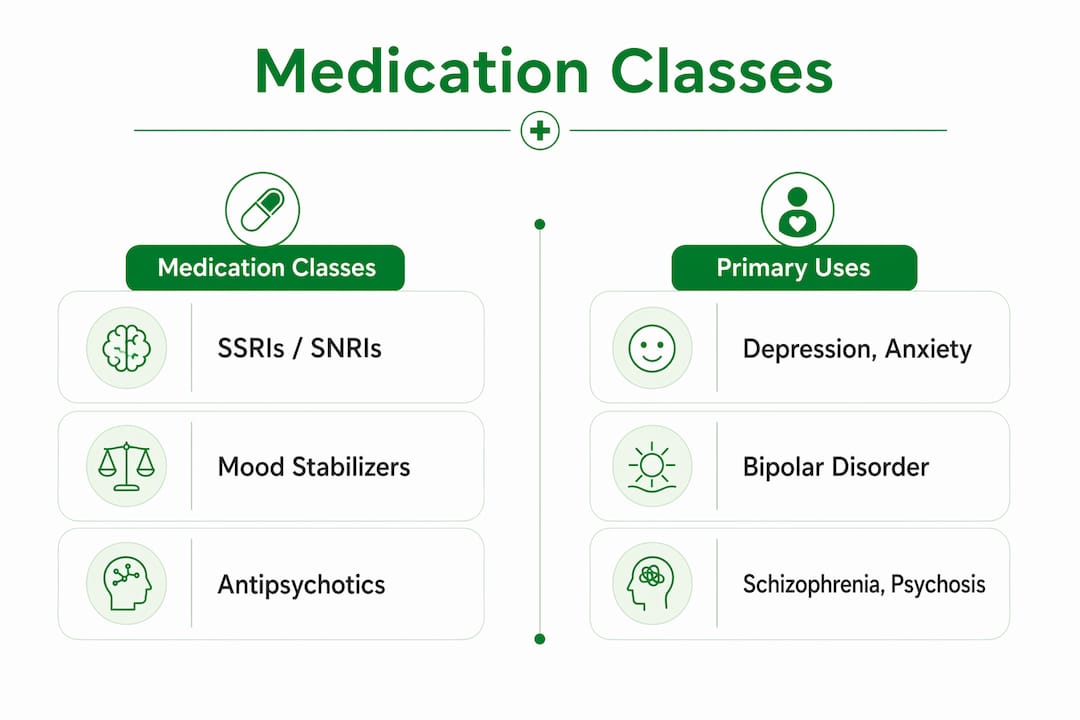
Psychotropic medications treat symptoms by influencing neurotransmitters in the brain. Most require a gradual period to reach full effect, though a few work faster.
| Medication class | Primary use | Typical onset |
|---|---|---|
| SSRIs / SNRIs | Depression, anxiety | 4–8 weeks |
| Mood stabilizers | Bipolar disorder | Weeks to months |
| Antipsychotics | Psychosis, schizophrenia, severe bipolar | Days to weeks |
| Stimulants | ADHD | Days |
| Buprenorphine / naltrexone | OUD | Hours to days (craving relief) |
The APA recommends combining psychotherapy with pharmacotherapy for many patients because the combination frequently produces better outcomes than either alone. For severe mental illness, medication is typically necessary. Psychotherapy then improves functional outcomes that medication alone cannot fully address.

The mechanism is straightforward: medications stabilize the symptoms (severe mood swings, cravings, psychotic episodes) that make it nearly impossible to engage in talk therapy. Once those symptoms are controlled, therapy becomes far more productive. As one clinical perspective puts it:
For OUD specifically, SAMHSA’s integrated care model shows that ongoing outpatient medication treatment improves retention and reduces overdose risk compared with no medication. Psychosocial supports — counseling, recovery coaching, housing assistance when needed — close the remaining gaps.
Virtual care follows a clear sequence. Knowing the steps ahead of time removes most of the uncertainty.
Side effects and adherence are monitored remotely through symptom scales, secure messaging with your care team, and periodic labs when the medication requires it (lithium levels, thyroid function, metabolic panels for antipsychotics).
For controlled substances, federal telehealth prescribing rules apply. Buprenorphine can be initiated via telehealth under current DEA guidance; Schedule II stimulants for ADHD have specific requirements that your provider will walk you through.
Pro Tip: Before your first telehealth visit, gather a list of every current medication (including supplements), your symptom history with approximate start dates, and any prior psychiatric diagnoses or treatment. This cuts your intake time significantly and helps the clinician make a more accurate assessment.
Side effects are real, but they are manageable when you stay in communication with your provider.
ASAM is direct on the stigma issue: labeling MAT medications as “addictive” is clinically inaccurate and keeps people from life-saving treatment. Used as prescribed under medical supervision, OUD medications support recovery and do not cause compulsive substance use.
Never stop a prescribed psychiatric medication abruptly. Tapering under provider supervision protects against withdrawal effects and gives an accurate read on whether the medication was working.
Treatment duration is individualized. Some patients take an antidepressant for several months after a first depressive episode and then taper off successfully. Others manage chronic conditions with medication for years or a lifetime. MAT for OUD can run months, years, or indefinitely — stopping should always be a shared decision with a provider.
Adherence directly affects whether a medication can be fairly assessed. A drug that is taken inconsistently looks ineffective even when it would work at steady state.
The first 0–12 weeks are the adjustment period: dose titration, side effect monitoring, and sometimes switching medications. After that, a stable regimen typically requires less frequent check-ins. NIMH notes that patients often need to try multiple medications or doses before finding the regimen that balances efficacy and tolerability — that is normal, not a sign that treatment is failing.
Seek a medication evaluation when symptoms are interfering with work, relationships, or daily function, or when you have a co-occurring substance use disorder that needs integrated care.
Starting mental health treatment at home is straightforward when you know what to bring and what to expect.
This article is general health information, not medical advice. Confirm current prescribing rules and treatment options with a licensed provider for your specific situation.
Skip the weeks-long wait for an in-person psychiatry appointment. RoenRx connects you with experienced clinicians for same-day virtual evaluations, anxiety and mental health prescriptions, and pharmacy delivery that brings your medication to your door.

The workflow is built for real life: complete a short intake online, meet with a clinician by video or phone, and receive a personalized treatment plan with follow-up built in. Secure messaging with your care team means side effect questions don’t wait until your next scheduled visit. For patients without insurance or those who have run into access barriers, RoenRx offers a direct path to evidence-based care without the usual friction.
Ready to get started? Review the telehealth consent and book your first evaluation at RoenRx.com.
Medication-assisted mental health care works best when the right medication class is matched to the right condition and paired with psychotherapy and consistent follow-up.
| Point | Details |
|---|---|
| MAT vs. medication management | MAT is a specific term for FDA-approved OUD treatment; psychiatric medication management covers depression, anxiety, bipolar, ADHD, and psychosis. |
| Combined care advantage | The APA recommends combining pharmacotherapy and psychotherapy because the combination frequently produces better outcomes than either alone. |
| Treatment duration varies | Duration ranges from months to lifelong depending on diagnosis and response; stopping medication should always involve a provider. |
| Adherence is the variable | Inconsistent adherence makes it impossible to assess whether a medication is working; LAIs and pharmacy delivery reduce this risk. |
| RoenRx next step | RoenRx offers same-day virtual evaluations, mental health prescriptions, and pharmacy delivery for patients ready to start care. |
The loudest misconception I keep seeing is that medication is a shortcut — something patients take instead of doing the real work of therapy. The evidence runs the other direction. For moderate-to-severe depression, bipolar disorder, and OUD, medication is often what makes therapy possible in the first place. You cannot process trauma or build coping skills when you are in active withdrawal or can’t get out of bed.
The stigma around MAT is particularly costly. ASAM’s position is clear: these medications reduce mortality. Patients who avoid buprenorphine or naltrexone because someone told them it was “just trading one addiction for another” are taking on real overdose risk based on a clinical myth. That is not a nuance — it is a life-or-death distinction.
What I’d encourage anyone starting this process to hold onto: the first medication rarely hits perfectly, and that is expected. The goal in the first 12 weeks is information — how your body responds, what needs adjusting, whether therapy should be added or intensified. Persistence and honest communication with your provider are the actual work. The medication is a tool that makes that work viable.