TL;DR
- No single company is "best." The right one is whichever platform is licensed in your state and treats the condition you actually have. RoenRx covers GLP-1 weight loss, birth control, ED, low testosterone, hair loss, skincare, mental health, and menopause under one membership.
- Prescription telehealth routes your order to a licensed, US-based pharmacy that fills it and ships it to your door, usually with automatic refills, so there's no counter wait at CVS or Walgreens.
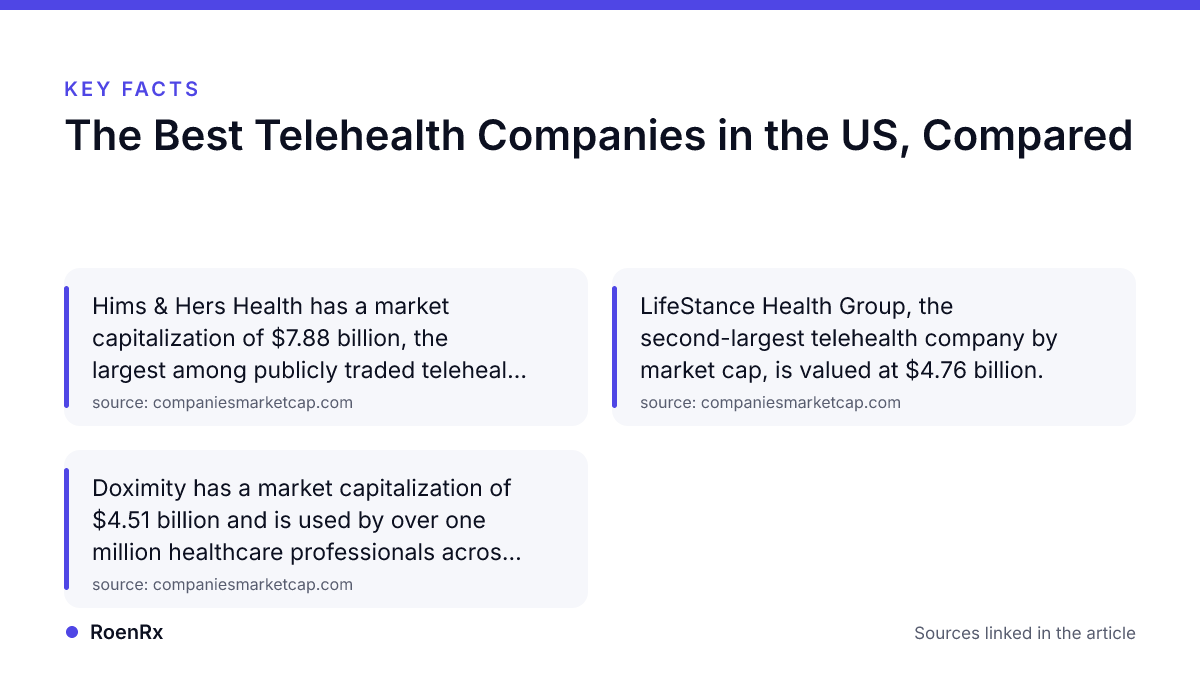
- The category has serious money behind it. Hims & Hers Health carries a $7.88 billion market cap, the largest of any publicly traded telehealth company, ahead of LifeStance Health at $4.76 billion and Doximity at $4.51 billion (used by over a million healthcare professionals nationwide).
- Three questions eliminate most of the guesswork: which states are they licensed in, do refills auto-ship or require a new consult, and does the listed price include the medication or just the visit.
- Skipping the monthly pharmacy trip is worth about $240 a year at 60 minutes a month and $20 an hour. Swap in your own hourly rate and the math still holds up.
Type "best telehealth company" into Google and you get a ranked list assembled by people who have never met you. The honest answer is that no single name wins. A platform built for same-day urgent-care video visits, like Doctor On Demand, isn't competing with a platform built around monthly GLP-1 refills and coaching, like RoenRx or Ro. They're different products that happen to share a category label.
Here's how to tell them apart on the things that decide whether you're happy six months in.

Table of Contents
- What is the best telehealth company?
- What are the top telehealth companies in the USA?
- How do telehealth companies handle prescription fulfillment and delivery?
- What clinical outcomes or satisfaction metrics actually differentiate providers?
- How do telehealth platforms ensure provider licensing across all 50 states?
- Which telehealth company fits your specific situation?
- What's a concrete next step?
- Frequently asked questions
What is the best telehealth company?
The best telehealth company is the one licensed in your state that treats your specific condition, fills prescriptions through a US-based pharmacy, and stays involved after the first visit.
For general urgent care and mental health check-ins, Doctor On Demand and similar video-visit platforms do that job well. For GLP-1 weight loss medications like Zepbound, Wegovy, and Ozempic paired with nutrition and lifestyle coaching, RoenRx, Ro, and Medvi's GLP-1 program are built for that specific use. For birth control, ED treatment, hair loss, or perimenopause symptoms, the question worth asking is whether one membership covers all of them. RoenRx bundles them, which matters a lot if you're treating two or three things at once and don't want three separate intakes, three logins, and three charges hitting your card on different days.
What are the top telehealth companies in the USA?
The market splits into four lanes: broad urgent-care video visits, GLP-1-focused weight loss programs, women's health specialists, and multi-condition platforms that handle several of those under one login. Here's how the major names line up on what a buyer actually decides on.
| Company | Built for | Pricing question that matters most | Best fit when |
|---|---|---|---|
| RoenRx | Weight loss (GLP-1), birth control, ED, low-T, hair loss, skincare, mental health, menopause | Which conditions the single membership covers, and what self-pay looks like without insurance | You're treating more than one thing and want it in one place |
| Doctor On Demand | General urgent care and mental health video visits | Per-visit fee versus what your insurance plan pays | You need a same-day answer on an acute problem |
| Ro | Men's health, weight loss, hair loss | Whether medication cost is bundled into the plan or billed separately | You want men's health and weight loss under one roof |
| Medvi (GLP-1 program) | GLP-1 weight loss only | Compounded versus brand-name pricing, and which one you're actually getting | GLP-1 access is your single priority |
Newer entrants like Amble, Fridays, and Shed show up in the same search results. Before you compare any of them to the four above, get two things in writing: their state licensing list and their core specialty. If a company can't answer either in one email, that tells you something about how they'll handle a refill problem in month five.
Pro tip: Ask every company the same three questions and write the answers in a note on your phone. Which states are you licensed in? Are refills automatic or does each one need a new consult? Does the price on your site include the medication? Marketing pages are built to blur those three answers. Direct questions aren't.
How do telehealth companies handle prescription fulfillment and delivery?
Most legitimate platforms don't fill anything themselves. They route your prescription to a licensed pharmacy partner. At RoenRx, that means US-based, FDA-regulated pharmacies, discreet packaging, and automatic refills, so you're not re-ordering every 30 days or standing in a line.
That's a real departure from picking up at a CVS pharmacy or Walgreens pharmacy, where your evening depends on whoever's behind the counter and how deep the queue is. If you've ever waited twenty minutes only to hear your script "needs another day," our breakdown of CVS pharmacy trips costing you time in 2026 traces exactly where that time disappears to.
Put a number on it. Say a monthly pickup runs 45 minutes round trip plus a 15-minute average wait. That's 60 minutes a month, or 12 hours a year. Value your time at $20 an hour and the math is 12 × $20 = $240 a year, before gas or a burned lunch break. At $35 an hour it's $420. Mail-order doesn't remove every friction point in healthcare, but it removes that one completely.
The rule of thumb we use: if your annual time cost beats the difference in medication price between mail-order and your local counter, mail-order wins on the spreadsheet, not just on convenience. We ran the same comparison for Walgreens pharmacy pickup against mail-order if you want the numbers applied to a different chain.
- Ask if refills are automatic. Some platforms require a provider check-in every cycle. Others auto-ship unless you cancel. The difference shows up as a gap in your medication if you assume wrong.
- Ask which pharmacy fills the order. A named, US-based, FDA-regulated pharmacy is the standard. An unnamed "partner network" is not an answer.
- Ask about packaging. For ED medication or birth control, plain outer packaging with no drug name on the label is the difference between convenient and awkward.
What clinical outcomes or satisfaction metrics actually differentiate providers?
This is where most telehealth comparisons collapse, because almost nobody publishes independently verified outcome data the way hospitals report readmission rates. So you have to ask for the operational numbers instead.
Four worth requesting by email before you enroll:
- Average weight change at 12 weeks among their GLP-1 patients, and whether that figure includes people who dropped out.
- Six-month persistence rate. What percentage of patients who start are still on therapy half a year later? Low persistence usually means poor side-effect management, not unmotivated patients.
- Median time from intake submission to prescription sent. Ask for the median, not the "as fast as" number in the ad.
- Response time on a message to your provider. Two hours and two days are both technically "ongoing support."
Third-party recognition helps too. Amwell has been named Best Overall Telehealth Solution by the American Telemedicine Association, and asking any platform what external validation they hold is fair game. A blank answer isn't automatically disqualifying. Plenty of smaller, legitimate operations have never applied for an award. It just means you lean harder on the four questions above.
Pro tip: Ask whether a provider reviews your progress over time or approves one prescription and disappears. Coaching that actually tracks nutrition, activity, sleep, and side-effect response is a completely different product from a single script, even when the molecule in the box is identical.
Life stress complicates all of this. If part of what's driving you toward mental health or menopause care is a property you're managing from a distance or a house that has to sell on a deadline, handle that thread in parallel instead of letting it compound. For homeowners in Metro Detroit in that spot, Sell Dave Your House buys houses as-is for cash with no repairs or listing process, which is usually the faster exit when the house itself is the stressor.
How do telehealth platforms ensure provider licensing across all 50 states?
A provider can only legally treat you in a state where they hold an active license. Platforms solve this by maintaining a network of providers across many states and routing your case to one licensed where you live. At RoenRx, a provider licensed in your state reviews your intake and builds your plan, rather than a national protocol getting stamped onto every zip code identically.
State rules genuinely differ on controlled substance prescribing, how often follow-ups are required, and which conditions can be treated remotely at all. That's why the same platform can move fast in one state and ask you for extra steps in another.
- Verify the license yourself. Ask for your provider's name, credential, and license state. Most state medical boards have a public lookup that takes about two minutes.
- Ask when they confirm your location. A serious platform verifies your state before matching you with a provider, not after your card is charged.
- Ask what happens if you move. Relocating mid-treatment usually triggers a new provider match. If your refill is due in eight days and the match takes ten, you have a gap. Start the transfer the week you sign the lease, not the week you run out.
- Ask for the credential type. Physicians, nurse practitioners, and physician assistants can all prescribe in most states, but scope of practice varies, and so does what they can adjust without a supervising sign-off.
Which telehealth company fits your specific situation?
Match the platform to the condition, not the advertising. A few common scenarios:
- GLP-1 weight loss with coaching, insured or not: RoenRx's weight loss program pairs Zepbound, Wegovy, and Ozempic with nutrition and activity coaching. Compare Ro and Medvi's GLP-1 program on refill process and whether coaching is included or sold separately.
- Birth control without an office visit: Confirm the platform ships to your state and how it handles annual check-ins, since renewal requirements vary by state.
- ED handled discreetly: RoenRx's ED program includes options often searched as the best viagra for men alternative, alongside generic sildenafil and tadalafil, shipped in plain packaging.
- Suspected low testosterone, but not ready for full TRT: Enclomiphene, offered through RoenRx, supports your body's own testosterone production instead of suppressing it the way injectable TRT can. Ask any provider to explain that distinction in plain language before you start. If they can't, find another provider.
- Anxiety, depression, or insomnia: Confirm whether the platform offers therapy, medication management, or both, and how fast you can get a follow-up when a medication isn't working. The first prescription frequently isn't the right one.
- Perimenopause or menopause symptoms being brushed off in person: Look for a platform that treats hormonal symptoms as their own category rather than folding them into general primary care.
Pro tip: Read the FAQ page and the reviews before you sign up. Hidden fees, refill delays, and murky cancellation terms almost always surface in those two places first.
What's a concrete next step?
Write down the two or three conditions you need treated. Then run each candidate platform against three questions: licensed in your state, medication included in the price or not, and how refills work. Fifteen minutes with that list undoes most of the ambiguity the marketing pages are built to create.
If GLP-1 weight loss, birth control, ED, low-T, hair loss, mental health, or menopause symptoms are on your list, RoenRx's home page shows how intake and provider matching work before you commit to anything.
Frequently asked questions
Can you use telehealth without insurance?
Yes. Most platforms, RoenRx included, serve patients with or without insurance. Your out-of-pocket cost depends on the specific medication and whether your insurer covers telehealth visits at all. Ask for the self-pay price upfront rather than assuming insurance is required.
Is it safe to get prescriptions from an online provider?
It's safe when the platform uses licensed providers and fills through US-based, FDA-regulated pharmacies. That's the same standard behind a prescription filled at a CVS pharmacy or Walgreens pharmacy, minus the counter visit. If a company doesn't state its pharmacy sourcing plainly on the site, confirm it in writing before you order.
How fast can you get your first prescription through telehealth?
Timelines vary by platform and condition. Most intake-to-approval windows run from same-day to a few business days once a licensed provider reviews your information. Controlled substances and certain conditions require extra verification that adds time, so ask for the median turnaround if speed is what you're optimizing for.