TL;DR
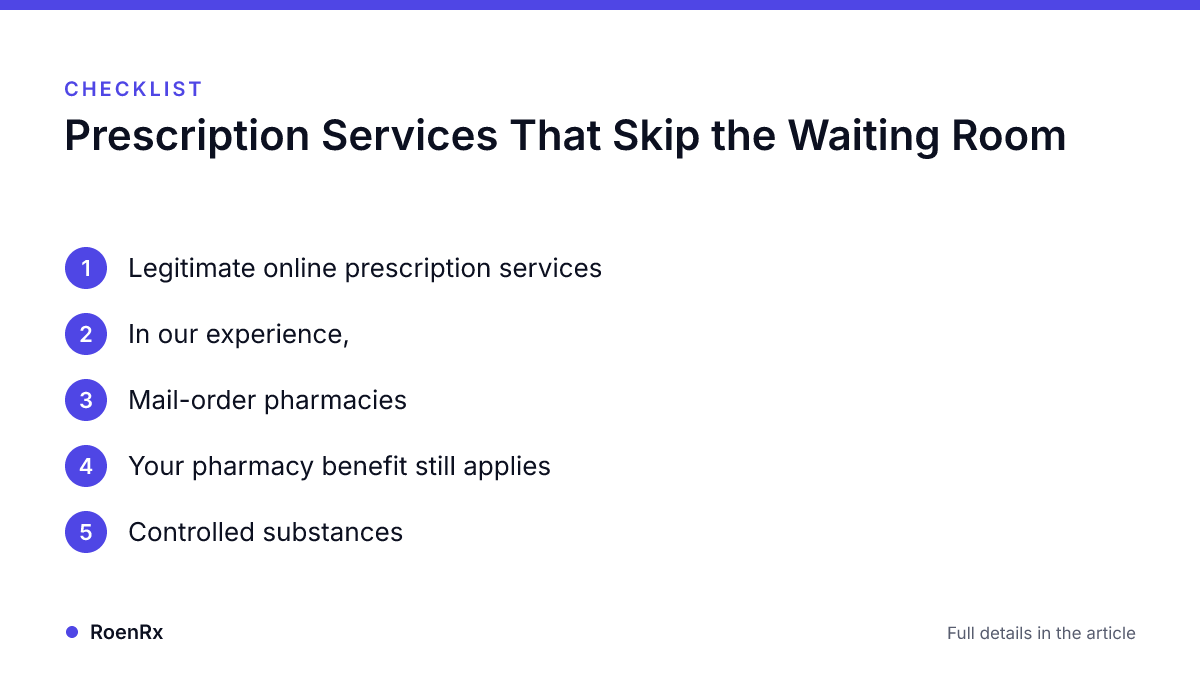
- Legitimate online prescription services connect you with a provider licensed in your state who reviews your health history and can prescribe FDA-approved medications without an office visit, for most non-controlled conditions.
- In our experience, a telehealth prescription clears provider review within a day or two, while getting a new-patient slot at a local practice can take weeks.
- Mail-order pharmacies fill at a licensed, U.S.-based pharmacy and ship with automatic refills, so your pharmacy-counter time drops to zero.
- Your pharmacy benefit still applies to a telehealth-sourced prescription. What changes is how the consultation itself gets billed.
- Controlled substances like certain ADHD stimulants or long-term opioid therapy usually still require extra verification or an in-person exam. GLP-1s, birth control, ED treatment, and hair loss medications don't carry that restriction.
You don't need to stand at a CVS counter to get a prescription filled. A licensed provider can review your symptoms, medical history, and current medications through a secure app, write the prescription, and route it to a pharmacy, often the same day. The catch is that not every "online prescription" outfit works the same way. Knowing the difference between a real telehealth provider and a prescription mill is what actually protects you.
Table of Contents
- Which online prescription service is best?
- Can I request a prescription without seeing a doctor?
- How do telehealth prescriptions compare to CVS or Walgreens on cost and speed?
- What happens after your first online consultation?
- Does insurance cover telehealth prescriptions?
- Your next step
- Frequently asked questions
Which online prescription service is best?
The best online prescription service is the one licensed in your state, staffed by real clinicians, and filling through FDA-regulated U.S. pharmacies. Not the one with the biggest ad budget.
That sounds obvious. But plenty of sites blur the line between "telehealth provider" and "online storefront that skips the provider step entirely." A legitimate service asks detailed intake questions, has a licensed clinician actually read your answers, follows up by message or video if something looks off, and only then sends the prescription. If a site lets you pick a drug off a menu and pay, that's not medicine. That's a vending machine with extra steps, and it's the kind of operation state medical boards and the FDA go after.
When you're comparing options, look at:
- Provider credentials. Is the person reviewing your case an MD, DO, NP, or PA licensed in your state, not just licensed somewhere?
- Pharmacy sourcing. Does the company name its pharmacies as U.S.-based and FDA-regulated, or is that detail buried in a footer?
- Ongoing care. Do you get check-ins and dose adjustments, or a one-time transaction?
- Refill process. Automatic, or do you re-request and re-pay for a fresh consultation every 30 days?
Pro tip: Search the site for the name of the dispensing pharmacy and its state board license number. Reputable operations put it in the FAQ or the footer. If you have to email support to find out who's filling your medication, you already know enough. Second tell: read the cancellation terms before you order. Services confident in their care make canceling a two-click affair. Prescription mills bury it behind a phone tree.
For a side-by-side breakdown on these exact points, our guide to the best telehealth companies in the US goes through it condition by condition.
Can I request a prescription without seeing a doctor?
You can get a prescription without walking into an office. You can't get one without any clinical review at all. A licensed provider still has to evaluate your case, even when that happens asynchronously through a questionnaire and photos instead of a live visit.
This is the most misunderstood part of telehealth. People hear "no doctor visit" and assume "no doctor." What changed is the format, not the oversight.
For birth control renewals, mild acne, hair loss, or ED, a provider can often approve treatment from a thorough intake form alone. For someone starting a GLP-1, or anyone with a complicated history, expect a message exchange or a short video check-in first. And expect to be turned down sometimes. A good provider will decline to prescribe when your intake flags something that needs an in-person workup, and that refusal is a feature, not bad service. As GoodRx explains in its overview of online prescriptions, the provider-review step is what makes a telehealth prescription legally and medically valid.
Fill out the intake honestly, by the way. Under-reporting a medication or a condition to speed things along is the fastest way to get a prescription that interacts badly with something you're already taking.
How do telehealth prescriptions compare to CVS or Walgreens on cost and speed?
Telehealth usually wins on speed and convenience. The pharmacy counter still wins when you need an antibiotic in your hands this afternoon and can't wait on shipping. Here's the honest breakdown:
| Factor | Traditional pharmacy (CVS, Walgreens) | Telehealth + mail-order |
|---|---|---|
| Getting the prescription | Requires a scheduled visit, often booked days or weeks out | Provider review typically completed in about a day |
| Picking it up | Drive, park, wait in line, bound by cvs pharmacy hours or your local Walgreens pharmacy schedule | Shipped to your door, no store hours to plan around |
| Refills | You call, wait on hold, or drive back each month | Automatic refills scheduled to your dosage |
| Dose adjustments | New appointment required | Message your provider in the app |
| Newer medications | Subject to local stock and regional shortages | Broader pharmacy network, though shortages still bite |
| Best for | Same-day urgent needs, complex diagnoses | Maintenance meds, chronic conditions, sensitive conditions |
Run the math on your own refill routine. The formula: minutes per pharmacy round trip × refills per year ÷ 60 = hours you spend annually on pickup.
Say a round trip takes 27 minutes on a good day, counting the drive over, parking, the line, and the drive back. Twelve refills a year at 27 minutes each is 324 minutes, or 5.4 hours. That's an illustrative scenario, not a study, so plug in your own drive time. If the counter is ten minutes away and you always hit a line, you're closer to 45 minutes a trip and nine hours a year. Add the wasted trip where they tell you it's on backorder and to come back Thursday.
The threshold worth applying: if a medication you take every month costs you more than about three hours a year in logistics, mail-order is doing real work for you.
Pro tip: Before you switch, ask the mail-order pharmacy how they handle a 90-day supply versus 30. Ninety-day fills usually mean fewer copays over the year on the same drug, and fewer chances for a shipment to arrive late. Our breakdown of Walgreens pharmacy vs. mail-order costs lays out the numbers, and our piece on what CVS pharmacy trips actually cost you covers the wait-time patterns most people underestimate.
What happens after your first online consultation?
Your first consultation should start a relationship, not close a sale. Well-run services build follow-ups, refill approvals, and dose changes into the membership instead of charging a new visit fee every time you have a question.
Once your provider approves the plan:
- The prescription routes to the pharmacy. A U.S.-based, FDA-regulated pharmacy fills and ships it, usually within a few business days.
- Automatic refills kick in. The next shipment is scheduled off your dosage, so you're not re-requesting monthly. Keep an eye on the ship date the first two cycles, because that's when timing drift shows up.
- Check-ins happen on a schedule. On a GLP-1, that often means touching base around each titration step rather than waiting for a calendar date. For testosterone support, anxiety or depression treatment, or perimenopause symptoms, expect a periodic re-evaluation before refills continue.
- You can message between visits. Nausea that won't settle, a plateau at week ten, a new symptom: those go to a licensed clinician instead of sitting until your next appointment.
- Labs get ordered when relevant. Low testosterone and long-term GLP-1 use both call for periodic bloodwork. A good provider flags it, sends the order, and follows up when results land. A weak one leaves you to remember.
That coordination is the whole difference. Anyone can sell you one prescription. Managing a chronic condition over eighteen months takes someone actually watching the trend line.
Does insurance cover telehealth prescriptions?
Your plan's pharmacy benefit covers the medication the same way it always has. What varies is how the consultation gets billed.
If your insurance covers a generic birth control pill or a GLP-1 at your local pharmacy, that coverage generally carries over when the same drug is filled through a telehealth-connected pharmacy, because the claim still runs through your insurer's pharmacy network. The visit charge is where platforms diverge. Some bill your insurance for the consultation like a regular appointment. Others charge a flat membership fee no matter what you're insured for. And plenty of weight-loss prescriptions end up self-pay simply because the employer plan excludes that drug class outright.
Pharmacy chains have moved the same direction. Kroger's pharmacy services and mail-order operations like PPS both process insurance identically whether the prescription started in an exam room or in an app.
Two calls save the most money. First, call the member services number on your card and ask whether your specific drug is on the formulary, what tier it sits in, and whether prior authorization is required. Second, ask the telehealth provider straight out what's billed to insurance and what isn't. RoenRx works with patients with or without insurance, and our FAQs page spells out what's typically self-pay across our GLP-1, birth control, and men's health programs.
Your next step
Pull up your current prescription bottle and check the drug name against the conditions telehealth can prescribe for. Maintenance medications for weight loss, birth control, ED, hair loss, and mental health almost always qualify. Then book a consultation, get matched with a provider licensed in your state, and set the first refill to ship a week before your current supply runs out. That one buffer week is what keeps you from ever standing in a pharmacy line again.
Frequently asked questions
How long does it take to get medication after an online consultation?
Most patients see their first shipment within a few business days of provider approval. Compounded medications and anything requiring extra verification take longer, and shortages on high-demand drugs can add time no pharmacy controls.
Is it safe to get prescriptions through a mail-order pharmacy?
Yes, provided the pharmacy is U.S.-based and FDA-regulated, which means it meets the same dispensing, storage, and quality standards as the store down the street. The real risk sits with unregulated overseas sellers and sites that skip the licensed-provider review.
Can I switch back to picking up prescriptions in person if I don't like mail delivery?
Usually. Most telehealth providers will send an e-prescription to a local pharmacy you name instead of shipping it. Ask before you sign up, since a few programs price the medication and the delivery together and can't unbundle them.